Travel & Logistics
9 articles in this category · Last updated 2026-05-17
Coming to China for medical care is not simply "buying a plane ticket and flying over." Visas, on-site interpretation, accommodation location, SIM cards and mobile payment, customs declaration, document handoff after returning home -- if any single link breaks, an otherwise smooth treatment plan can derail at the last mile.
The articles in this category follow the timeline: before departure (visas, family companions), during your stay in China (assistance, interpretation, accommodation, daily tools), and after returning home (discharge documents, customs, remote follow-up). Each piece is grounded in real-case lessons.
If you only have time to read one starting article, begin with "International Medical Repatriation: When You Need It, Who Provides It, and How to Choose an Air Ambulance" -- pick the wrong starting point, and every other arrangement gets pushed back.
Entry & Visa
China has many visa categories, and policies change quickly. The most common mistakes for inbound medical travelers are picking the wrong visa type (using a tourist visa for long-term treatment) or forgetting the family companion visa. This section breaks it down along three lines: patient visa, family visa, and the Greater Bay Area special channel.

Travel & Logistics · Cornerstone · 4 min read
International Medical Repatriation: When You Need It, Who Provides It, and How to Choose an Air Ambulance
Reading time: 8 minutes International medical repatriation (also referred to as medical evacuation) is a highly specialised service — commercial medical escort, stretcher transport on commercial aircraft, and dedicated air ambulance jets...
Published 2026-05-23 · Read →

Travel & Logistics · 5 min read
Elderly Patients Travelling to China for Care: Comorbidity Management, Anesthesia Risk, and Realistic Expectations
Reading time: 10 minutes Elderly patients (usually meaning ≥ 65 years, with extra attention above 75) face more than the disease itself when travelling cross-border for care — comorbidity management, anaesthesia risk,...
Published 2026-05-23 · Read →

Travel & Logistics · 6 min read
Pediatric Cross-Border Care in China: Congenital Heart Disease, Pediatric Oncology, and Rare Disease
Reading time: 11 minutes Paediatric cross-border care is materially more complex than adult care — different disease spectrum, different anaesthesia risk, different psychological support needs, and additional layers of complexity around parental...
Published 2026-05-23 · Read →

Travel & Logistics · 8 min read
Recovery Period Planning in China: The Critical 4–12 Weeks After Transplant, CAR-T, or Proton/Heavy-Ion Therapy
Reading time: 11 minutes Many international patients equate "discharged" with "ready to go home." For transplant, CAR-T, and proton/heavy-ion therapy, discharge is the middle of treatment, not the end. The four to...
Published 2026-05-22 · Read →
Daily Life in China
Treatment itself is only part of the time you spend in China. Daily interpretation, where you sleep, how you reach the hospital, whether your phone can hail a taxi or make payments -- these "non-medical" links shape the comfort of your entire stay. This section delivers advice you can use immediately.
Travel & Logistics · Cornerstone · 6 min read
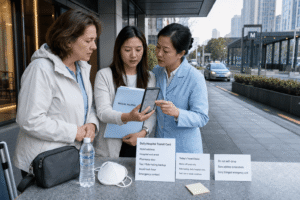
Getting Around in China During Treatment: Metro, Taxi, DiDi, and Hospital Shuttle Practical Guide
Reading time: 9 minutes International patients receiving treatment in China move between hotel, hospital, pharmacy, and supermarket every day — two or three times at minimum, five or six on a heavy...
Published 2026-05-22 · Read →
Travel & Logistics · 9 min read
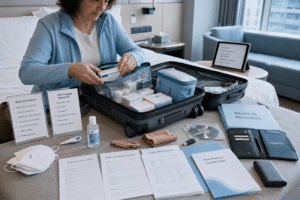
Pre-Departure Checklist: Medication, Follow-up, Luggage, and Documents Before Going Home
Reading time: 11 minutes Going home is not just booking a flight. The moment treatment in China is complete, recovery is sufficient, and you are cleared to travel — that single moment...
Published 2026-05-22 · Read →

Travel & Logistics · 6 min read
Food and Diet During Medical Treatment in China: Post-Op Nutrition, Religious Diets, and Special Needs
Reading time: 10 minutes What patients eat in China during treatment, who prepares it, how religious dietary requirements are met, and whether a post-surgical patient can handle Chinese food are questions almost...
Published 2026-05-22 · Read →

Travel & Logistics · 8 min read
Accompanying Family in China: Visa, Role, Daily Life, and Healthy Boundaries
Reading time: 12 minutes The patient is the centre of treatment, but accompanying family is the structure that holds everything else up. Across the international patients we've coordinated, the difference between those...
Published 2026-05-22 · Read →
Discharge & Return Home
Finishing treatment is not the end. Discharge papers, imaging discs, medication you take with you, and remote follow-up after returning home determine whether you can carry your China treatment back and keep continuity with your home physician. This section is the practical checklist around discharge.

Travel & Logistics · Cornerstone · 7 min read
Your First Day in China: Airport Pickup, Hotel Check-in, and Hospital Registration
Reading time: 9 minutes After a ten- to fifteen-hour transpacific flight — especially when you arrive carrying an illness — the last thing that should happen is "no one is here to...
Published 2026-05-22 · Read →

Travel & Logistics · 7 min read
Accommodation Guide for Medical Travel to China: Hospital-Adjacent vs Serviced Apartment vs Hotel
Reading time: 12 minutes Accommodation for medical travel to China is not the same exercise as booking a hotel for a holiday. A five-day stay and a three-month stay call for...
Published 2026-05-22 · Read →
Travel & Logistics · 10 min read
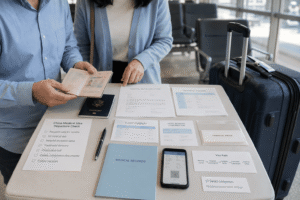
Complete Guide to China Medical Visa (S1/S2): The First Step for International Patients
Reading time: 11 minutes For many international patients, the first thing that actually blocks them after they've decided to come to China for treatment is not the hospital, not the doctor —...
Published 2026-05-22 · Read →
Preparing to come to China for treatment, but still untangling the "non-medical" links -- visas, accommodation, on-site assistance, discharge documents?
Send us an email with your expected travel window, country of residence, number of patients and family companions, and projected treatment duration. Within 1-2 business days we'll reply with a complete inbound itinerary framework -- visa category, entry route, accommodation suggestions, and assistance arrangements. Free, no commitment required.
Send your case to hello@medcareinchina.com →
-- MedCareInChina Editorial Team