Reading time: 12 minutes
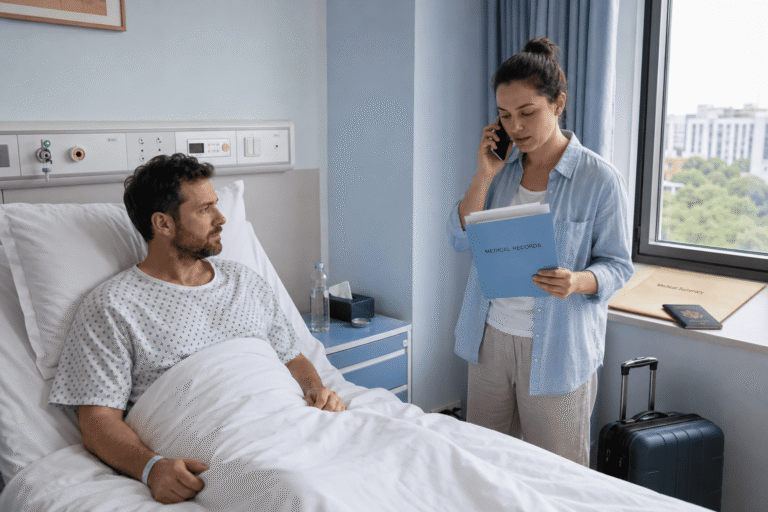
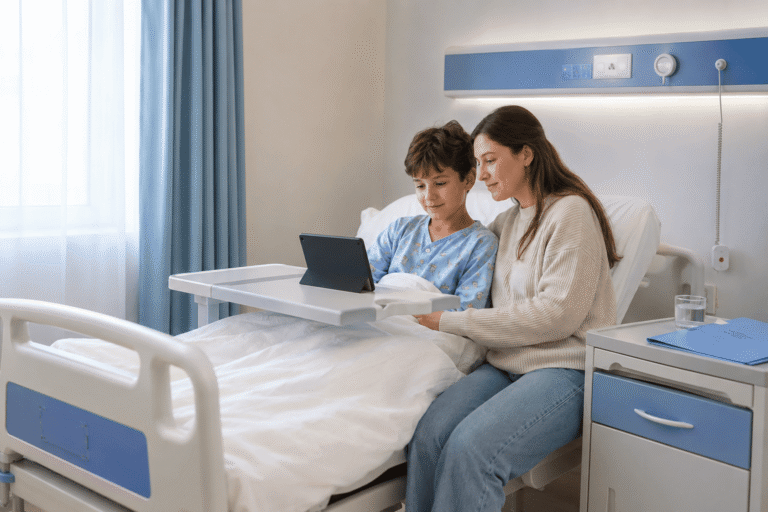
The patient is the centre of treatment, but accompanying family is the structure that holds everything else up. Across the international patients we’ve coordinated, the difference between those who arrived with family support and those who came alone is real — not in the medical outcome itself, but in adherence, emotional steadiness, and the willingness to stay long enough for the right answer. That said, “bringing family” is not a single decision. The visa class is different, what they’re allowed to do in the hospital is different, the residence permit timing changes if they stay more than six months, and three months of full-time caregiving in a foreign country is itself a heavy thing. This article works through the accompanying-family role honestly — visa, lodging, daily life, what they can and can’t do at the bedside, the emotional load, and how to leave well.
The Family Member’s Visa: S2 or S1
Following Article #45:
- Expected to accompany for 180 days or fewer → S2 (same category as the patient typically uses)
- Expected to accompany for more than 180 days → S1, with a residence permit obtained within 30 days of entry
Documents the accompanying family member typically submits:
- The patient’s already-approved S visa
- Authenticated family relationship document (marriage certificate, birth certificate) through your country’s foreign-affairs ministry or via Hague Apostille
- A copy of the patient’s hospital invitation letter
- Financial documentation (same as Article #45)
A frequent misconception: L visa “should be fine for family.” It can technically cover a short visit, but cannot be extended, cannot convert to residence permit, and is not always accepted by hospital international departments as a caregiver basis. Apply for S directly.
How Many Family Members to Bring
Chinese visa policy does not formally cap the number of accompanying family members, but pragmatically:
- One primary caregiver — long-term, stable, with decision authority (usually spouse or adult child)
- One or two rotating caregivers — if a parent is in treatment, two adult children alternating roughly two-week shifts is common
- More than three family members on the ground materially raises accommodation, food, and visa cost without commensurate benefit
The setup we see most often: one primary caregiver in-country + one remote support person back home handling insurance paperwork, work coordination, and family logistics from a distance.
What Family Can Actually Do at the Bedside
Chinese tertiary hospital international departments and the high-end private hospitals we work with are relatively flexible with family presence, but it still differs from US or European norms.
International department inpatient wards:
- Usually allow one caregiver to stay 24 hours with use of a fold-out bed
- Some allow multiple visitors during day hours but only one overnight
- Visiting hours are typically 10:00–20:00, stricter in ICU, transplant, and CAR-T units
Standard wards (if transferred):
- Caregiver passes required, typically permitting overnight presence 18:00–07:00
- Visiting hours are more restricted
ICU / isolation wards:
- Visits limited to specific time windows (often 1–2 hours daily)
- Some hospitals require gowning and sanitization before entry
Family members can usefully do:
- Help with communication (even with a translator present, you are the person the patient trusts most)
- Support meals (bring food, place orders, monitor intake)
- Confirm major decisions (significant treatment changes)
- Provide emotional support
- Take notes (medication orders, follow-up scheduling)
Family members should not:
- Decline a treatment in front of the physician on the patient’s behalf — the patient should be present and speaking
- Bring unauthorized herbs or supplements into the room — they can interfere with chemotherapy, targeted agents, or immunotherapy
- Play music or videos out loud in the ward — Chinese hospital culture is quieter than many Western settings
- Adjust medication independently — any change goes through the attending physician
Accommodation for the Accompanying Family
Cross-reference Article #46. A few notes specific to family:
- Prioritize a serviced apartment with separate bedroom and living area so the caregiver can be off-duty without disturbing the patient
- Keep a separate quiet space available — being at bedside 24 hours a day is unsustainable; four to six hours daily at the hotel is realistic baseline
- Plan for a hired daytime caregiver if you are the sole family member — this is a service you arrange with a local agency, not something we provide
- Stay close to the hospital — middle-of-the-night calls back to the bedside happen more often than people expect
The Family Member’s Daily Life
Three months of caregiving in a foreign country is a major life change. Practically:
Rhythm of a typical day:
- Six to eight hours at or near the hospital
- Two to three hours on errands (medication, investigations, billing, paperwork)
- One to two hours coordinating with home (work, family, insurance)
- Six hours of sleep (often less)
Psychological load:
- Caregiving alone in a foreign country is a high-risk emotional state — loneliness plus anxiety plus decision fatigue
- The caregiver should have a regular remote talking partner — friend, therapist, religious advisor
- Connecting with other international patient families helps, when it’s possible to arrange organically
Physical health:
- The caregiver also needs care — daily walks of 30 minutes, regular meals, basic health screening if the stay extends
- Long inpatient exposure can transmit hospital infections (flu, norovirus); hand hygiene matters
The Emotional and Psychological Side — Said Plainly
This part doesn’t appear in most articles, but the accompanying family piece has to address it:
- Decision fatigue is real, especially when prognosis is uncertain. Caregivers often feel “every choice could be wrong.” We suggest a 24-hour decision buffer at major nodes (pre-surgery, change of treatment line)
- The caregiver needs care too — physicians usually ask the patient how they are doing and rarely ask the caregiver. If you are the caregiver, tell the physician or coordinator how you are doing
- Post-return adjustment is common, especially when treatment outcomes were difficult. Counselling back home is appropriate, not a sign of weakness
- Remote family members will feel less of it than you do — and they may second-guess your decisions in ways that aren’t fair. That is normal; protect your energy
Whether the Family Member Can Work in China
By visa rule:
- S visa does not permit employment in China (even remote work for a foreign employer sits in a grey area)
- Working legally in China requires a Z visa plus a work permit, which is incompatible with caregiver status
In practice, a family member on an S visa who continues their existing remote employment for a non-Chinese employer using their own laptop, paid into their home-country bank account, is rarely scrutinized. Do not register as a sole proprietor in China, do not take on Chinese platform work, and do not open a Chinese business bank account.
When the Family Member Goes Home
Not every accompanying family member needs to stay all the way to discharge. Common patterns:
- Anchor at major nodes — primary caregiver arrives one week before surgery, leaves two weeks after, hands off to a relief caregiver
- Rotating shifts — siblings or spouses alternating two to four weeks each
- Remote support plus local daytime hired caregiver — primary family member is not in-country; a local daytime caregiver is hired from a local agency, supplemented by accompanied-care visits
Each pattern has trade-offs; the right one depends on treatment type and family situation.
What MedCareInChina Can and Cannot Do for Accompanying Family
Our two products are Remote Consultation and In-China Accompanied Care. Honest scope:
- If you have engaged In-China Accompanied Care, the chaperone is present during hospital visits and can act as bilingual support — that support extends to the accompanying family member when both are at the hospital together. The accompanied-care service is one chaperone, not a dedicated family service
- When accommodation is being discussed under the accompanied-care arrangement, the chaperone can mention area choices that work better when family is also living there
What we do not do:
- We do not file the family member’s visa application or pre-review the visa packet
- We do not provide nursing or caregiving services — for hired daytime caregivers, you contract a local agency directly
- We do not run a patient community or formally introduce families to other international families
- We do not coordinate family member rotations or handovers
- We do not provide mental health counselling — for that, please engage a licensed therapist (many international platforms support remote sessions in your language)
Action Checklist (Caregiver Edition)
- Complete family-relationship document authentication before departure
- Apply for the correct visa category (S2 or S1)
- Agree explicitly with backup caregivers on division of work
- Set up a regular remote conversation cadence with a friend or therapist before you fly
- Do not take on everything in the first week — let yourself adjust to time zone and routine
- Do not neglect your own body and mind
- Build in defined rest windows on long treatments — one full day off every two weeks at minimum
Sources
[1] PRC Exit and Entry Administration Law — provisions on S-category visas: https://www.npc.gov.cn/ [2] Ministry of Public Security Exit-Entry Administration — Residence permit procedures: https://www.nia.gov.cn/ [3] Hague Apostille Convention — Authentication of family relationship documents: https://www.hcch.net/ [4] Ministry of Foreign Affairs of the PRC — Document authentication for visa purposes: https://www.mfa.gov.cn/