Reading time: 18 minutes
When international readers think of China’s private international hospitals, the familiar names are United Family Healthcare, Shanghai Jiahui International, ParkwayHealth, and SIMC. These have operated for 10–25 years and have established clear positions in expatriate communities.
Heyou Pinnacle Medical Center is one of the newest additions to that list. Located in Shunde District, Foshan, Guangdong, it was founded through the family office of He Xiangjian, founder of Midea Group — China’s manufacturing giant ranked #277 on the Fortune Global 500 with a 2024 market capitalization exceeding US$77 billion. Total investment in the Heyou International Health System exceeds US$1.5 billion, occupying 25.73 hectares with planned capacity of 1,500 beds and 580,000 square meters of built area [1][2]. This is one of the largest single private medical system investments in China over the past decade.
But scale itself isn’t the argument. The questions international patients need answered are: where does this hospital actually sit in China’s medical supply landscape? What can it do that conventional private international hospitals cannot? What is its relationship to public Tier-3A hospitals? Which international patients does it genuinely suit?
This article tries to answer these questions.
1. The system structure — Heyou Pinnacle is not a single hospital, it’s an ecosystem
The first step in understanding Heyou Pinnacle is knowing it isn’t a standalone hospital — it’s part of the HeYou International Health System, which comprises five institutions [2]:
- Heyou Hospital — non-profit general hospital operating within China’s medical insurance coverage, serving local Greater Bay Area residents.
- Heyou Pinnacle Medical Center (IMC) — international high-end medical center serving high-net-worth individuals and international families. 22,900 sqm built area, 100 beds, 40+ clinical specialties.
- Heyou Proton & Heavy Ion Center — equipped with internationally advanced radiation treatment equipment, offering both proton and heavy-ion therapies. This is particularly significant — discussed in detail below.
- Meihe Hospital — community general hospital; originally an incubator and pilot facility, now serving the surrounding community with check-ups, traditional Chinese medicine, and specialty services.
- FAMOUS Aesthetic Medicine — medical aesthetics center.
The entire system operates under the support of the He Xiangjian Charity Foundation (US$1.5 billion fund, focusing on elderly health, culture and arts, poverty alleviation, community development) — a non-profit positioning [9]. Mr. He’s stated philosophy — “to serve hometown and give back to society” — places this closer to a Mayo Clinic-style family foundation tradition than to the property-developer-funded private hospitals of China’s first wave.
Practical implications for international patients:
- Heyou Hospital (the non-profit general institution) is part of China’s insurance system; foreign patients generally don’t engage there directly.
- Heyou Pinnacle Medical Center + Heyou Proton & Heavy Ion Center are the actual entry points for international patients.
- Resources across the five institutions are integrated — Heyou Hospital’s emergency and ICU capacity, Heyou Pinnacle’s international medical workflow, and the Proton & Heavy Ion Center’s radiation treatment capability operate as a connected medical ecosystem rather than isolated centers.
2. Three hard signals worth noting
In China, plenty of private hospitals claim “highly capable” status. Very few can actually attract authority-level specialists, configure top-tier equipment, and secure regulatory advantages. Heyou Pinnacle has three concrete signals:
Hard signal #1: Professor Lu Jiade leads the Proton & Heavy Ion Center
Who is Lu Jiade? He is the founder of the clinical technology system at Shanghai Proton and Heavy Ion Center (SPHIC) [3][4]. SPHIC is mainland China’s first — and currently the only public-system — operating proton-and-heavy-ion treatment center. In clinical operation since June 2014, it is the national benchmark. As of mid-2023, SPHIC had treated 5,648 cumulative patients, with 1,025 patients in 2022 alone, ranking first globally among comparable proton-heavy-ion facilities by annual treatment volume [3].
Lu Jiade’s role at SPHIC was to build China’s first clinical proton-and-heavy-ion radiotherapy treatment system — not a routine department-head résumé, but foundational clinical work. He was one of the principal technical leaders of the registration clinical trials for China’s first particle therapy equipment, jointly led the registration clinical research, and was responsible for the standard operating procedures (SOPs) for heavy-ion treatment [4].
His move to Heyou Pinnacle means two things:
- Private institutions are now capable of attracting top-tier talent away from the public system — something unthinkable in China a decade ago, now happening.
- The Heyou Proton & Heavy Ion Center is not an equipment-purchase marketing project. The equipment requires hundreds of millions of dollars; but the doctors who can actually run such equipment clinically number only a few in China. Where Lu Jiade is, proton-heavy-ion clinical capability is assured.
Hard signal #2: A systematized influx of national-level specialists
Lu Jiade isn’t an outlier. Heyou Pinnacle has attracted multiple national-level specialists — at a concentration rare among new private international hospitals in China:
- Su Fengxi [5] — Honorary President of the Breast Tumor Hospital at Sun Yat-sen Memorial Hospital, Sun Yat-sen University. First-time Director of the Breast Tumor Medical Department (established 2010). Founded the Guangdong Medical Association’s Breast Disease Branch as its inaugural chairman. National leader in breast-conserving surgery; over 10,000 breast cancer surgeries performed, breast-conservation rate exceeding 50% (national leading level). 40+ years of clinical experience.
- Li Baomin [6] — Pioneer of neurointerventional work at the General Hospital of the PLA (301 Hospital). Completed over 20,000 neurointerventional and neurovascular diagnostic and therapeutic procedures, with a surgical success rate exceeding 95% and a mortality rate below 0.2%. Vice Director of the Cerebrovascular Intervention Group of the Chinese Medical Association’s Neurology Branch. 40+ years of clinical experience.
- Wu Zenghui — Spine surgery specialist. First in China to perform XLIF (extreme lateral interbody fusion) minimally invasive spinal surgery. Lingnan Famous Doctor.
- Liu Xiaofang — National Key Specialty Leader; Lingnan Famous Doctor. Chief Physician of Integrated Traditional Chinese and Western Medicine. Outstanding Hospital Director of Guangdong Province.
- Wang Fuke — Director of Sports Medicine. Yunling Famous Doctor. Arthroscopic minimally invasive surgery authority.
- Xie Keji — Director of Urology. Level-1 Chief Physician. Recipient of the 2020 “Dayu Cup” from the Chinese Medical Association, the highest honor in urinary continence in China.
- Cao Shiping — Director of Cardiology. 40+ years of coronary intervention experience. 70+ published papers, 4 national patents.
- Li Jun — Director of General Surgery. Lingnan Famous Doctor. Comprehensive liver cancer treatment, pancreaticoduodenectomy, biliary tract cancer.
- Li Zijun — Director of Gastrointestinal Medicine. Postdoctoral research and visiting scholar at the Hospital of the University of Pennsylvania, and at California Pacific Medical Center.
- Additional national-level specialists are distributed across pediatrics, obstetrics, nephrology, ENT, stomatology, and geriatric medicine.
The system employs over 1,300 staff including nearly 1,000 healthcare professionals [1][2]. Discipline leaders are from China’s top 100 hospitals, with 70%+ holding key roles in national or provincial medical societies and 80%+ serving as master’s or doctoral supervisors. In 2022, the system launched a global talent recruitment initiative attracting 50 discipline leaders.
Practical implication for international patients: at Heyou Pinnacle, the attending physician quality can reach top-tier Chinese public Tier-3A levels — this is the fundamental difference between China’s second-wave private hospitals (such as United Family, Jiahui) and the third wave (Heyou Pinnacle, Guangzhou Concord). Second-wave hospitals draw doctors primarily from mid-career physicians plus some senior public-hospital moonlighters; the third wave can directly attract top-tier public-system specialists into full-time or majority-time private practice.
One essential caveat remains: even with a high overall team standard, for your specific case, you must verify the actual surgical volume of the lead surgeon in that specific procedure over the past 12 months. This isn’t unique to Heyou Pinnacle — it applies to every private international hospital in China (United Family, Jiahui, SIMC included).
Hard signal #3: Designated institution under the GBA “HK & Macao Drug and Device Access” policy
This policy, launched in 2020 by China’s National Medical Products Administration, permits designated medical institutions in the Greater Bay Area to directly import drugs and medical devices already approved in Hong Kong or Macao but not yet approved on the Chinese mainland [7][8]. As of late 2025, the program covers all 9 mainland GBA cities, with 70+ designated institutions and 140+ approved drug and device varieties.
This is a concrete regulatory advantage — Heyou Pinnacle can deploy certain drugs and devices unavailable at other mainland Tier-3A hospitals, shortening the “is the right drug/device available in China?” wait that international patients typically face.
For patients dealing with oncology targeted therapies, rare-disease drugs, novel biologics, and advanced medical devices, this is a quantifiable policy advantage.
3. Discipline structure — what Heyou Pinnacle can do
The system has established 48 first- and second-level departments, with multiple Centers of Excellence planned to international standards. From an international patient perspective, key capabilities are distributed as follows:
Oncology Center
- Medical Oncology
- Hematology
- Radiation Oncology
- Particle Project (Proton + Heavy Ion)
International patient focus: proton-heavy-ion therapy (distinctive), targeted therapy, chemotherapy, comprehensive multidisciplinary treatment. Breast oncology is led by Professor Su Fengxi.
Five major emergency centers (built to national standards)
- Chest Pain Center — acute myocardial infarction and other life-threatening conditions
- Stroke Center — ischemic and hemorrhagic strokes
- Trauma Center — multidisciplinary severe trauma care
- Maternal and Obstetric Emergency Center
- Neonatal Emergency Care Center
Surgical system
Neurosurgery, Orthopedics I/II/III, General Surgery, Thoracic Surgery, Urology, Plastic Surgery, Cardiovascular Surgery, Gynecology, Obstetrics.
International patient focus: spinal minimally invasive surgery (Wu Zenghui), joint replacement (Wang Fuke, Liu Xiaofang), hepatobiliary and pancreatic surgery (Li Jun), neurointervention (Li Baomin), urology (Xie Keji), breast surgery (Su Fengxi).
Internal medicine system
Neurology, Pediatrics, Cardiology, Respiratory Medicine, Rheumatology, Endocrinology, Infectious Diseases, Gastrointestinal Medicine.
International patient focus: coronary intervention (Cao Shiping), nephrology, gastroenterology and endoscopy (Li Zijun), geriatric medicine.
Health Management Center
Comprehensive executive check-ups and high-end early-cancer screening.
Other key departments
ENT and Head and Neck Surgery, Stomatology, Ophthalmology, Anesthesiology, Surgical Center, Dermatology, Rehabilitation Medicine (Chen Wujun — cardiac rehabilitation), Traditional Chinese Medicine, Clinical Nutrition, Geriatric Medicine, Psychological Medicine.
A clinical case worth specific mention
Heyou’s Neurosurgery team has, using spinal cord stimulation (SCS), recently “awakened” two patients who had been in a Persistent Vegetative State (PVS) for several months [1]. Following surgery, the patients have shown improved consciousness, can follow verbal commands, clench their fists, and toss a ball. PVS treatment is a frontier field — globally, the number of centers performing such procedures with reproducible outcomes is very limited. Such clinical cases are rare among new private hospitals.
4. The Heyou Proton & Heavy Ion Center — why this matters on China’s medical map
This is the capability that distinguishes Heyou Pinnacle from every other private international hospital in China. It needs separate explanation.
Proton therapy vs proton + heavy-ion therapy
- Proton therapy — uses the “Bragg peak” property of proton beams to concentrate radiation dose precisely at the tumor while minimizing damage to surrounding healthy tissue. Suited for pediatric cancers, skull-base tumors, ocular tumors, and re-irradiation of recurrent cancers. Many operating centers exist in the US, Europe, and Japan.
- Heavy-ion therapy (primarily carbon-ion) — higher energy than proton, stronger biological effect (relative biological effectiveness, RBE, is roughly 2–3× that of proton), more effective for hypoxic tumors and radiation-resistant tumors (such as adenoid cystic carcinoma, bone and soft tissue sarcomas, some advanced liver cancers, pancreatic cancer). Globally operating heavy-ion centers are very few — Japan (QST and a handful of others), Germany (Heidelberg HIT, Marburg), Austria (MedAustron), Italy (CNAO), Shanghai SPHIC — fewer than 15 total worldwide [17].
The mainland China proton/heavy-ion landscape (2025)
| Center | Type | Capability |
|---|---|---|
| Shanghai Proton and Heavy Ion Center (SPHIC) | Public | Proton + Heavy ion (clinical operations since 2014) |
| Heyou Proton & Heavy Ion Center | Private | Proton + Heavy ion (led by Professor Lu Jiade) |
| Guangzhou Concord Cancer Center (Concord Medical Group) | Private | Proton (Varian ProBeam, operational since Dec 2024) |
| Gansu Wuwei Heavy Ion Treatment Center | Public-backed | Heavy ion |
| Shandong Zibo Wanjie Hospital | Private | Proton |
| Hefei Ion Medical Center | Under construction / early clinical | Proton |
In mainland China, centers with both proton and heavy-ion capability: only SPHIC and Heyou. SPHIC has 10+ years of public operation and the deepest clinical experience; Heyou is led by SPHIC’s founding architect — the most direct capability transfer.
Practical implication for international patients
If your situation falls into the following categories, proton/heavy-ion therapy is an option worth including in the decision matrix:
- Pediatric cancers — minimizing long-term radiation side effects
- Skull-base tumors, tumors near the brainstem — extreme precision required
- Adenoid cystic carcinoma, bone and soft tissue sarcomas — heavy-ion relative biological effectiveness advantage
- Re-irradiation of recurrent cancers — complex scenarios after previous conventional radiation
- Ocular tumors — organ and function preservation through precision radiation
- Hypoxic and radiation-resistant tumors — heavy-ion can break through conventional radiation limits
Cost range: SPHIC public costs roughly USD $45K–$60K per complete treatment course; Heyou Pinnacle pricing is case-by-case, as the center is newer to market and pricing is still calibrating. Confirm current pricing directly with the hospital; the free Pathway Scan does not provide individualized prices.
Honest disclosure: proton/heavy-ion is not a “universal radiation upgrade.” Most common cancers — early breast, early lung, early prostate — achieve excellent outcomes with conventional photon or intensity-modulated radiation therapy, without needing proton or heavy-ion. The genuine indications for proton/heavy-ion are the specific scenarios above. Chinese domestic insurance typically does not cover proton/heavy-ion treatment; some premium international policies do cover it (case-by-case confirmation required) [18][19][20][21].
5. What international patients actually get at Heyou Pinnacle
Service capabilities
- Fluent English: bilingual physicians and nursing staff; Arabic, Russian and other languages require advance booking through interpreter services.
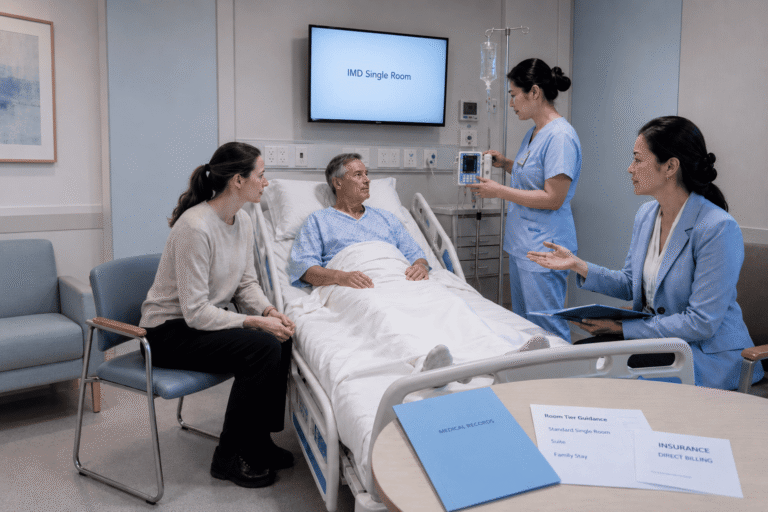
- Hotel-style inpatient rooms: 100 beds, international-standard service workflow.
- International commercial insurance direct billing: supported (specific insurer in-network status confirmed case-by-case).
- Multilingual service.
- GBA “HK & Macao Drug and Device Access” designated institution — the key regulatory advantage discussed earlier.
- 8 highly capable architecture awards — including the 2021 German Iconic Design Award and Innovation Architecture Award. The campus is set in the “Royal Orchid” cultural and tourism district, near the He Art Museum — environmental quality is top-tier.
Typical itinerary durations
- Comprehensive checkup (incl. PET-CT): 3–5 days
- Cataract surgery: 3–4 days
- Joint replacement (hip/knee): 5–7 days inpatient + 1–2 weeks observation = 2–3 weeks
- Minimally invasive spinal surgery: 1–2 weeks
- Proton/heavy-ion therapy (single course): 4–8 weeks
- Complex oncology multidisciplinary treatment: 6–12 weeks
Differentiation vs other Chinese private international hospitals
| Dimension | United Family / Jiahui / SIMC | Heyou Pinnacle |
|---|---|---|
| Operating years | 10–25 years | Newer (2020s operation) |
| Expatriate patient base | Large, mature | Building |
| Service-workflow maturity | High | High (case-volume accumulating) |
| Top-specialist concentration | Medium-high (mostly public-hospital moonlighters) | Very high (national-level specialists in full-time or majority-time private practice) |
| Specialty depth (complex oncology, neurointervention, proton/heavy-ion) | Limited | Strong |
| Architecture and equipment | Mid-high | Top-tier (US$1.5B+ investment) |
| Location | Beijing/Shanghai/Guangzhou city center | Foshan-Shunde (GBA, 1-hour drive from Shenzhen/Guangzhou) |
| Regulatory advantage | Standard | GBA HK/Macao Drug & Device Access designated |
| Price positioning | High-end | High-end |
6. Who Heyou Pinnacle suits — and who it doesn’t
🟢 Suits
🟢 Complex oncology requiring proton or heavy-ion therapy
- The scenarios above: pediatric cancers, skull-base tumors, adenoid cystic carcinoma, sarcomas, re-irradiation.
- The Lu Jiade-led system is one of the top two in China.
🟢 Breast cancer specialty treatment
- The Su Fengxi system: 10,000+ surgical volume, 50%+ breast-conservation rate.
- Suited for early- and mid-stage breast cancer requiring breast-conservation and comprehensive treatment.
🟢 Complex spinal surgery
- Wu Zenghui (XLIF pioneer in China) + Liu Xiaofang systems.
- Suited for minimally invasive spinal surgery, spinal deformity correction, non-fusion techniques.
🟢 Neurointerventional treatment
- Li Baomin system (20,000+ stent placement and embolization experience).
- Suited for cerebrovascular disease, complex interventional treatment, cerebral perfusion therapy.
🟢 Complex hepatobiliary and pancreatic surgery
- Li Jun (comprehensive liver cancer treatment, pancreaticoduodenectomy).
🟢 Cardiac intervention
- Cao Shiping (40+ years of coronary intervention).
🟢 High-end checkups and early-cancer screening
- Health Management Center and Oncology Center linkage; 3–5 day completion.
- GBA location convenient: 1 hour from Shenzhen/Guangzhou; 2–3 hours round-trip from Hong Kong.
🟢 GBA cross-border families
- Families working or living in Hong Kong or Macao with cross-border medical needs on the mainland.
- The HK/Macao Drug & Device Access policy provides direct benefit to this group.
🔴 Doesn’t suit
🔴 Emergencies and critical illness — handle locally. Crossing borders is itself the medical risk.
🔴 Unstable patients who can’t fly long-haul — fit-to-fly assessment by your existing treating physician.
🔴 Expecting “a miracle cure” — Heyou Pinnacle is not a miracle; it is a high-quality private international general hospital. If top US or European oncology centers have called your case untreatable, “China must have something” is usually disappointment in waiting.
🔴 Ultra-niche rare-disease subspecialties (top pediatric congenital cardiac, certain rare hematological diseases, some rare genetic conditions) — these scenarios still require evaluation against top-tier public specialty centers (Fuwai, Beijing Children’s, Peking Union Hematology, Beijing Tiantan).
🔴 Extreme price sensitivity — Heyou Pinnacle is high-end positioning, priced between Chinese public IMDs and developed-country private hospitals. If price is the only driver, Thailand’s Bumrungrad or India’s Apollo are cheaper for certain procedures.
7. Public Tier-3A vs Heyou Pinnacle — the same one-way bridge rule applies
In all our country pathway articles, we emphasize “China’s two systems + the bridge that runs only one way.” This rule applies here too.
The one-way bridge rule
- ✅ Public → Heyou Pinnacle works. A diagnosis, imaging report, or prescription issued by a public Tier-3A hospital (Peking Union, Shanghai Ruijin, Fudan-Zhongshan, etc.) is recognized by Heyou Pinnacle.
- ❌ Heyou Pinnacle → Public does not. Heyou Pinnacle’s consultations are not generally accepted by public Tier-3A as the basis for surgery or admission. If you want public treatment, the public hospital will require its own re-evaluation.
The reason: public Tier-3A remains the higher-ranked tier in the Chinese medical hierarchy; the downstream (private) accepts the upstream (public), but not vice versa.
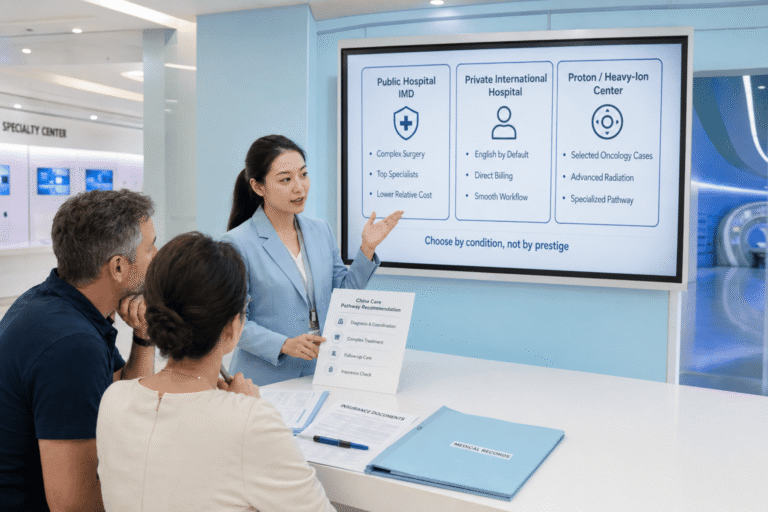
Practical case-to-institution matching
| Case type | Recommended pathway |
|---|---|
| Top specialty-defining: heart transplant, complex congenital heart, top oncology centers | Public Tier-3A (Fuwai, Peking Union, National Cancer Hospital) |
| Complex oncology requiring proton or heavy-ion | SPHIC public or Heyou Pinnacle (depending on indication and availability) |
| Breast cancer breast-conservation and comprehensive treatment | Heyou Pinnacle (Su Fengxi) or Sun Yat-sen Cancer Hospital |
| Complex spinal minimally invasive surgery | Heyou Pinnacle (Wu Zenghui) or Beijing Jishuitan, Beijing Tiantan |
| Neurointervention | Heyou Pinnacle (Li Baomin) or Beijing Tiantan, Naval Medical University Changhai |
| Comprehensive checkups | Heyou Pinnacle / Jiahui / United Family or other private internationals |
| Routine outpatient, imaging, IVF, dermatology, ophthalmology | Any private international |
| Complex internal medicine and rare diseases | Peking Union, West China, Ruijin and other top public Tier-3A IMDs |
Core principle: match based on what doctor the case needs first, then decide where to go — not the other way around. Heyou Pinnacle’s advantage is precisely that it has assembled doctors capable of handling complex cases, so it suits scenarios where case-to-physician matching is clear and the specific surgeon has rich experience in that procedure.
8. Cost and insurance
Price positioning
Heyou Pinnacle does not publish standard price lists publicly (few Chinese hospitals do); actual quotes require case evaluation. Initial industry benchmarking suggests prices sit between Chinese public IMDs (30–50% of private international) and developed-country private hospitals. Reference ranges:
| Procedure | China Public IMD | Heyou Pinnacle / Private International | US Self-Pay |
|---|---|---|---|
| Hip replacement | $8K–$12K | $15K–$22K | $40K–$80K |
| Comprehensive checkup (incl. PET-CT) | $2.5K–$4.5K | $5.5K–$9.5K | $5K–$15K |
| Proton therapy (single course) | $45K–$60K (SPHIC) | Case-by-case | $80K–$200K |
| Breast cancer breast-conserving surgery (comprehensive) | $5K–$10K | $12K–$20K | $30K–$60K |
Insurance support
- Heyou Pinnacle supports international commercial insurance direct billing — partners with Bupa Global [19], Cigna Global [18], AXA Global Healthcare [20], Allianz Worldwide [21], MSH, GeoBlue, Aetna International, and others (case-by-case confirmation).
- GBA “HK & Macao Drug and Device Access” designated institution — Hong Kong and Macao-approved drugs and devices not yet approved on the Chinese mainland can be deployed at Heyou Pinnacle, providing direct value for patients holding Hong Kong or Macao insurance policies [7][8].
- Chinese domestic basic insurance typically does not cover private international hospital high-end services; Chinese domestic commercial insurance policyholders require case-by-case confirmation.
Important reminder: MedCareInChina is not an insurance company, does not negotiate with your insurer, and does not advance insurance funds. We can help you confirm insurance and hospital in-network status, prepare pre-authorization packages, and coordinate direct-billing communication.
9. How MedCareInChina helps you engage with Heyou Pinnacle
⚠️ Important declaration: MedCareInChina is not an official representative of Heyou Pinnacle Medical Center, and we do not receive referral commissions from Heyou Pinnacle or any other hospital. We are an independent international patient navigation service — our position is on the patient side, not the hospital side.
What we can do:
- Initial routing scan (free Pathway Scan) — tell you only whether China appears worth further consideration and which type of next step may fit.
- Remote consultation arrangement (paid) — Single Expert USD $800 / MDT USD $1,000 per specialist — can coordinate with Heyou Pinnacle’s relevant specialists.
- Records organization and English-language medical record translation — preparing complete admission materials.
- Visa invitation letter coordination — Heyou Pinnacle can issue invitation letters for your S2/S1 private-affairs visa.
- In-China accompanied care (during treatment) — airport pickup, appointment coordination, medical interpretation, payment coordination, insurance documentation support, English-language discharge files, hand-off back home.
- Remote follow-up coordination after return — bridge between you and your home physician.
What we don’t do:
- Make medical decisions for you
- Make insurance decisions for you
- Hold or pass through medical funds (all medical fees flow directly from you to Heyou Pinnacle)
- Guarantee medical outcomes
10. Next step — send us your case
📧 hello@medcareinchina.com
Subject: Heyou Pinnacle Pathway Scan
In the body, tell us:
- Your current condition or diagnostic direction (one or two sentences)
- Your country and city, rough travel window
- Your insurance situation
- The state of your medical records (describe; don’t send files yet)
- Any cultural or dietary requirements (halal, female physician, number of family members travelling)
Free Pathway Scan boundary: Within 1–2 business days, we provide one routing reply — whether China appears worth further consideration and which type of next service step may fit. It does not include a hospital or doctor list, record checklist, insurance determination, individualized cost estimate, diagnosis, or treatment recommendation. Share only basic non-sensitive details; do not send full medical files.
Sources
[1] Heyou Pinnacle Medical Center · Official Website — Hospital profile, specialty distribution, physician team, equipment, policy resources. https://imc.hyhospital.com/
[2] HeYou International Health System · Official Website — Group structure (5 institutions), address, contact, medical team, news. Address: No. 1 Hexin Road, Beijiao Town, Shunde District, Foshan City, Guangdong Province. https://www.hyhospital.com/
[3] Shanghai Proton and Heavy Ion Center (SPHIC) · Official Website — Mainland China’s first, and the world’s third, medical institution simultaneously equipped with proton and heavy-ion treatment (clinical operations since June 2014; 5,648 cumulative patients treated as of mid-2023; 1,025 treatments in 2022 ranking first globally among comparable facilities). Public source for Professor Lu Jiade as SPHIC clinical technology system founder. https://www.sphic.org.cn/
[4] Professor Lu Jiade · “Building Another Proton and Heavy Ion Hub in South China” (HeYou International Hospital official report) — Official announcement of Professor Lu Jiade joining the Heyou Proton & Heavy Ion Center; documents his role as principal technical leader of SPHIC’s registration clinical research and as responsible party for heavy-ion treatment SOPs. https://www.hyhospital.com/andyunews/info.aspx?itemid=1225
[5] Su Fengxi · Honorary President, Breast Tumor Hospital, Sun Yat-sen Memorial Hospital — Official physician page: Professor and Chief Physician; Provincial Chief Expert for China’s Million Women Breast Cancer Screening Project (Guangdong); inaugural Chairman of the Guangdong Medical Association Breast Disease Branch; first-time Director of the Breast Tumor Medical Department (established 2010); breast-conservation rate 50%+ at national leading level. https://www.gzsys.org.cn/node/14895
[6] Li Baomin · Neurointerventional Medicine, General Hospital of the PLA (301 Hospital) — Professor, Doctoral Supervisor, Chief Physician; over 20,000 neurointerventional and neurovascular procedures with surgical success rate exceeding 95%; Vice Director of the Cerebrovascular Intervention Group, Chinese Medical Association Neurology Branch. https://m.youlai.cn/yyk/docindex/6245/
[7] Guangdong Provincial Health Commission + Guangdong Provincial Drug Administration · “HK & Macao Drug and Device Access” Designated Medical Institution List — Official documentation of the GBA “HK & Macao Drug and Device Access” policy (implemented since 2021; as of the 4th batch in late 2025, designated medical institutions cover all 9 mainland GBA cities, with 70+ institutions and 140+ approved drug and device varieties). http://mpa.gd.gov.cn/zwgk/gzwj/content/post_4494777.html
[8] Guangdong-Hong Kong-Macao Greater Bay Area “HK & Macao Drug and Device Access” Special Page (Central People’s Government Liaison Office in Macao official report) — Policy background and significance; data on 9-city full coverage and drug/device imports. https://www.zlb.gov.cn/20240913/c6761f6440f7495d94b57f6a41ebf92b/c.html
[9] He Xiangjian Science Foundation · Official Website — Foundation background; established by Mr. He Xiangjian (founder of Midea Group), 2017 US$920 million charitable plan (100M Midea shares + US$310 million cash), 2023 He Science Foundation with US$460 million initial commitment. https://heprize.org/en/Home
[10] Midea Group · Fortune Global 500 Official Ranking — Ranked #277 on Fortune Global 500 (2024); one of the world’s largest home appliance manufacturers.
[11] MedCareInChina · Proton and Heavy-Ion Therapy in China (internal reference) — Integrated analysis of SPHIC, Heyou, and Guangzhou Concord. https://medcareinchina.com/proton-and-heavy-ion-therapy-in-china-sphic-process-indications-and-comparison-with-us-japan-and-europe/
[12] MedCareInChina · International Medical Insurance and China Hospital Direct Billing (internal reference) — Comparative analysis of public IMD and private international hospital direct-billing networks. https://medcareinchina.com/international-medical-insurance-and-china-hospital-direct-billing-a-complete-guide-to-coverage-workflow-and-pitfalls/
[13] MedCareInChina · CAR-T Cell Therapy in China (internal reference) — Six NMPA-approved CAR-T products in China + US/EU list price comparison. https://medcareinchina.com/car-t-cell-therapy-in-china-six-approved-products-top-centers-pricing-and-comparison-with-western-centers/
[14] MedCareInChina · Complete Guide to China Medical Visa (S1/S2) (internal reference) — International patient visa pathway for medical travel to China. https://medcareinchina.com/complete-guide-to-china-medical-visa-s1-s2-the-first-step-for-international-patients/
[15] MedCareInChina · From Canada / UK / Australia / USA / MENA to China for Medical Care (internal reference) — Companion country-pathway series.
[16] National Medical Products Administration (NMPA, China) — China’s national drug and medical device registration authority; the national-level regulator for the HK/Macao Drug & Device Access policy. https://www.nmpa.gov.cn/
[17] Particle Therapy Co-Operative Group (PTCOG) — Authoritative global statistical body for particle therapy centers; official source for the operating status of proton and heavy-ion treatment centers worldwide. https://www.ptcog.site/
[18] Cigna Global · International Health Insurance · China Network. https://www.cignaglobal.com/
[19] Bupa Global · Find a Provider — 2025 expansion to 3,600 designated hospitals across 300 Chinese cities. https://www.bupaglobal.com/en/customers/find-a-provider
[20] AXA Global Healthcare — AXA’s international product in China (via Prosper Health partnership covers approximately 1,350 Tier-3A hospitals). https://www.axaglobalhealthcare.com/
[21] Allianz Care · International Medical Insurance — 280+ public IMD and private international hospitals in China. https://www.allianzcare.com/
[22] MedCareInChina · Service & Refund Policy / Medical Disclaimer / Privacy Policy — Full service boundary documentation. Service & Refund Policy · Medical Disclaimer · Privacy Policy
Last updated 2026-05-30. All USD conversions calculated at; actual exchange rate at settlement applies. All medical decisions remain between you and your treating physician. MedCareInChina provides patient navigation services; it is not a medical provider, is not an official representative of Heyou Pinnacle Medical Center, does not diagnose, does not prescribe, and does not guarantee treatment outcomes.
— MedCareInChina Editorial Team