10 minutes read
For international patients traveling to China for medical care, insurance is often the largest execution challenge — can it direct-bill? Which hospitals accept my insurance? Do I need pre-authorization? Which clauses in my policy might deny claims? If these questions aren’t sorted out before traveling, you may face tens of thousands of dollars in cash pressure after arriving in China. This article is the foundational piece of the Insurance & Payment series, covering the direct billing networks of major international medical insurers in China, top IMDs’ insurance partnership lists, direct billing and reimbursement workflows, and five common insurance pitfalls — helping you fully resolve insurance questions before you travel.
Direct Billing vs Reimbursement: The Core Distinction
Direct Billing:
- The insurance company settles directly with the hospital
- The patient does not need to pay cash upfront
- At discharge, you only settle the self-pay portion (copay, deductible, non-covered items)
- The ideal form for international patients
Reimbursement:
- Patient pays the full amount in cash upfront
- Collects invoices, medical records, reports, and other documentation
- Submits to the insurance company after treatment
- Awaits review + reimbursement cycle (typically 4–12 weeks)
- Significant cash flow pressure — major surgery may require $50,000-$200,000+ USD upfront
Core recommendation: Before traveling, confirm whether your insurance can direct-bill with your target Chinese hospital. If you cannot direct-bill and need to pay $50,000+ USD in cash upfront, this alone may make traveling to China for treatment unfeasible.
Major International Medical Insurance Networks in China
The table below summarizes the most common insurance providers used by international patients and their China direct billing status [1]:
| Insurance Provider | Network in China | Public IMD | Private International Hospitals |
|---|---|---|---|
| Bupa Global | 3,600 designated hospitals (2025 expansion, 300 cities) | ✅ Supported | ✅ Widely supported |
| MSH China | 500+ hospitals in 20+ cities, global 60,000+ | ✅ Widely supported | ✅ Widely supported |
| AXA Global Healthcare | Through Prosper Health partnership ~1,350 Tier-3A + MSH network | ✅ (includes PUMCH, Sun Yat-sen, Huashan, etc.) | ✅ (includes United Family) |
| Cigna Global / CMB Cigna | Global 1.65M; Shanghai operations center | ✅ (pre-auth required) | ✅ |
| Allianz Worldwide Care | 280+ private and public hospitals | ✅ | ✅ |
| AIA Insurance | Major cities private + international hospitals | Partial (varies by province and policy type) | ✅ |
| GeoBlue (BCBS) | Significant China network | Partial (requires at least 48-hour Direct Pay application) | ✅ |
| IMG / April / ALC Health / Aetna International | China network data not publicly disclosed | Case-by-case verification | Case-by-case verification |
Practical recommendations for international patients:
- Bupa Global, MSH, AXA, Cigna: strongest networks in China; most major Tier-3A IMDs accept direct billing
- GeoBlue: usable but more complex workflow (48-hour Direct Pay application)
- AIA: coverage varies significantly by province
- Smaller insurers (IMG, April, etc.): must verify case-by-case before traveling
China’s Top Hospital International Insurance Direct Billing Networks
Public Hospital IMDs [2]:
| Hospital | Direct-Billing Insurers | Notes |
|---|---|---|
| Peking Union Medical College Hospital (PUMCH) IMS | Maintains a “Cooperative Commercial Insurance Roster” (specific number not disclosed) | Includes major international insurers |
| Shanghai Ruijin IMD | 20+ domestic and international insurers | Mature system since 1998 |
| Shanghai Huashan IMC | 30+ direct billing contracts, ~100 actual partnerships | Insurance business accounts for 50%+ of total revenue — most complete direct billing system |
| Sun Yat-sen 1st Affiliated Hospital Nansha IMC | 15 commercial insurers | Opened 2023; includes AIA, Pacific, Ping An, Taikang, etc. |
Private International Hospitals [3]:
| Hospital | Direct-Billing Insurers |
|---|---|
| Shanghai Jiahui International Hospital | ~60 global insurers (largest in East China) |
| Shanghai ParkwayHealth | 50+; SIMC 60+ global partners |
| United Family Healthcare (Beijing/Shanghai/Guangzhou/Shenzhen/Boao) | 22 international insurers |
Core conclusions:
- Private international hospitals (Jiahui, ParkwayHealth, United Family) have broader direct billing networks than public IMDs — 50-100 vs 15-30
- Public IMDs’ advantage is physician capability (China’s top specialists are at public hospitals)
- One-way bridge strategy (see Article 4): if your case is complex enough to require public Tier-3A surgery, start at a Public IMD (which offers both bilingual support and access to top specialty surgeons). After the surgery is complete and stable, follow-up, medication management, and recovery monitoring can move to a private international hospital — which accepts public hospital reports and prescriptions, and offers smoother insurance direct billing. The reverse direction (start private, transfer to public for surgery) does not work because public hospitals do not accept private hospital workups.
Standard Workflow for International Insurance Direct Billing
Step 1 · Pre-Travel Pre-Authorization [4]
- Submit treatment plan and estimated costs to your insurance company or TPA (third-party administrator)
- TPA reviews — typically 24–48 hours (longer on weekends/holidays)
- Key documents:
- Physician diagnosis letter
- Treatment plan
- Estimated cost itemization
- Source and destination hospital information
- Recommended to start the application 4–6 weeks before departure — to avoid last-minute rejections
Step 2 · Obtain Guarantee of Payment (GOP) Upon Hospital Arrival
- Once approved, the insurance company issues a Guarantee of Payment document to the hospital
- Specifies coverage amount and validity period
- Almost all inpatient stays, surgeries, and high-value diagnostics (MRI/PET-CT) in China require GOP in advance to waive the cash deposit
Step 3 · During Treatment
- The hospital settles directly with the insurance company / TPA
- The patient does not handle billing details
- The coordinator (see Article 11) assists with insurance communication
Step 4 · Discharge Settlement
- Self-pay portion settled on the spot:
- Copay
- Deductible
- Items not covered by insurance (such as self-pay drugs, amounts beyond the lifetime cap)
Step 5 · Follow-Up Continuation (if applicable)
- Some treatments have follow-up phases
- The insurance company continues to cover related costs within the coverage period
Reimbursement Workflow (When Direct Billing Isn’t Available)
When your insurance company doesn’t have direct billing with your target hospital, the reimbursement pathway applies [5]:
Step 1 · Cash Payment: patient pays the full cost
Step 2 · Document Collection (key documents issued by Chinese hospitals):
- Official tax invoice (Fapiao) — must have hospital seal
- Itemized bill
- Medical record summary + diagnosis certificate
- Lab / imaging / pathology reports
- Prescriptions and medication receipts
Step 3 · Translation Requirements:
- Professional English translation (see Article 12 on translation requirements)
- Must preserve ICD-10 diagnosis codes, hospital license numbers, prescription numbers, itemized cost structure
- Some insurance companies require notarized translation
Step 4 · Submit to Insurance Company:
- Submission deadline typically 90 days (from treatment date)
- Some insurers 180 days, a few 30 days
- Online submission or mail
Step 5 · Await Review + Reimbursement:
- Review cycle 4–12 weeks
- Complex cases (oncology treatment, etc.) may require additional insurer inquiries
- Reimbursement amount calculated per policy terms
Practical recommendation: the reimbursement pathway carries significant risk for short-term China visits — you may need to advance $50,000-$200,000+ USD during your time in China. If your insurance and target hospital cannot direct-bill, recommendations:
- Choose a hospital with direct billing
- Have your coordination agency negotiate temporary direct billing with the insurance company
- Prepare sufficient cash + credit cards + international wire transfer arrangements
Five Major Insurance Pitfalls (Must-Check Before Traveling)
Pitfall 1 · Lifetime Cap [6]
- International medical insurance generally has lifetime or annual coverage caps — different from ACA-protected US domestic policies
- Typical lifetime caps: $1M–$5M USD
- Oncology, CAR-T, organ transplants, and other high-cost treatments can easily reach the cap within a few years
- Key check: what is your policy’s lifetime cap, and how much has been used?
Pitfall 2 · Pre-Existing Condition Exclusion [7]
- International insurance generally requires medical underwriting
- Conditions existing before the policy was taken out are often completely excluded
- Some policies have a 2-year observation period — only after 2 years is the condition covered
- Key check: would the condition you plan to treat be considered a pre-existing condition?
Pitfall 3 · Experimental Treatment Exclusion [8]
- “Untried or experimental treatment” is a standard exclusion clause in international policies
- Newer therapies may be deemed experimental and denied:
- Some immunotherapies (especially novel bispecific antibodies for new indications)
- Gene therapies
- Stem cell therapies
- Early-phase clinical trial drugs
- Key check: would the treatment plan you’re considering be deemed experimental by the insurer?
Pitfall 4 · Maternity Treatment Exclusion + Waiting Period
- Maternity treatment (IVF, assisted reproduction): mostly completely excluded by international insurance
- Pregnancy waiting period: typically 10–12 months, some up to 24 months
- Pregnancy at the time of policy enrollment generally not covered
Pitfall 5 · Other Common Exclusions
- Cosmetic / aesthetic surgery (unless reconstructive after trauma)
- Self-harm, drug-related
- War and nuclear risk
- Unauthorized overseas treatment — some policies require pre-authorization for overseas treatment
- Certain specific treatments (such as some dental, vision correction surgery, etc.)
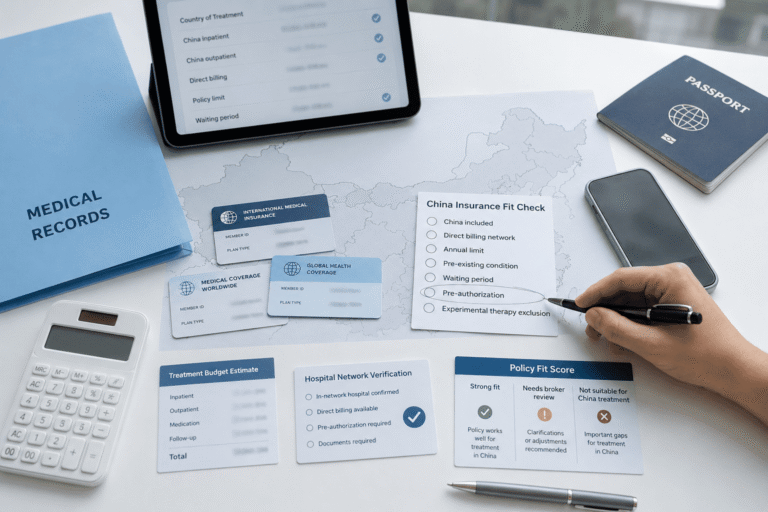
Practical Recommendations: Pre-Travel Insurance Preparation Checklist
✅ Review your policy:
- Carefully read policy wording
- Focus on Exclusions and Limits
- Confirm lifetime cap and amount already used
✅ Contact your insurance company:
- Inquire about China direct billing network
- Ask whether your planned specific treatment is covered
- Obtain pre-authorization workflow description
- Confirm your target hospital is in the direct billing network
✅ Upgrade your policy if needed:
- If your current policy’s lifetime cap is insufficient to cover treatment, consider upgrading or purchasing supplemental insurance
- Some policies allow mid-term upgrades
✅ Prepare contingency funds:
- Even with direct billing insurance, recommend preparing $10,000-$30,000 contingency funds for:
- Self-pay portion
- Costs beyond insurance coverage
- Emergency medical situations
✅ Use a professional coordination agency:
- International medical coordination agencies (such as MedCareInChina) can:
- Ask the target hospital whether it accepts your insurer or offers direct billing
- Provide hospital-side questions and official contact routes for you to verify
- Help organize or translate hospital-issued documents after you obtain them
- Translate medical records and invoices
Common Questions
My policy says “worldwide coverage” — does that mean it’ll definitely work in China? Not necessarily. “Worldwide coverage” typically means “usable globally,” but doesn’t equal “direct billing networks globally”. You may be able to do reimbursement (cash + claim) but not direct billing — a major difference.
Can I confirm whether a hospital can direct-bill before traveling? You should verify this with both sides. MedCareInChina can ask the target hospital whether it accepts your insurer or offers direct billing. You must confirm coverage, pre-authorization, reimbursement and policy terms directly with your insurer. We do not represent you in insurer communications.
If insurance covers only part of the cost, can I pay the rest in installments on-site? Major Chinese Tier-3A IMDs and private international hospitals typically don’t accept on-site installments — you need full payment or insurance direct billing. Recommend preserving credit card limits + international wire transfer preparation.
When will I receive my reimbursement? Typically 4–12 weeks after submission. Complex cases (such as oncology treatment) may take longer. Recommend keeping all original invoices with multiple scanned backups.
The insurance company denied my treatment as experimental — what do I do?
- Have your home country physician write a medical necessity letter
- Provide international guideline support (NCCN, ESMO, etc.)
- Use MDT or specialist opinions to support the case
- Appeal if necessary
- Prevention is better than remediation — clarify this during pre-authorization
My policy’s lifetime cap doesn’t cover the full oncology treatment — what do I do?
- Consider doing the most critical treatment first (such as surgery + first-line chemotherapy), and continue maintenance therapy back home
- Self-pay treatment costs at some Chinese hospitals are far lower than US — even reaching the lifetime cap, the remaining self-pay portion may be affordable
- Consider upgrading the policy or purchasing supplemental insurance (must be done before treatment)
Can travel insurance (such as World Nomads, Allianz Travel) be used? Typically not — travel insurance only covers emergency medical care (such as acute attacks, accidental injuries), not planned treatment. Planned treatment in China requires international health insurance or self-pay.
Bottom Line
Core points of international medical insurance and direct billing in China:
- Direct billing vs reimbursement: direct billing is ideal; reimbursement has cash flow pressure
- Major international insurers (Bupa, MSH, AXA, Cigna, etc.) have comprehensive direct billing networks at major Chinese Tier-3A IMDs
- Private international hospitals (Jiahui, ParkwayHealth, United Family) have broader direct billing networks than public IMDs (50-100 vs 15-30)
- Five major pitfalls: lifetime cap, pre-existing conditions, experimental treatment, maternity, other exclusions
- Must complete pre-authorization before traveling — to avoid discovering inability to direct-bill after arriving in China
Most practical pre-travel insurance checklist:
- Confirm policy lifetime cap balance
- Confirm whether your condition is considered pre-existing
- Confirm whether your planned treatment is considered experimental
- Confirm direct billing status of target hospital with insurance company
- Complete pre-authorization
If you are unsure how your insurance will work in China, MedCareInChina can ask the target hospital about insurer acceptance or direct billing and can help translate hospital-issued documents. You must review policy terms and handle coverage, pre-authorization, reimbursement and appeals directly with your insurer. We do not make insurance determinations.
Start with a free Pathway Scan. We will tell you whether China is worth further consideration and which type of next step may fit. The free scan does not include hospital or doctor recommendations, medical advice, individualized cost estimates, insurance determinations, or treatment planning.
See Service & Refund Policy and Medical Disclaimer for service boundaries.
Sources
- Major international insurance networks in China — Bupa Global 2025 expansion to 3,600 designated hospitals, 300 cities; MSH China 500+ hospitals in 20+ cities, global 60,000+; AXA through Prosper Health ~1,350 Tier-3A; Cigna global 1.65M; Allianz 280+ hospitals. Sources: Cigna Global China https://www.cignaglobal.com/where-we-cover/china ; Bupa 2025 news https://www.bupa.com.hk/en/media-centre/20251210_r/ ; Allianz https://www.china-health-insurance.com/insurers/allianz/direct-settlement/ ; AXA-Prosper Health https://www.prnewswire.com/apac/news-releases/axa-partners-with-prosper-health-to-expand-healthcare-and-wellness-ecosystem-in-china-302133896.html ; MSH https://www.mshasia.com/ ; GeoBlue Direct Pay https://www.geo-blue.com/directpay/
- Public IMD direct billing lists — PUMCH IMS Cooperative Insurance Roster https://www.pumch.cn/department_ims/detail/24147.html ; Ruijin 20+ insurers https://www.rjh.com.cn/2018RJPortal/txylbjzx/sy/index.shtml ; Huashan 30+ contracts actual ~100 https://m.thepaper.cn/newsDetail_forward_28939950 ; Sun Yat-sen 1st Nansha 15 insurers https://nansha.fahsysu.org.cn/node/28960
- Private international hospital direct billing lists — Jiahui ~60 https://baike.baidu.com/item/上海嘉会国际医院 ; United Family 22 https://beijing.ufh.com.cn/patient-visitor-info/insurance-direct-billing?lang=en ; ParkwayHealth 50+ https://www.parkwaychina.com/en/cost-management
- Direct billing workflow — Pre-authorization → GOP → in-treatment direct billing → discharge self-pay settlement. 24-48 hour pre-auth typical. Sources: MedBridgeNZ China Direct Billing Guide https://www.medbridgenz.com/post/china-hospital-direct-billing-guide ; Policy Pulse International Claims Checklist https://licpolicytalks.com/en/international-insurance-health/international-medical-insurance-claims-your-complete-fast-track-checklist-direct-billing-pre-auth-more/
- Reimbursement workflow and translation requirements — Typical 90-day submission deadline; requires ICD-10, hospital license number, prescription number, itemized cost structure. Sources: International Insurance Claim Guide https://www.internationalinsurance.com/articles/file-health-insurance-claim/ ; ChatsControl Translation Requirements https://chatscontrol.com/blog/international-health-insurance-translation-policies-claims
- Lifetime Cap on International Insurance — Different from ACA-protected US domestic policies. Source: American Cancer Society https://www.fightcancer.org/policy-resources/bans-lifetime-and-annual-cost-caps-protect-cancer-patients
- Pre-existing Conditions Exclusion — International insurance generally requires underwriting; often 2-year observation. Source: International Insurance https://www.internationalinsurance.com/articles/pre-existing-conditions/
- Experimental Treatment Exclusion — “Untried or experimental treatment” is a standard exclusion clause. Source: Pacific Prime Common Exclusions https://www.pacificprime.com/blog/common-health-insurance-exclusions.html
- Maternity Waiting Period — Typically 10-12 months, some 24 months. Source: Pacific Prime Maternity Waiting https://www.pacificprime.com/blog/maternity-insurance-what-are-waiting-periods.html
- Private International Hospital Direct Billing Summary — ParkwayHealth Billing & Insurance https://www.parkwaychina.com/en/cost-management ; China News Agency Shanghai Jiahui https://www.sh.chinanews.com.cn/yljk/2024-10-24/129628.shtml