13 minutes read
“International medicine” in China actually runs along two parallel paths: the International Medical Department (IMD) inside a public hospital, and the private international hospital built from the ground up around international patients. Both can offer English service and insurance direct billing — but their operating logic, physician pool, pricing, and surgical capability differ in important ways. This article walks through both paths, plus a special case worth its own section — proton and heavy-ion therapy — so you can choose the right entry point for your situation.
Path One: International Medical Departments (IMDs) Inside Public Hospitals
An IMD is not a feature found at every Tier-3A hospital. It is a designation formally granted by the provincial health commission — recognition extended to a limited number of hospitals in each province.
The “10% ceiling” policy: under National Health Commission regulations, the combined volume of a public hospital’s “special needs medical services” (which includes IMD services) — measured by service items, outpatient volume, and inpatient beds — cannot exceed 10% of the hospital’s total [1]. Scarcity is built into the system by design.
But between 2024 and 2026, these rules are being relaxed. The most significant development is a wave of provincial-level “international medical service pilot” programs. Hospitals formally admitted to these pilots receive specific privileges: dedicated physical zones, autonomous pricing rights, dedicated international insurance direct-billing channels, and more.
China’s International Medical Service Pilot Landscape (as of May 2026)
| Province / City | Number of Pilot Hospitals | Date |
|---|---|---|
| Guangdong (17 in Guangzhou, 4 in Shenzhen, 2 in Zhuhai, 1 in Foshan, 1 in Shantou) | 25 | March 2026 |
| Shanghai (High-Level Public Hospital International Medical Tourism Pilot) | 13 | 2023 |
| Shenzhen (separate municipal program) | 10 | 2024 |
| Beijing (Internationalized Hospital Pilot) | 7 | August 2019 |
In March 2026, Guangdong announced 25 pilot hospitals in one batch — the largest and most comprehensive provincial-level IMD framework in China to date.
Guangdong’s First Batch of 25 Pilot Hospitals (announced March 2026) [2]:
Guangzhou (17 hospitals): Guangdong Provincial People’s Hospital, Guangdong Women and Children Hospital, Sun Yat-sen University First Affiliated Hospital (Yuexiu + Nansha campuses), Sun Yat-sen Memorial Hospital (SYSU 2nd), SYSU Third Affiliated Hospital, Zhongshan Ophthalmic Center, Sun Yat-sen University Cancer Center, SYSU Affiliated Stomatological Hospital, SYSU Sixth Affiliated Hospital, Southern Medical University Nanfang Hospital, Southern Medical University Zhujiang Hospital, Jinan University First Affiliated Hospital, Guangdong Provincial Hospital of Chinese Medicine, Guangzhou Medical University First Affiliated Hospital, Guangzhou First People’s Hospital, Guangzhou Medical University Affiliated Women and Children Medical Center, Guangdong Qifu Hospital.
Shenzhen (4 hospitals): Shenzhen People’s Hospital, Peking University Shenzhen Hospital, The University of Hong Kong-Shenzhen Hospital, Southern Medical University Shenzhen Hospital.
Zhuhai (2 hospitals): SYSU Fifth Affiliated Hospital (Zhuhai), Zhuhai People’s Hospital.
Foshan (1): Foshan Fosun Chancheng Hospital. Shantou (1): Shantou University Medical College First Affiliated Hospital.
Special privileges granted to Guangdong pilot hospitals [2][3]:
- Standalone International Medical Demonstration Zone, built using newly added beds and physically separated from the hospital’s basic medical services
- Autonomous pricing authority — not bound by the 10% ceiling
- Dedicated green channel for international commercial insurance direct billing
- Integration with the HK-Macao Drug and Device Connect policy, accelerating access to imported medications and devices
- Authority to develop cross-border online medical consultation services
IMD vs. Standard Outpatient: What You’re Actually Paying For
The most visible difference is registration fees. Using Peking Union Medical College Hospital (PUMC) as an example [4]:
| Item | Standard Outpatient | International Medical Department |
|---|---|---|
| Attending physician registration | ~$4 | — |
| Associate Chief Physician registration | ~$8 | $85–$125 |
| Chief Physician / Renowned Specialist registration | ~$14 | $125–$170 |
Registration fees run roughly 10–12× higher. Surgical fees, inpatient fees, and diagnostic fees typically run 3–5× higher [5]. IMD services default to not being covered by China’s social insurance — they’re paid out of pocket or through commercial insurance.
But that multiple is not primarily buying you “better doctors.” It’s buying process convenience, English-language communication, scheduling certainty, and dedicated service space. This is the most common misconception international patients have.
What IMDs typically provide:
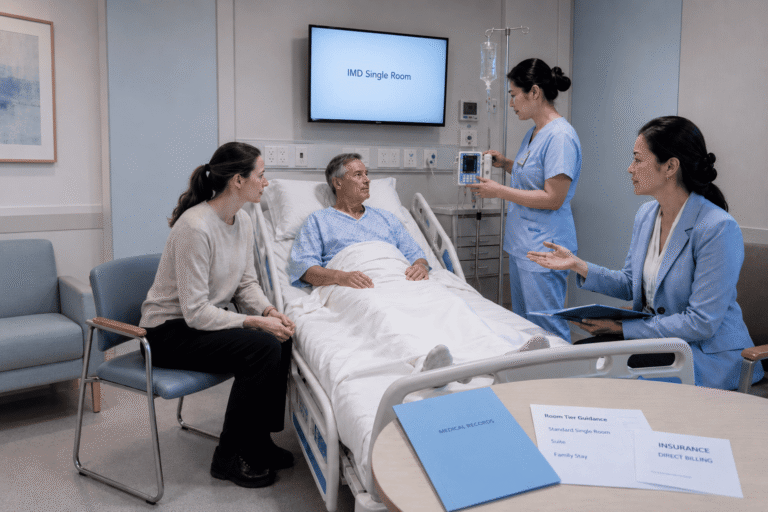
- Independent treatment space — a separate floor or dedicated building, with much lower outpatient foot traffic
- Lockable scheduling — specialist appointments can be confirmed 1–2 weeks in advance
- English-language clinical service — English-speaking physicians + in-house medical interpreters + bilingual reports
- Dedicated outpatient diagnostic channels — ultrasound, ECG, blood draws typically run on an IMD priority track
- International insurance direct billing (see below)
What IMDs typically don’t provide:
- Different doctors — IMD physicians are the same staff who see standard outpatients, with the difference that IMD physicians are restricted to Associate Chief Physician level or above
- Independent capability for complex surgery — major procedures (cardiac surgery, neurosurgery, organ transplants, etc.) are typically performed in the main department’s operating room by the main department’s specialists
- Independent imaging, pathology, or interventional radiology — these still share the hospital-wide platform
Path Two: Private International Hospitals
Where a public IMD is a department inside a public hospital, a private international hospital is a standalone legal entity designed from the start around international and high-end patients. Both fall under “international medicine,” but their operating logic, physician pool, pricing, and surgical capabilities differ meaningfully.
Major private international hospitals (as of May 2026):
| Hospital | City | Opened | Beds | Group |
|---|---|---|---|---|
| Jiahui International Hospital [6] | Shanghai | 2017 | 500 | Jiahui Health, partnered with Harvard Mass General |
| Beijing United Family Hospital [7] | Beijing | 1997 | flagship | United Family Healthcare |
| Shanghai United Family Hospital | Shanghai | 2004 | ~200+ | UFH |
| Guangzhou United Family Hospital | Guangzhou | 2017 | ~70–100 | UFH |
| Shenzhen New Frontier United Family | Shenzhen | 2022 | 350 | UFH |
| ParkwayHealth Hongqiao [8] | Shanghai | Opened 2024 | 450 | IHH Group (80+ hospitals across Asia) |
| Heyou Pinnacle Medical Center (IMC) [9] | Foshan, Guangdong | June 2024 | 1,500 (group total) | Founded by Midea Group founder He Xiangjian, China-HK joint venture |
Core characteristics of private international hospitals:
- Physicians: full-time staff + select international/returnee physicians + visiting specialists from public hospitals (multi-site practice)
- Insurance direct billing: typically 30–80+ international insurers (substantially broader than the 15–30 typical at public IMDs)
- Service experience: hotel-style, fully English by default, fully English documentation, flexible scheduling
- Complex surgery capability: comprehensive hospital level, with the most complex procedures (cardiac, neurosurgery, organ transplant, complex oncologic surgery) generally referred out to public Tier-3A institutions
- Pricing: generally higher than public IMDs (consultation $140–$350), but insurance direct billing substantially reduces the cash burden
Three-Way Comparison: Standard Outpatient vs. Public IMD vs. Private International Hospital
| Dimension | Standard Outpatient | Public IMD | Private International Hospital |
|---|---|---|---|
| Consultation fee | $4–$14 | $85–$170 | $140–$350 |
| English communication | very limited | bilingual Chinese/English | English by default |
| Physician pool | hospital’s general staff | same as standard outpatient (Associate Chief or above) | full-time staff + consultants + multi-site practice specialists |
| Complex surgery capability | full | transferred to main department | mid-level (most complex cases referred to public hospitals) |
| Insurance direct billing | typically none | 15–30 insurers | 30–80+ insurers |
| Process convenience | same as local patients | dedicated channels, scheduled | full appointment system, hotel-style service |
| Pricing | lowest | mid-range | highest (but direct billing reduces cash burden) |
| Best fit | self-pay budget, comfortable without English | complex cases needing English | mid-complexity + service experience priority |
Profiles of Leading Public IMDs
Peking Union Medical College Hospital IMS [10]
- Dedicated wards: 200+ single rooms and suites
- Insurance direct billing: ~30 domestic and international insurers
- Service coverage: 30+ clinical specialties
Shanghai Ruijin Hospital IMD [11]
- Established 1998 — one of China’s earliest public IMDs
- Cumulative international patient volume: over 80,000
- Insurance direct billing: 20+ insurers
Fudan Huashan Hospital International Medical Center [12]
- Dedicated floor
- Designated medical institution for 10 consulates in Shanghai
Sun Yat-sen University First Affiliated Hospital IMC [13]
- Dedicated 24th floor of the Comprehensive Medical Building + Nansha campus International Medical Service Pilot Zone
- Insurance direct billing: 15 commercial insurers
- From 2024 trial operation through May 2025: served 7,500+ patients from 40+ countries/regions, with ~15% from the United States
- Selected in Guangdong’s First Batch of 25 International Medical Service Pilot Hospitals (2026) [2]
Beijing aggregate data: According to the Beijing Municipal Health Commission, during the 13th Five-Year Plan (2016–2020), Beijing received approximately 127,000 international patient visits cumulatively [14].
Profiles of Leading Private International Hospitals
Shanghai Jiahui International Hospital [6]
- 500-bed comprehensive hospital, opened 2017
- The Jiahui International Cancer Center, in partnership with Harvard’s Massachusetts General Hospital — covers breast, gastrointestinal, lung, and hematologic cancers; full chemotherapy, targeted, and immunotherapy capabilities
- Insurance direct billing: 30+ domestic and international commercial insurers, plus HSBC Hong Kong direct billing
- The only international hospital in Shanghai included in social insurance settlement — oncology patients can receive up to 70% reimbursement
Beijing United Family Hospital (BUFH) [7]
- Opened 1997 — China’s first international comprehensive hospital
- JCI accredited continuously since 2005 — one of China’s earliest JCI-accredited hospitals
- Network annual outpatient volume: 1 million+; cumulative international patients close to 100,000
- New Hope Oncology Center: chemotherapy, targeted therapy, immunotherapy
- Direct billing with most major international insurers
ParkwayHealth Hongqiao Shanghai [8]
- Opened 2024, 450 beds
- IHH Group (Asia’s largest private hospital network, 80+ hospitals including Gleneagles in Malaysia and Mount Elizabeth in Singapore)
- Comprehensive hospital with an established oncology department
- Insurance direct billing: Bupa, MSH, AXA, CMB Cigna, and other major high-end commercial insurers
Heyou Pinnacle Medical Center IMC (Foshan, Shunde) [9]
- Opened June 2024, founded by Midea Group founder He Xiangjian
- Group total construction area 580,000 sqm, planned 1,500 beds
- Group structure: Heyou Hospital (non-profit Tier-3 comprehensive) + Heyou Pinnacle IMC (China-HK joint venture, positioned as high-end international medicine)
- Commercial insurance direct billing
- Affiliated proton and heavy-ion center currently in commissioning (see below)
A critical note on cross-system flow: the recognized direction is one-way. Public hospital diagnoses, imaging reports, and prescriptions are accepted by private international hospitals — but the reverse is not true. A private hospital’s workup is generally not accepted by a public Tier-3A as a basis for admission or surgery. If your case is complex enough to require a public Tier-3A, start there from the beginning (with an accompaniment service for language support if needed). After the procedure is complete and stable, follow-up, medication management, and monitoring can move to a private international hospital, which will accept and continue the public hospital’s care plan. Do not start at a private hospital and plan to “transfer for the surgery” — you will pay for the workup twice.
A Special Case: Proton and Heavy-Ion Therapy
If your oncology condition is suited to proton or heavy-ion therapy, the Shanghai Proton and Heavy Ion Center (SPHIC) is currently the only mature option for international patients in China — one of the few situations where this article actually recommends a single institution by name. Other proton centers in China are either still under construction or lack mature international patient infrastructure.
Shanghai Proton and Heavy Ion Center (SPHIC) [15]
- Public, jointly developed by Shanghai Shenkang Hospital Development Center and affiliated with Fudan University
- Opened May 2015
- Equipped with both proton and heavy-ion (carbon ion) capabilities — China’s first and at the time only such center
- The world’s first proton/heavy-ion center to exceed 1,000 patients treated per year
- 220 beds, can treat nearly 50 disease categories
- Operates an International Patient Center providing bilingual service and second-opinion consultations
- Has treated 70+ patients from the United States, United Kingdom, and other countries
- Pricing: standard treatment course approximately $38,600 USD; full-package pricing including inpatient stay, diagnostics, and nursing approximately $43,000 USD; complete international patient pricing range approximately $38,000–$55,000 USD
- For comparison: proton therapy in the United States typically costs $100,000–$200,000 USD
Heyou Proton and Heavy-Ion Center (Foshan, Shunde) [9]
- Private, part of the Heyou Pinnacle Medical Center group
- Investment exceeding $278M USD
- Equipped with proton rotating gantry + heavy-ion multi-angle treatment — described by the institution as the most comprehensive configuration globally
- As of May 2026, still in equipment commissioning and clinical validation phase — not yet receiving patients
- Expected to begin treating patients after clinical validation completes in 2026
Honest assessment: The Heyou proton center is the most significant private-sector proton/heavy-ion project in southern China, and once operational it is expected to become a key option for international patients in the region. But until Heyou is officially open, international patients requiring proton or heavy-ion therapy should choose SPHIC — this is the responsible recommendation.
Other proton or heavy-ion centers in China include the Wanjie Hospital in Zibo, the Yizhou Hospital in Zhuozhou, the Wuwei Heavy Ion Hospital in Gansu, and the Hefei Ion Medical Center. As of May 2026, none have mature international patient service infrastructure, so they are not currently recommended for international patients.
Insurance Direct Billing: The Practical Reality
Insurers commonly used by international patients with direct-billing relationships at top Chinese IMDs:
- Cigna, Allianz Worldwide Care, AXA, MSH China, AIA
- Some Chinese domestic high-end insurance (Pacific Insurance, Ping An, Taikang high-end medical plans)
Insurers that reimburse but typically don’t direct-bill:
- Bupa Global — direct-billing available at private hospitals; reimbursement at most public IMDs
- GeoBlue (international arm of US Blue Cross) — primarily reimbursement
Direct-billing network comparison:
- Public IMDs: typically 15–30 insurers
- Private international hospitals (UFH, Jiahui, ParkwayHealth): typically 30–80+ insurers
- Private hospital settlement workflows are more standardized and documentation is fully in English; public IMD documentation is mostly in Chinese with English summaries, and administrative workflows take longer
Impact of the 2026–2027 Guangdong pilot: the 25 pilot hospitals have been formally granted the authority to develop “dedicated green channels for international commercial insurance direct billing” [2]. During the pilot period, direct-billing capability at Guangzhou’s 17 admitted hospitals is expected to improve substantially.
Visa, Accommodation, and Translation Support
Medical visa Letters of Acceptance (LOAs): PUMC, Ruijin, Huashan, Sun Yat-sen 1st Affiliated, and Fuwai IMDs can all issue medical visa invitation letters. Private international hospitals (UFH, Jiahui, etc.) can issue them as well.
Accommodation and airport pickup:
- Ruijin IMD explicitly provides “visa, accommodation, and translation” support packages
- Sun Yat-sen 1st Affiliated Nansha campus offers affiliated hotels and airport pickup
- Other major public IMDs typically rely on third-party coordination services
Translation:
- Major public IMDs maintain in-house English, Japanese, French, and German interpreters
- Private international hospitals operate bilingually by default
- For complex medical record translation, professional medical translation companies typically deliver higher quality than in-house translators
When to Choose Which?
Consider a public IMD when:
- You need a top public hospital’s department chief as your surgeon (public hospitals’ complex surgical capability is deeper)
- Your condition can be handled fully within the hospital’s IMD
- You’re comfortable with the public hospital’s overall rhythm and want pricing below the private option
Consider a private international hospital when:
- Your condition is not the most complex (general internal medicine, common surgery, obstetrics, pediatrics, oncology diagnosis, etc.)
- Your international insurance has a direct-billing arrangement with that hospital
- You want full English service, hotel-style experience, fully internationalized documentation
- Service experience is a high priority and budget allows
Consider SPHIC when:
- Your cancer is well-suited to proton or heavy-ion therapy (pediatric cancers, skull base tumors, brain tumors, uveal melanoma, liver cancer, prostate cancer, pancreatic cancer, and other cases where sparing normal tissue is critical)
The choice: enter through the right door, because the bridge between public and private is one-way.
Public hospital diagnoses, exam reports, and prescriptions are recognized by private international hospitals — so a Public → Private handoff for follow-up is a valid and useful pattern. The reverse is not true: public Tier-3A hospitals do not accept a private hospital’s consultation, imaging, or treatment plan as a basis for admission. They require their own physicians to re-evaluate the case from scratch, frequently including repeat imaging and pathology re-review. You do not save money by starting private and trying to transfer to public for the surgery; you pay for the workup twice.
The three realistic patient pathways:
- Standard outpatient (Public): lowest cost, limited English support. Suitable when you have a Mandarin-speaking helper and your case is routine or you can navigate Chinese hospital workflows directly.
- Public IMD (International Medical Department): same physician pool as Standard outpatient (Associate Chief Physician or above), bilingual support, dedicated channels, faster scheduling. The right choice when your case is genuinely complex and you want top specialty depth with English support. After surgery you can move follow-up to a private international hospital, which will accept and continue the public hospital’s plan.
- Private international hospital end-to-end: full English service, insurance direct billing, hotel-style experience. The right choice for routine, outpatient, diagnostics, IVF, dermatology, ophthalmology, and other cases where service experience and insurance convenience matter most and the case does not require specialty-defining public-hospital depth. Most complex specialty surgeries — oncology, neurosurgery, complex cardiac, transplant — are NOT performed at private international hospitals; those patients should start at a Public IMD, not at private.
The decision logic: match the entry door to your case complexity. Simple stays in private. Complex starts in public; once stable, follow-up can move to private. The system does not let you do it the other way around.
Common Questions
Are private international hospital physicians the best in China? Typically no — the most senior specialists are concentrated in public Tier-3A hospitals. But private international hospital physicians are typically carefully selected Associate Chief Physician level or above (many coming from Tier-3A institutions), and they can dedicate more time and attention specifically to you — a different dimension of clinical experience.
Can I use Chinese social health insurance at an IMD? Generally no. Shanghai Jiahui International Hospital is the exception — the only international hospital in Shanghai included in social insurance settlement, with oncology patients eligible for up to 70% coverage [6].
Can surgery be performed inside an IMD? Routine procedures can be. Major complex surgeries are typically referred to the hospital’s main department operating room.
When will the Heyou proton center be available? Expected to begin treating patients after clinical validation completes in 2026. Until then, patients requiring proton or heavy-ion therapy should choose SPHIC.
Can I move between public and private hospitals mid-treatment? Yes, and this is the most common approach for international patients.
Bottom Line
International medical care in China runs along two parallel paths plus one special case:
- Public IMDs: deepest clinical capability, lower relative pricing, full complex-surgery capacity; provincial pilot recognition (Guangdong 25, Shanghai 13, Beijing 7, Shenzhen 10)
- Private international hospitals: best service experience, widest insurance direct-billing networks (30–80+ insurers), full capability for cases up to mid-high complexity
- Proton and heavy-ion therapy: SPHIC in Shanghai is currently the only mature option for international patients (~$38,000–$55,000 USD), with Heyou in Foshan scheduled to open after clinical validation in 2026
The most practical combination for international patients: private hospital for diagnosis and coordination, public hospital or specialized center for the most critical treatment, private hospital for follow-up.
Free Pathway Scan boundary: We reply with one routing decision — whether it appears worth continuing and which type of next service step fits. It does not include a hospital or doctor list, record checklist, insurance determination, individualized cost estimate, case summary, diagnosis, or treatment recommendation. Share only basic non-sensitive details at this stage; do not send full medical files.
Start with a free Pathway Scan. We will tell you whether China is worth further consideration and which type of next step may fit. The free scan does not include hospital or doctor recommendations, medical advice, individualized cost estimates, insurance determinations, or treatment planning.
See Service & Refund Policy and Medical Disclaimer for service boundaries.
Sources
- Special Needs Medical Services Regulation + 10% Ceiling Policy — National Health Commission notices on pricing management of special needs medical services in public medical institutions. http://www.nhc.gov.cn/
- Guangdong First Batch of 25 International Medical Service Pilot Hospitals — Jointly announced by the Guangdong Provincial Health Commission, the Guangdong Healthcare Security Administration, and the Guangdong Medical Products Administration on March 26, 2026. Pilot period 2026–2027. https://www.gdghospital.org.cn/NewsHospital/info_itemid_67669.html ; https://m.21jingji.com/article/20260327/herald/065d793161961e7d356e9def49ce156d_zaker.html
- Special Privileges of Guangdong Pilot Hospitals — https://www.xkb.com.cn/articleDetail/481915 ; Yangcheng Evening News Health: https://health.ycwb.com/2026-03/26/content_54031195.htm
- PUMC Price Disclosure — Peking Union Medical College Hospital official price disclosure page. https://www.pumch.cn/price_publicity.html
- Typical IMD Surgical and Inpatient Pricing Multiples — Compiled from 39 Health Network and multiple media investigations. https://m.39.net/news/mip_f1wfz2k.html
- Shanghai Jiahui International Hospital — 500-bed comprehensive hospital opened 2017; Jiahui International Cancer Center in partnership with Harvard Mass General Hospital. The only international hospital in Shanghai included in social insurance settlement, with up to 70% coverage for oncology patients. https://www.jiahui.com/ ; https://www.massgeneral.org/cn/jiahui-cn
- Beijing United Family Hospital (BUFH) — Opened 1997; JCI accredited continuously since 2005; network annual outpatient volume 1 million+, cumulative international patients ~100,000. https://beijing.ufh.com.cn/
- ParkwayHealth Hongqiao Shanghai — Opened 2024, 450 beds, part of IHH Group. https://www.parkwaychina.com/
- Heyou Pinnacle Medical Center IMC (Foshan, Shunde) — Opened June 2024; group total construction area 580,000 sqm, planned 1,500 beds; affiliated proton and heavy-ion center investment exceeding $278M USD with proton rotating gantry + heavy-ion multi-angle treatment configuration, still in commissioning and clinical validation as of 2026. https://www.hyhospital.com/ ; https://imc.hyhospital.com/ . MedCareInChina has a written cooperation agreement with Heyou Pinnacle as of 2026.
- PUMC International Medical Services (IMS) — 200+ single rooms and suites; direct billing with ~30 insurers; 30+ specialties. https://ims.pumch.cn/about.html
- Shanghai Ruijin Hospital IMD — Established 1998; cumulative international patients over 80,000; direct billing with 20+ insurers. https://www.rjh.com.cn/
- Fudan Huashan Hospital International Medical Center — Dedicated floor; designated medical institution for 10 consulates in Shanghai. https://m.thepaper.cn/newsDetail_forward_28939950
- Sun Yat-sen University First Affiliated Hospital IMC — Dedicated 24th floor of the Comprehensive Medical Building + Nansha campus International Medical Service Pilot Zone. From 2024 trial operation through May 2025: 7,500+ patients from 40+ countries/regions, ~15% from the US. Direct billing with 15 commercial insurers. Admitted to Guangdong’s First Batch of 25 International Medical Service Pilots (2026). https://nansha.fahsysu.org.cn/basic/28976
- Beijing 13th Five-Year Plan International Patient Data — Beijing Municipal Health Commission press briefing, 2016–2020 cumulative international patient visits ~127,000. https://wb.beijing.gov.cn/home/ztzl/bjssswgjjwzx/xlbd/202109/t20210917_2496106.html
- Shanghai Proton and Heavy Ion Center (SPHIC) — Public hospital opened 2015; world’s first proton/heavy-ion center to exceed 1,000 patients treated per year; both proton and heavy-ion (carbon ion) capability. https://www.sphic.org.cn/ ; Shanghai Municipal Government English profile: https://english.shanghai.gov.cn/en-Hospitals/20241012/5bcd1afd5752428da050337895efafeb.html
- Provincial International Medical Service Pilot Comparison — Shanghai 2023 (13 high-level public hospital pilots); Beijing August 2019 (7 internationalized hospital pilots); Shenzhen 2024 (first batch of 10 international medical tourism pilots). https://www.kanyijie.com/details?id=2193
- National Medical Sector Opening Pilot 2024 — Ministry of Commerce, NHC, and NMPA joint notice “On Launching Pilot Work to Expand Opening in the Medical Sector,” September 2024. https://www.gov.cn/zhengce/zhengceku/202409/content_6973072.htm