8 minutes read
When international patients prepare for medical care in China, one of the earliest questions is: “I already have a CT / MRI / PET-CT done — will Chinese hospitals accept it, or do I need to redo everything?” The answer directly affects your budget, travel timeline, and treatment schedule. If foreign imaging is accepted, you save meaningful time and cost; if it isn’t accepted, repeat imaging adds days and adds to the bill. This article walks through which imaging is accepted, which isn’t, the differences across modalities, and how to maximize the usability of foreign imaging.
The Short Answer: Yes in Most Cases, With Three Conditions
Condition 1 · Must be DICOM originals, not just PDF reports
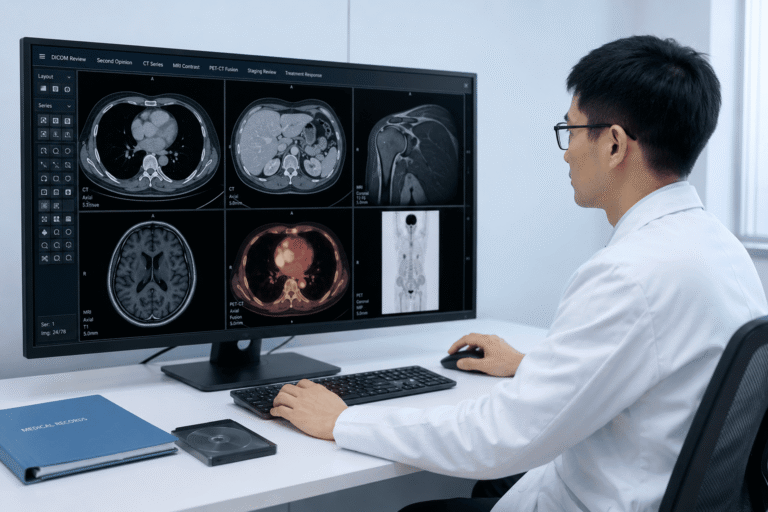
Chinese Tier-3A hospital PACS systems support the DICOM 3.0 international standard — the universal format for medical imaging worldwide [1]. After your CT / MRI / PET-CT is done overseas, you should be able to obtain it as a DICOM-format disc or USB — this is the prerequisite for use at Chinese hospitals.
Condition 2 · Timing must meet Chinese physicians’ clinical requirements
Different disease types have meaningfully different timing requirements (detailed below). An oncology scan from 6 months ago may require redoing; a stable orthopedic scan from 6 months ago typically can still be used.
Condition 3 · The Chinese hospital will re-read the imaging
Even when your foreign imaging is accepted, the Chinese hospital’s radiology department will almost always issue its own re-read report — your home country’s report serves as reference, not as the final diagnostic basis. This is standard Chinese hospital workflow, not distrust of your home physician.
How DICOM Compatibility Actually Works in Practice
In theory: Chinese Tier-3A hospitals’ PACS systems (GE, Philips, Siemens, Neusoft, United Imaging, DongHua, etc.) all follow the DICOM 3.0 international standard [2], so they can theoretically read DICOM imaging from any standard PACS system worldwide.
Small issues that may arise in practice:
- Some US / European hospitals embed vendor proprietary tags (private tags) in DICOM files, which may cause Chinese PACS to fail to display thumbnails, though the raw data remains readable
- Some hospitals use JPEG 2000 Lossless compression, which some Chinese in-hospital viewers need additional handling for
- Sequence naming differences: MRI sequence names vary across vendors (T2 FLAIR, DWI b-values, contrast phase) — accompanying English reports help
Practical recommendations:
- Request DICOM discs after completing imaging abroad (not just PDF reports)
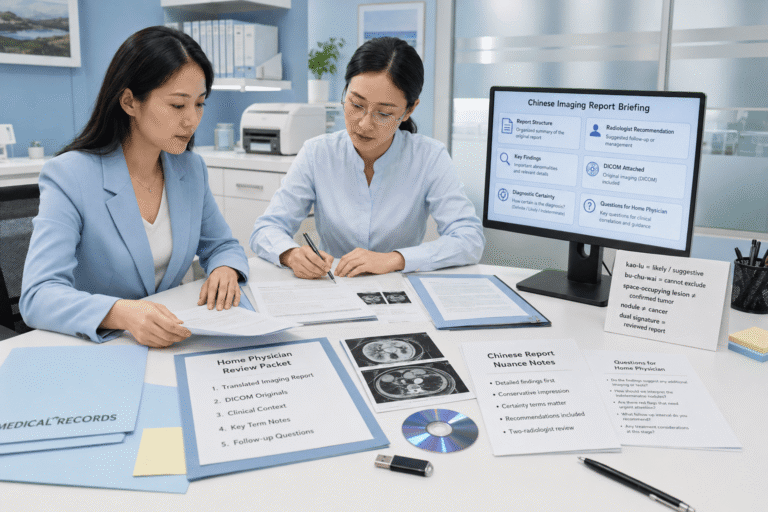
- Bring the original English report as well — provides sequence context
- Before traveling, verify the files open correctly on your own computer using a DICOM viewer (free options include RadiAnt, Horos, MicroDicom) — if your computer can’t open them, Chinese PACS likely can’t either
Acceptance by Modality
| Modality | Acceptance | Primary Reason | Practical Recommendation |
|---|---|---|---|
| CT | High | Standard DICOM, simple sequence structure, best cross-vendor compatibility | Bring disc / USB; typically used without issue |
| X-ray (DR/CR) | High | Single-frame DICOM, virtually no compatibility issues | Use directly |
| MRI | Medium–High | DICOM readable, but sequence naming varies; T1/T2 and contrast phase need annotation | Bring DICOM + English report (with sequence descriptions) |
| PET-CT / PET-MR | Medium | DICOM readable, but SUV quantitative calculation depends on metadata (injection dose, time, patient weight) | Bring complete metadata; if missing, the Chinese physician may require redoing |
| Angiography (DSA, GI contrast) | Medium | Multi-frame DICOM readable, but real-time operation has diagnostic value that’s hard to replace | Reference value; complex surgical pre-planning may require redoing |
| Ultrasound | Low | Real-time operator-dependent; foreign static reports limited diagnostic value | Typically redone — ultrasound needs to be performed at the treating hospital |
Imaging Validity: Timing Requirements by Disease Type
China’s National Health Commission has not issued a national-level “foreign imaging validity” guideline — the following reflects clinical practice consensus at major Chinese Tier-3A hospitals [3][4]:
| Condition Type | Validity Window | Recommendation if Exceeded |
|---|---|---|
| Active oncology / on treatment | Within 4–6 weeks | Re-do required to assess current status |
| Stable oncology / surveillance | Within 3–6 months | Usable, but may add a baseline image |
| Complex cardiovascular / neurological emergency | Within days to 2 weeks | Must be re-done |
| Stable fracture / degenerative orthopedic conditions | Within 3–6 months | Usable |
| Chronic disease / endocrine workup | Within 3–6 months | Typically usable |
| Complex pre-surgical evaluation | Within 2–4 weeks | Often requires re-do |
| PET-CT (treatment response assessment) | Within 6 weeks | Beyond this, typically requires re-do |
Practical principles:
- The newer the imaging, the more likely it’ll be accepted
- The more active the disease, the shorter the validity window
- If unsure whether re-do is needed, send DICOM files to the Chinese IMD in advance for pre-review — this avoids discovering on-site that re-do is needed
Standard Workflow at Chinese Hospitals
The typical workflow when foreign imaging arrives at a Chinese IMD:
Step 1 (same day) · Imaging import You bring the DICOM disc / USB to the IMD; reception imports the imaging into the in-house PACS system.
Step 2 (1–3 business days) · Chinese hospital radiology re-reads The hospital’s radiology team independently reviews the DICOM imaging and issues an in-house imaging report. This isn’t distrust of your home report — it’s because:
- Different physicians can interpret the same imaging differently (normal medical practice)
- The Chinese physician needs to assess from the Chinese clinical standards perspective
- Subsequent treatment decisions must rest on the in-house report
Step 3 · Comparison between foreign and in-house reports If the in-house report differs from your home report, the IMD typically coordinates radiology with the clinical specialist team to discuss and determine the final diagnostic direction. This “two-report comparison” is itself added value international patients receive — essentially a free “imaging second opinion.”
Step 4 · Report delivery Reports are typically delivered in bilingual Chinese and English through the IMD channel. Standard outpatient channels typically deliver Chinese only, with English versions requiring a specific request.
Cost Considerations
Public hospital radiology re-read fee is typically bundled into the specialist consultation fee — usually a modest amount on the order of a regular IMD appointment.
If imaging needs to be re-done:
- CT, MRI, and X-ray at public hospitals: modest cost
- PET-CT at public hospitals: substantially higher (in the range of $1,100–$1,500 USD)
- Private international hospitals: typically 2–4× public hospital pricing across the board
Seven Situations Where Re-Do Is Required
Even with complete foreign DICOM imaging, the following seven situations almost always trigger a re-do:
- Imaging exceeds clinical validity window (see table above)
- Imaging quality is insufficient (low-field MRI under 1.5T, CT slice thickness above 5mm)
- Critical sequences are missing (DWI missing for oncology, LGE missing for cardiac MRI, etc.)
- Precise pre-surgical localization is needed (complex neurosurgery, complex cardiac surgery)
- Clinical condition has changed significantly (symptoms worsening, new symptoms)
- Ultrasound is almost always re-done (a property of real-time operation)
- Infection-related imaging — Chinese infection management regulations require in-house results
How to Maximize the Usability of Foreign Imaging
Before traveling (4–6 weeks ahead):
- Request DICOM discs / USB for all relevant imaging (not just PDF)
- Also request a complete English report for each
- Verify files open correctly on your own computer using a DICOM viewer
- Send DICOM files (or sample thumbnails) to the Chinese IMD in advance for pre-review — confirm usability or identify needed re-dos
Upon arrival:
- Keep disc / USB in carry-on luggage (don’t check it — it can’t be replaced if lost)
- Prepare a cloud backup as redundancy (Google Drive, iCloud, Dropbox)
During consultation:
- Proactively share your home-country diagnosis — so the physician doesn’t start from zero
- Ask the IMD to issue the in-house report with the original foreign report attached as reference — helps the physician understand the case faster
Common Questions
Can I just bring PDF reports without DICOM? Not recommended. A PDF report has significantly less diagnostic value than DICOM originals — Chinese physicians need to read the imaging independently to reach conclusions. Bringing only PDFs almost always results in a re-do.
My imaging is from 6 months ago — is it usable? Depends on disease type — stable cases (orthopedic, degenerative conditions, chronic disease) may be usable; active oncology and complex pre-surgical evaluation almost always require a re-do.
How long does the in-house re-read take? Typically 1–3 business days. Urgent cases can be expedited to within 24 hours.
What if the in-house and foreign reports differ significantly? The IMD will coordinate multi-party discussion (radiology + clinical specialists) to determine the final diagnostic direction. The difference between two reports is itself valuable information — it helps avoid blind spots in a single report.
Can I upload DICOM discs to the cloud for Chinese physicians to view abroad? Theoretically yes, but some Chinese hospital computers may have firewall restrictions limiting access to overseas cloud platforms. Bringing physical media (disc / USB) as primary method is strongly recommended.
MRI sequence names aren’t familiar to me — what do I do? Bring the original English report — it typically explains the purpose of each sequence (e.g., “T2 FLAIR for lesion detection”). The Chinese radiologist can correctly identify sequences from the English report + DICOM imaging.
Can a Chinese physician do a “remote second opinion” based only on my home country’s PDF report? Theoretically yes (see Article 9), but a remote second opinion without DICOM originals has limited value — the physician can only “interpret an interpretation” from your home physician’s reading, not independently evaluate.
Bottom Line
Core principles:
- Standard foreign DICOM imaging is generally usable at Chinese Tier-3A hospitals — provided you bring the original disc / USB
- The Chinese hospital will re-read — this is process, not distrust
- Different modalities have different acceptance: CT/X-ray highest → MRI/PET medium → ultrasound typically requires re-do
- Timing is the biggest factor: oncology active 4–6 weeks, stable cases 3–6 months
The three most important preparation steps:
- Request DICOM originals (not just PDF)
- Imaging in carry-on + cloud backup
- Send to the Chinese IMD in advance for pre-review — avoid discovering on-site that a re-do is needed
If you’re unsure whether your imaging meets Chinese IMD requirements, MedCareInChina can pre-review your DICOM imaging before departure and advise on whether a re-do or additional sequences are needed.
Start with a free Pathway Scan. We will tell you whether China is worth further consideration and which type of next step may fit. The free scan does not include hospital or doctor recommendations, medical advice, individualized cost estimates, insurance determinations, or treatment planning.
See Service & Refund Policy and Medical Disclaimer for service boundaries.
Sources
- DICOM 3.0 International Standard — The universal format for medical imaging globally, supported by major Chinese Tier-3A hospital PACS systems. NEMA international standard. https://dicom.nema.org/
- Major Chinese PACS vendor DICOM compatibility — GE, Philips, Siemens (foreign) + Neusoft, United Imaging, DongHua (domestic) all comply with DICOM 3.0 and HL7 standards, conforming to IHE specifications. Domestic PACS vendor technical overview: https://www.cnblogs.com/h2zZhou/p/6272279.html
- EANM FDG PET/CT Oncology Imaging Standardization Guidelines — European Association of Nuclear Medicine guidelines on PET-CT timing for treatment response evaluation. http://www.360doc.com/content/24/0816/15/70321589_1131524347.shtml
- Chinese Tier-3A clinical practice consensus on imaging validity — General 3-month, oncology active 4–6 weeks, cardiovascular/neuro emergency days to 2 weeks. Synthesized from multiple hospital guidelines.
- NHSA radiology service pricing guideline 2024 — National Healthcare Security Administration. https://www.nhsa.gov.cn/art/2024/11/25/art_201_14760.html
- Shanghai radiology pricing standardization — https://ybj.sh.gov.cn/qtwj/20250429/f5dd5e766bf54230b98f5c19024f3067.html
- Beijing United Family Hospital pricing reference (private international) — https://beijing.ufh.com.cn/beijing-pricing?lang=en