Reading time: 10 minutes
Pathology determines the entire treatment pathway for a cancer patient — chemotherapy regimen, targeted therapy, surgical decision, radiotherapy dose. All of it is built on the pathology report. But pathology is human work, and published international research shows that clinically meaningful diagnostic revisions at expert second review vary by tumour type — academic centres including Johns Hopkins have reported that for certain tumour types (notably lymphoma, sarcoma, and rare cancers), the rate of diagnostic revision or refinement on expert review can reach 10–25% [1][2]. Leading Chinese pathology departments — Peking Union Medical College Hospital, Fudan University Shanghai Cancer Center, Sun Yat-sen Cancer Center, West China Hospital — operate with full immunohistochemistry, molecular pathology, and next-generation sequencing capability, and cross-border pathology second opinion is typically far less expensive than at leading Western centres. This article works through when to seek a second opinion, the process, how to engage Chinese centres, and typical costs.
1. When a Pathology Second Opinion Is Strongly Advisable
Strongly advisable:
- Any first-time cancer diagnosis — the moment treatment is decided; the cost of review is trivial compared with the cost of misdiagnosis
- Rare tumours — lymphoma subtypes, sarcoma, neuroendocrine tumours, rare epithelial cancers
- Diagnosis inconsistent with imaging or clinical picture
- Borderline lesions, low-grade tumours, or in-situ disease where the diagnosis is contested
- Original report is very brief, lacks immunohistochemistry, or lacks molecular subtyping
- Before starting an expensive long-term therapy (CAR-T, targeted therapy, PD-1)
- At a decision point of surgery vs no surgery, or radical vs conservative approach
Usually not necessary:
- Benign findings with clear diagnosis (lipoma, fibroma, and similar)
- Cases already reviewed at a leading international centre
- Cases already with thorough molecular profiling that is consistent with the clinical picture
2. The Pathology Second Opinion Process
Two main approaches:
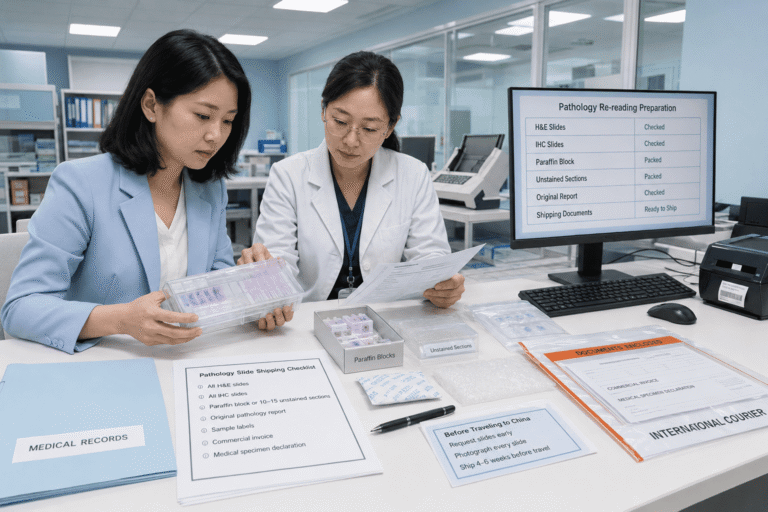
A. Physical slide / block transport, Chinese pathology re-read, additional stains as needed
- You request from your home-country hospital the FFPE block, H&E slides, and IHC slides
- International courier (DHL / FedEx, with appropriate medical specimen declaration) to the receiving Chinese department
- Chinese pathology: re-reads all slides, cuts new sections if needed, and adds IHC / FISH / molecular testing as appropriate
- A bilingual second-opinion report is issued, citing concurrence with or revision of the original diagnosis
B. Digital pathology (remote slide reading)
- Your home-country hospital scans the slides on a digital pathology scanner to produce whole-slide images (WSI)
- Transmitted to the Chinese department through an encrypted channel
- The Chinese pathologist reads on screen and issues a report
Digital pathology is faster and cheaper (no shipping). Its limitation is that no new stains can be added — review is bounded by what is on the existing slides.
In practice: complex cases often use a combination — start with digital review, then ship physical material if additional work is needed.
3. Additional Tests That Can Be Added
| Item | Value |
|---|---|
| Full IHC panel | Re-evaluate cell of origin, subtype, expression profile |
| FISH | Specific fusion or amplification detection (e.g., HER2, ALK) |
| Molecular NGS | EGFR / KRAS / BRAF / microsatellite instability, others |
| MSI / dMMR / PD-L1 scoring | Determines immunotherapy candidacy |
| ctDNA / liquid biopsy (when indicated) | Selected scenarios |
4. Leading Chinese Pathology Centres
| Hospital | City |
|---|---|
| Peking Union Medical College Hospital, Pathology | Beijing |
| Fudan University Shanghai Cancer Center, Pathology | Shanghai |
| Sun Yat-sen University Cancer Center, Pathology | Guangzhou |
| West China Hospital, Pathology | Chengdu |
| PLA General Hospital (301), Pathology | Beijing |
| Peking University Cancer Hospital, Pathology | Beijing |
| Second Affiliated Hospital of Zhejiang University, Pathology | Hangzhou |
| Institute of Hematology and Blood Diseases Hospital, Chinese Academy of Medical Sciences (specialised in lymphoma and leukaemia) | Tianjin |
5. Typical Process Time
| Stage | Time |
|---|---|
| Patient retrieves blocks and slides at home | 1–2 weeks |
| International shipment | 5–10 days |
| Chinese pathology second read (no additional stains) | 5–10 business days |
| Additional IHC / FISH | 3–7 business days |
| Additional molecular NGS | 7–14 business days |
| Bilingual report issuance | 1–3 business days |
| Total | 3–6 weeks |
6. Typical Costs (USD,)
| Item | Public tertiary pathology | High-end / third-party laboratory |
|---|---|---|
| Slide second read (no additional stains) | 150–400 | 300–800 |
| + full IHC panel | + 300–800 | + 500–1,500 |
| + FISH (single probe) | + 250–500 | + 400–900 |
| + solid tumour NGS large panel (500+ genes) | + 1,500–3,500 | + 2,500–5,500 |
| + MSI / dMMR / PD-L1 | + 200–500 | + 400–800 |
| Bilingual second-opinion report | Included | Included |
US reference: pathology second opinion plus additional testing at major US centres typically USD 1,500–6,500 [3].
7. Notes on Cross-Border Pathology Specimen Shipping
- Specimen type: FFPE block (first choice; can support additional staining and molecular work), unstained slides, stained slides
- Packaging: moisture and impact protection; usually room-temperature shipping (cold chain not needed)
- International courier paperwork: commercial invoice to state “Human pathology specimen, for diagnostic purposes, no commercial value”
- Customs: a small number of countries impose specific declaration rules on human tissue imports (e.g., Australia, Brazil)
- Return shipment: whether the original hospital requires the remaining block be returned (most patients ask to keep the residual block)
- Data security: digital pathology images transmitted across borders fall narrowly within the scope of China’s regulations on human genetic resources for the slide images themselves, but accompanying genomic sequencing data crossing borders is a separate compliance concern [4]
8. What MedCareInChina Can and Cannot Do on the Pathology Second Opinion Pathway
Our two products are Remote Consultation and In-China Accompanied Care.
- Remote Consultation: USD 800 single-expert consultation. Useful as the clinical landing for a pathology second opinion: once you have the Chinese pathology report, remote-consult with an oncologist, haematologist, or surgeon to discuss the treatment plan
- In-China Accompanied Care: most pathology second opinions do not require the patient to travel — that is the major advantage
What we do not do: we do not issue the pathology report (pathology departments issue it), we do not ship slides on your behalf (you work directly with the pathology department or international courier), and we do not place molecular testing orders on your behalf.
9. Action Checklist
- Retrieve all pathology materials from your home-country hospital (block, H&E slides, IHC slides, original report)
- Confirm acceptance and pricing with the Chinese pathology department (via remote consultation or email)
- International shipment (or digital pathology transmission)
- Wait for the second-opinion report (3–6 weeks)
- Discuss the report with a clinician via remote consultation if needed → decide treatment direction
- Subsequent clinical treatment can continue at home or in China
Sources
[1] Raab SS et al. — Clinical impact of pathology second-opinion reviews, peer-reviewed literature on diagnostic discrepancy rates [2] Johns Hopkins Pathology — Second-opinion programme outcomes: https://pathology.jhu.edu/ [3] Mayo Clinic Laboratories — Pathology consultation references: https://www.mayocliniclabs.com/ [4] State Council of the People’s Republic of China — Regulations on the Administration of Human Genetic Resources of the People’s Republic of China: https://www.most.gov.cn/ [5] College of American Pathologists — Practice guidelines: https://www.cap.org/