Reading time: 9 minutes
Radiology is another decisive node in clinical decision-making. Multiple international studies have shown that on second-opinion review of oncologic imaging, key findings are revised or refined in a meaningful proportion of cases [1][2]. Leading Chinese imaging centres — Peking Union Medical College Hospital Radiology, Huashan Hospital of Fudan University Radiology, PLA General Hospital Department of Diagnostic Radiology, and others — operate with full high-field-strength MRI (3.0T and above), high-end CT, PET-CT and PET-MR reading capability, and mature subspecialty division (neuro, thoracic, cardiovascular, abdominal, musculoskeletal, oncologic). The biggest advantage of imaging second opinions is that they can be done almost entirely remotely — the patient typically does not need to travel. This article works through when it is worth doing, the process, and typical costs.
1. When an Imaging Second Opinion Is Worth Doing
Strongly worth considering:
- Cancer staging or treatment response assessment — directly drives the next treatment step
- Difficult neuro-imaging — brain tumour, demyelinating disease, rare conditions
- Cardiac imaging — complex CMR or CCTA interpretation
- Paediatric imaging — paediatric subspecialty reading is more reliable
- Home report is very brief, inconsistent with the clinical picture, or shows significant change from prior imaging
- Before major surgery — anatomical judgement from imaging drives surgical approach
Usually not needed:
- Straightforward trauma X-ray
- Already read at a leading international centre
- Plain films, basic ultrasound, or routine negative health-check imaging
2. The Remote Imaging Second Opinion Process
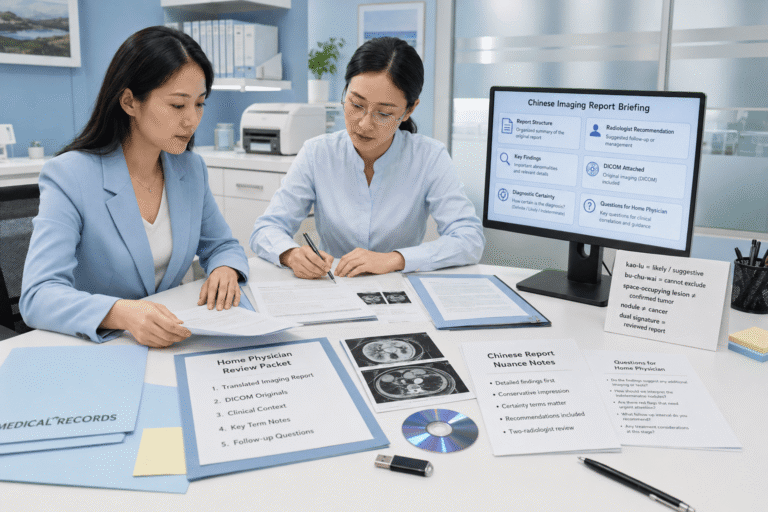
- Your home-country hospital provides the DICOM raw data (not a PDF report, not a phone screenshot)
- Data is transmitted to the Chinese imaging centre via encrypted cloud platform or dedicated medical imaging transmission system
- A Chinese subspecialty radiologist reads independently
- A bilingual second-opinion report is issued, covering key findings, agreement or revision vs the original report, and clinical recommendations
- Multidisciplinary review can be arranged if needed
Data transfer options:
- DICOM disc or external drive — your home-country hospital can usually burn this
- PACS-to-PACS cross-border transfer — supported by a small number of hospitals
- Encrypted medical imaging cloud platform — common
3. Where Second-Opinion Value Varies by Imaging Type
| Imaging type | Second-opinion value |
|---|---|
| Brain MRI for difficult neurology | High |
| High-resolution chest CT (small nodule characterisation) | High |
| Abdominal/pelvic MRI or contrast CT (cancer staging) | High |
| Cardiac CCTA / CMR | High |
| PET-CT / PET-MR | High |
| Musculoskeletal MRI (sports injury, tumour) | High |
| Paediatric neuro / chest imaging | High |
| Emergency trauma CT | Usually sufficient as read |
| Routine X-ray or ultrasound for health check | Usually sufficient as read |
4. Leading Chinese Imaging Centres
| Hospital | City | Strengths |
|---|---|---|
| Peking Union Medical College Hospital, Radiology | Beijing | Strong all-round |
| Huashan Hospital of Fudan University, Radiology | Shanghai | Neuroimaging and oncologic imaging |
| PLA General Hospital, Diagnostic Radiology | Beijing | All-round and cardiovascular |
| Zhongshan Hospital of Fudan University, Radiology | Shanghai | Cardiovascular and abdominal |
| Beijing Tiantan Hospital, Neuroimaging Centre | Beijing | Neuroimaging |
| Fuwai Hospital Cardiovascular Imaging Centre | Beijing | Cardiac imaging |
| Shanghai East Hospital / Tenth People’s Hospital | Shanghai | Cardiac |
| Second Affiliated Hospital of Zhejiang University | Hangzhou | |
| West China Hospital, Radiology | Chengdu | All-round |
| Sun Yat-sen University Cancer Center, Imaging | Guangzhou | Oncologic imaging |
5. Typical Process Time
| Stage | Time |
|---|---|
| Patient retrieves DICOM data at home | 1–7 days |
| Data transfer to the Chinese imaging centre | 1–3 days (encrypted cloud) / 5–10 days (physical shipment) |
| Chinese subspecialty radiologist reading | 3–7 business days |
| Bilingual report issuance | 1–3 business days |
| Total | 2–4 weeks |
6. Typical Costs (USD,)
| Item | Public tertiary international dept. | High-end / third-party imaging |
|---|---|---|
| Single-region CT or MRI second read | 80–250 | 150–500 |
| Multi-region combination (whole-body PET-CT + head/neck MRI) | 250–600 | 400–1,000 |
| Complex neuroimaging in-depth reading | 200–500 | 350–800 |
| Combined cardiac CCTA + CMR reading | 250–500 | 400–900 |
| Cross-disciplinary joint reading (imaging + pathology) | 350–800 | 600–1,500 |
US reference: imaging second opinions at major US centres typically USD 300–1,500 [3].
7. What MedCareInChina Can and Cannot Do on the Imaging Second Opinion Pathway
Our two products are Remote Consultation and In-China Accompanied Care.
- Remote Consultation: USD 800 single-expert consultation. Once the imaging second opinion is in hand, you can remote-consult with the relevant clinical specialist to discuss the result and treatment direction
- In-China Accompanied Care: imaging second opinions typically do not require the patient to travel — that is the strength of this pathway
What we do not do: we do not issue imaging reports (radiology departments do), and we do not handle DICOM transmission technical details for you (you work directly with the imaging centre).
8. Action Checklist
- Request DICOM raw data from your home-country hospital (disc, external drive, or digital download)
- Confirm acceptance, transfer method, and pricing with the Chinese imaging centre
- Data transfer and wait for the report (2–4 weeks)
- Remote-consult on the result if needed
- Treatment decisions follow the read
Sources
[1] Hatzoglou V et al. — Discordance rates in second-opinion neuroradiology reviews, peer-reviewed literature [2] American College of Radiology — Second opinion practice references: https://www.acr.org/ [3] Mayo Clinic Imaging Consultation Services — public references: https://www.mayoclinic.org/ [4] Radiological Society of North America (RSNA) — Practice guidance: https://www.rsna.org/