9 minutes read
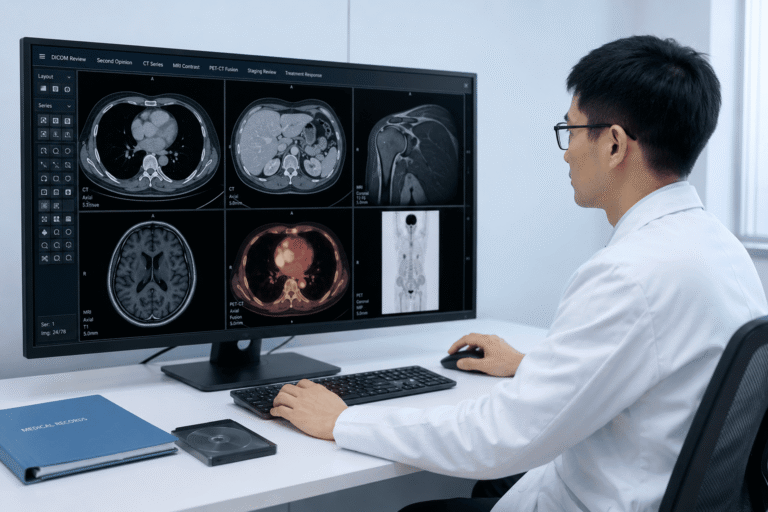
PET-CT (positron emission tomography combined with CT) is one of the most common single-imaging reasons international patients travel to China — equipment generation rivals top Western centers and sometimes surpasses them; pricing typically runs a fraction of US costs; and China offers certain tracers (such as FAPI) that solve diagnostic challenges Western centers struggle with. This article walks through China’s PET-CT equipment, available tracers, examination workflow, pricing range, and the hospitals best suited for international patients.
China’s PET-CT Equipment Landscape
Regulatory framework: PET-CT is classified as “Class B large medical equipment,” requiring provincial health commission approval [1]. The “14th Five-Year Plan” sets China’s PET-CT total at 1,667 units, with 860 new installations this period [2]. This means PET-CT accessibility in China is rapidly expanding.
Latest-generation equipment:
- United Imaging uEXPLORER total-body PET-CT (Chinese-made): the world’s first, installed at Fudan University Zhongshan Hospital in 2019. 194 cm axial field of view (traditional PET-CT has ~22 cm), capable of whole-body imaging in 15 seconds, with radiation dose reduced to 1/40 of traditional models [3]. As of September 2023, China had 16 units installed, with 6–7 new installations per year.
- GE Discovery MI, Siemens Biograph Vision, Philips Vereos: mainstream international digital PET-CTs, widely deployed in nuclear medicine departments at top-tier Chinese hospitals — Peking Union Medical College, PLA General Hospital, Peking University Cancer Hospital, Fudan Cancer Center, Zhongshan Hospital, West China Hospital, Sun Yat-sen 1st Affiliated, Shenzhen People’s, Zhejiang University 1st Affiliated, etc.
Practical implication for international patients: China’s major Tier-3A PET-CT equipment matches top Western centers — you won’t sacrifice imaging quality by coming to China. In certain situations (total-body PET-CT, latest digital detectors, China-exclusive tracers), China actually leads.
Available Tracers
The core of PET-CT is the tracer — different tracers target different diseases. China’s available tracers:
18F-FDG (Fluorodeoxyglucose)
- Most common, covers >85% of oncology / inflammation / neurological studies
- Standard at all PET-CT centers nationwide
- Applications: most solid tumors, lymphoma, infection, neurodegenerative diseases
68Ga / 18F-PSMA
- Prostate cancer-specific
- Chinese Urological Association’s “Expert Consensus on PSMA PET Imaging for Prostate Cancer (2025 Edition)” includes 22 recommendations [4]
- Applications: prostate cancer staging, biochemical recurrence evaluation, metastatic lesion localization
68Ga-DOTATATE / DOTATOC
- Neuroendocrine tumor-specific
- Routinely offered at multiple Tier-3A nuclear medicine departments [5]
- Applications: pancreatic neuroendocrine tumors, carcinoid, pheochromocytoma
68Ga-FAPI (fibroblast activation protein inhibitor) — China’s leading edge
- China is one of the most active countries globally in FAPI clinical translation [3]
- Applications: pancreatic cancer, cholangiocarcinoma, gastric cancer, ovarian cancer, lung squamous cell carcinoma, and other tumors where FDG imaging is non-specific or non-diagnostic
- Often combined with FDG for complementary diagnosis
11C-Choline, 11C-Methionine, and others
- Require in-hospital cyclotrons (short half-life, can’t be transported long distances)
- Available only at a few centers (PUMC, West China, PLA General, Peking University People’s, etc.)
- Applications: gliomas, pituitary tumors, prostate cancer
Practical implication for international patients: if your cancer is of the type that’s difficult to visualize on FDG (pancreatic, cholangiocarcinoma, neuroendocrine tumors, etc.), traveling to China for a FAPI or DOTATATE PET-CT has standalone medical value — beyond just pricing advantages.
Pricing — The Reality Is More Nuanced Than “China Is Cheap”
China’s PET-CT pricing varies meaningfully by province and by hospital tier. The National Healthcare Security Administration issued a price standardization guideline in November 2024 [6], but this is a benchmark/upper limit, not a national uniform price. Provincial implementation rolls out at different paces.
Pricing varies substantially across three key dimensions:
| Dimension | Pricing Range (USD) |
|---|---|
| Public hospitals in provinces where the new benchmark has been implemented (Shanghai, Guangdong, Anhui, Fujian, Chongqing, etc.) | $770–$1,000 for full-body FDG PET-CT |
| Public hospitals in provinces where the new benchmark has not been implemented yet (Beijing, Sichuan, Hubei, Northeast provinces, and others) | Typically $1,080–$1,540 for full-body FDG PET-CT |
| Public hospital IMD channel (for international patients) | Typically 1.5–2× the public rate, often around $1,500–$2,500 |
| Private international hospitals (Jiahui, United Family, Heyou Pinnacle, etc.) | Typically 2–3× the public rate, often around $2,000–$3,000 |
| Special tracers (PSMA / FAPI / DOTATATE) | Typically additional cost on top, often in the range of $1,500–$2,500+ |
Comparison to US:
- US PET-CT outpatient average ~$2,550 USD, inpatient ~$7,275 USD, uninsured commonly $1,300–$4,600+ USD [7][8]
- Chinese public hospital PET-CT typically costs 30–60% of the US outpatient average — substantially less, though not dramatically less than what some Chinese coordination services market
Practical principle: for patients traveling specifically for PET-CT (especially without insurance, paying out-of-pocket), PET-CT remains one of the more economically meaningful reasons to come to China — the cost savings on the single study often cover international airfare. But the price advantage is smaller than older marketing materials suggest if you’re going through an IMD or private international hospital in Beijing or other not-yet-adjusted provinces.
Standard Examination Workflow
Day before:
- 6 hours fasting (water is fine)
- Avoid high-sugar foods (affects FDG imaging)
- Fasting blood glucose control: < 6.1 mmol/L (diabetic patients < 11.1 mmol/L)
- Avoid vigorous exercise for 24 hours before
- Diabetic patients should confirm medication adjustments with the physician in advance
Typical examination day timeline:
| Time | Activity |
|---|---|
| 8:00 arrival | Blood glucose check, confirm fasting status |
| 8:15 | Inject 18F-FDG tracer |
| 8:30–9:30 | Rest quietly for 45–60 minutes — allows tracer distribution in the body |
| 9:30 void | Empty bladder, reduce pelvic artifact |
| 9:45 | Enter scanning room |
| 9:50–10:10 | Scan — traditional PET-CT about 10–20 minutes; total-body uEXPLORER can be reduced to 2–3 minutes |
| 10:10 | Examination complete |
| Total on-site time approximately 2.5–3 hours |
Report delivery:
- Standard outpatient channel: 24–48 hours
- IMD channel: can be expedited to same-day or next-day (with bilingual Chinese-English)
- Urgent situations: some hospitals can provide preliminary conclusions within 4–8 hours
Top PET-CT Centers for International Patients
Beijing:
- Peking Union Medical College Hospital (IMS International Medical Department) — comprehensive capability + complete IMD service
- PLA General Hospital (301) — full equipment + International Medical Center
- Beijing Tsinghua Changgung Hospital — JCI accredited + advanced equipment
Shanghai:
- Fudan University Zhongshan Hospital — the world’s first uEXPLORER total-body PET-CT installation site
- Shanghai Ruijin IMD — international medical department established 1998 + complete equipment
- Shanghai Huashan Hospital — neurological PET-CT strength
- Shanghai Proton and Heavy Ion Hospital — standard choice for pre-treatment PET-CT evaluation for oncology patients
Guangzhou:
- Sun Yat-sen University 1st Affiliated Hospital — main entry for international patients in southern China
- Sun Yat-sen University Cancer Center — oncology PET-CT strength
Shenzhen:
- The University of Hong Kong-Shenzhen Hospital (HKU-SZH) — Hong Kong-style service + standardized bilingual reporting
Hangzhou:
- Zhejiang University 1st Affiliated Hospital, Zhejiang University Sir Run Run Shaw Hospital — main PET-CT centers in the Yangtze River Delta
Four Common Scenarios Where International Patients Travel to China for PET-CT
Scenario 1 · US PET-CT out-of-pocket is too expensive
US PET-CT out-of-pocket averages $2,550–$4,600+; China public hospitals run roughly $770–$1,540 — a single PET-CT can save $1,000–$3,000+ USD, often covering international airfare.
Scenario 2 · Need for a China-exclusive tracer (especially FAPI)
If your cancer is one of the FDG-difficult-to-visualize types — pancreatic, cholangiocarcinoma, neuroendocrine tumor, ovarian cancer — FAPI / DOTATATE tracers are more accessible in China.
Scenario 3 · Wanting total-body uEXPLORER PET-CT
Fudan Zhongshan’s uEXPLORER is the world’s first total-body PET-CT — single scan covers the whole body, radiation dose 1/40, scan time 2–3 minutes. For pediatric oncology patients and patients needing repeated surveillance, this low-dose advantage has standalone medical value.
Scenario 4 · Pre-treatment PET-CT evaluation if already coming to China for treatment
If you’ve already decided to come to China for treatment (surgery, chemo, radiation), doing PET-CT before traveling or in the first week of your visit is the standard workflow — the physician needs PET-CT data to finalize the treatment plan.
Common Questions
How does the quality of Chinese PET-CT reports compare to US reports? Chinese major Tier-3A nuclear medicine departments produce reports at the same quality as top Western centers — physicians typically have similar training backgrounds (many with US training experience), equipment is comparable, and reading standards follow international guidelines.
Can I request a bilingual report? The IMD channel typically provides bilingual Chinese-English reports; the standard outpatient channel typically delivers Chinese only, with English versions requiring a specific request or self-translation.
PET-CT involves radiation — is it safe? PET-CT radiation dose is approximately 10–20 mSv (about 1.5–2× a diagnostic CT). A single PET-CT is safe medically, but should not be repeated frequently in the short term (recommended interval ≥ 3 months). The total-body uEXPLORER reduces dose to 1/40 of traditional models, especially suited for patients needing repeated surveillance.
Can diabetic patients have PET-CT? Yes, provided blood sugar is well-controlled (< 11.1 mmol/L). Insulin use needs to be coordinated with the nuclear medicine physician in advance — typically no insulin or food on the examination morning.
Can I have my US physician remotely review Chinese PET-CT results? Yes. The Chinese PET-CT report + DICOM originals you receive can be sent back to your home physician for review. Most US physicians can read DICOM directly — this is the international standard.
Does medical insurance cover PET-CT? Some international health insurance plans (Cigna, Allianz, Bupa, MSH, etc.) reimburse PET-CT. PET-CT at a public IMD is typically considered “medically necessary” — coverage is more likely to be approved. Confirm with your insurer before traveling.
Bottom Line
China PET-CT’s core appeal:
- Equipment matches or exceeds top Western centers (uEXPLORER total-body PET-CT is unique to China)
- Pricing typically 30–60% of US (with substantial variation by province and hospital tier)
- Tracer accessibility: FDG universal nationwide, with FAPI / DOTATATE / PSMA available at major centers
- Standardized workflow: same-day examination, 24–48 hour reports
Best suited for:
- Patients facing unaffordable US out-of-pocket costs
- Patients needing China-leading tracers like FAPI
- Patients needing total-body uEXPLORER PET-CT for special situations
- Patients already coming to China for treatment, needing pre-treatment PET-CT evaluation
If you’re considering PET-CT in China, MedCareInChina can match the right hospital and tracer for your specific case — certain tracers have different availability across hospitals.
→ Send your case to hello@medcareinchina.com
See Service & Refund Policy and Medical Disclaimer for service boundaries.
Sources
- PET-CT regulatory framework — National Health Commission large medical equipment configuration licensing. PET-CT is Class B equipment; PET-MR was reclassified from Class A to Class B in 2023. https://www.cn-healthcare.com/articlewm/20230415/content-1537328.html
- “14th Five-Year Plan” Large Medical Equipment Configuration Plan — Total PET-CT 1,667 units, 860 new installations this period. https://nirp.chinacdc.cn/fsaqssjb/fswsfgbzsjb/fgsjb/gfxwjsjb/202502/W020250428534267263625.pdf
- United Imaging uEXPLORER total-body PET-CT — First in the world, installed at Fudan University Zhongshan Hospital in 2019. 194 cm axial field of view, 15-second imaging, radiation dose 1/40 of traditional models. As of September 2023, 16 units installed in China. China is one of the most active countries globally in FAPI clinical translation. Source: J Nucl Med “Clinical Implementation of Total-Body PET in China” https://jnm.snmjournals.org/content/65/Supplement_1/64S ; Fudan Zhongshan news https://shmc.fudan.edu.cn/news/2025/0402/c1895a144793/page.htm
- PSMA PET Imaging Expert Consensus for Prostate Cancer in China 2025 — Issued by the Chinese Urological Association. https://www.urology.com.cn/home/Detail?id=271
- DOTATATE / DOTATOC application at Chinese PET-CT centers — J Nucl Med “Landscape of Nuclear Medicine in China.” https://jnm.snmjournals.org/content/65/Supplement_1/29S
- National Healthcare Security Administration Radiology Service Pricing Guideline 2024 — Issued November 20, 2024, sets benchmark/upper limits for radiology services; provincial implementation rolls out at different paces. First-batch provinces (Anhui, Guangdong, Shanghai, Fujian, Chongqing) implemented in April–July 2025 with full-body FDG PET-CT in the US$770–1,000 range. Provinces not yet implementing (Beijing, Sichuan, Hubei, etc.) typically retain prior pricing (US$1,080–1,540 range). https://www.nhsa.gov.cn/art/2024/11/25/art_201_14760.html ; Shanghai Healthcare Security Administration https://ybj.sh.gov.cn/qtwj/20250429/f5dd5e766bf54230b98f5c19024f3067.html
- US PET-CT pricing — US PET-CT outpatient average approximately $2,550 USD, inpatient approximately $7,275 USD, uninsured commonly $1,300–$4,600+ USD. Sources: CareCredit https://www.carecredit.com/well-u/health-wellness/pet-scan-cost/ ; GoodRx https://www.goodrx.com/health-topic/diagnostics/pet-scan-cost
- PUMC PET-CT examination instructions — Preparation requirements, workflow description. https://www.pumch.cn/detail/12815.html ; https://www.pumch.cn/detail/36577.html
- Peking University Cancer Hospital PET-CT precautions — https://www.bjcancer.org/Html/News/Articles/103490.html