9 minutes read
Most international patients preparing for medical care in China remember to bring their medical records, imaging, and insurance — but only a few realize they need to bring physical pathology slides. This is the preparation step most often overlooked, with the highest clinical cost for international patients. International research shows that 6–25% of oncology pathology cases have major discrepancies on second review that affect treatment — for certain complex cancer types (sarcomas, lymphomas, rare tumors), the rate reaches 38%. If you bring only your pathology report without the physical slides, Chinese physicians cannot independently verify your diagnosis — subsequent treatment planning may be built on an incorrect diagnosis. This article walks through why pathology slide re-reading matters so much, what materials to bring, how to ship internationally, the pricing, and the timeline.
International Evidence: The Real Value of Pathology Re-Reading
Large-scale studies from major medical centers all point to the same conclusion: a meaningful share of pathology diagnoses are revised on second review.
MD Anderson Cancer Center (2,718-case study) [1]:
- 25% had discrepancies
- 18.7% minor differences
- 6.2% major differences (affecting treatment)
Multi-center study across 11 NCI Comprehensive Cancer Centers (13,109 cases) [2]:
- Overall discrepancy rate 11.4%
- Major discrepancies 2.7% (changing treatment or follow-up)
- Minor discrepancies 8.6%
Mayo Clinic (71,811 cases) [3]:
- 88% of patients seeking a second opinion received a new or more refined diagnosis
- 21% had their diagnosis completely changed
- Aggregate discrepancy rates from 13 smaller studies: 1.3%–14.7%
Soft tissue sarcoma expert second review [4]:
- Discrepancy rate 25–38%
- Major discrepancies 12–25%
Tumor types particularly prone to major discrepancies:
- Lymphoma (complex subtyping affects treatment selection)
- Sarcoma (rare, histologically complex)
- Brain tumors (glioma grading)
- Skin malignancies (melanoma classification)
- Female reproductive system tumors (subtype classification)
- Rare tumors (pathologist experience varies widely)
Practical implication for international patients:
- If you have a complex or rare cancer, the probability of diagnosis change after re-reading is meaningful
- A diagnosis change can mean a completely different treatment plan (lymphoma subtype determines CAR-T eligibility; sarcoma subtyping determines limb-sparing vs amputation)
- Doing pathology re-reading before finalizing your treatment plan is the critical safeguard against treating in the wrong direction
Why Pathology Re-Reading Matters More Than Imaging Re-Reading
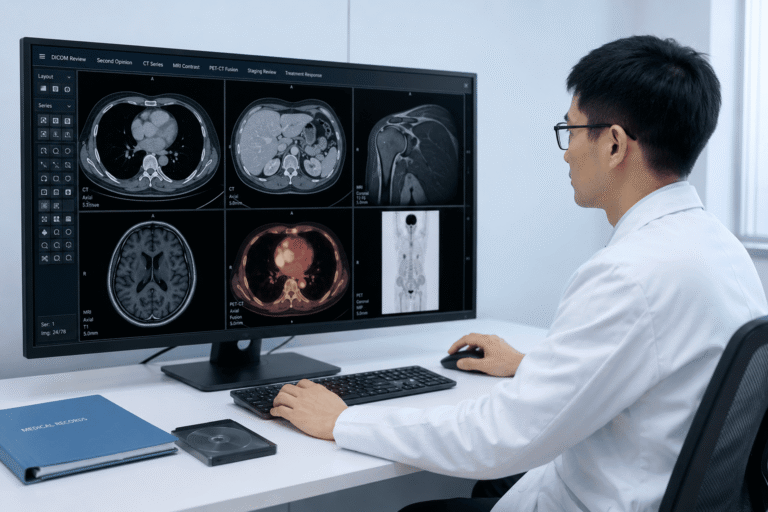
International patients typically prioritize imaging (bringing DICOM discs) but overlook physical pathology slides. This is a serious cognitive bias, because:
Imaging vs Pathology:
| Dimension | Imaging | Pathology |
|---|---|---|
| Decisiveness for treatment plan | Moderate (suggestive diagnosis) | Very high (gold standard for diagnosis) |
| Can be re-done | Easily (just re-scan) | Difficult (requires another biopsy, invasive) |
| Discrepancy rate between readers | Lower | Higher (especially for complex cancers) |
| Difficulty of file duplication | Easy (DICOM is digital) | Difficult (slides are physical objects) |
Key point: imaging can be re-done; pathology slides themselves are difficult to regenerate — if you bring only the report, Chinese physicians can only “accept” your home country’s pathology diagnosis without being able to independently verify it. This is the largest invisible risk in clinical decision-making.
Materials Needed for Pathology Re-Reading
Standard requirements at China’s top pathology centers (PUMC, CICAMS, SYSUCC, etc.) [5][6][7]:
Core materials (required):
- H&E stained slides (all relevant slides from the original institution)
- Immunohistochemistry (IHC) stained slides (all IHC stains already performed)
- Original pathology report copy (containing patient name, pathology number, sampling location, original diagnosis)
Additional materials for difficult cases:
- Paraffin blocks — allow new staining or molecular testing
- Unstained sections — typically 10–15 slides, 4 micron thickness
Supporting materials:
- Relevant clinical information (history, symptoms, examination findings)
- Relevant imaging (especially X-ray/CT/MRI for bone and soft tissue tumors)
- Patient identification
- If multi-site biopsies: must clearly label each tissue with corresponding location
Why Paraffin Blocks or Unstained Sections Matter So Much
This is the point international patients most often miss:
- H&E slides only allow “viewing the existing diagnosis” — no new testing can be performed
- Paraffin blocks or unstained sections allow Chinese pathology to perform new immunohistochemistry or molecular tests — often the key to determining tumor subtype, targeted therapy selection, and prognostic evaluation
- Example: a lung adenocarcinoma patient whose original institution only tested EGFR can have Chinese pathology run a complete EGFR/ALK/ROS1/BRAF/KRAS/NTRK/PD-L1 panel from the paraffin block — determining the full range of targeted and immunotherapy options
Practical recommendations:
- Before traveling, proactively request paraffin blocks from your home country’s pathology department (most hospitals retain blocks for 10+ years per regulation)
- If paraffin blocks can’t be released (some countries’ hospitals have retention regulations), request at least 10–15 unstained sections
- Package paraffin blocks or unstained sections in individual sealed bags, labeled with the pathology number
Top Chinese Pathology Re-Reading Centers
Peking Union Medical College Hospital (PUMC) Pathology [8]
- >35,000 cases processed annually
-
40,000 immunohistochemistry stains annually
-
4,000 intraoperative frozen sections annually
- 55,000+ cumulative consultations, with ~7,000 new consultations per year
- National referral center for difficult and rare diseases
Cancer Hospital, Chinese Academy of Medical Sciences (CICAMS) Pathology [5]
- National Key Clinical Specialty in Pathology, National Cancer Center key academic discipline
- National diagnostic center for difficult cancer pathology
- 3–4 attending physicians provide consultation daily
- 80–120 cases re-read per day
- Same-day signoff rate ≥ 80%
Sun Yat-sen University Cancer Center (SYSUCC) Pathology [7]
- Established 1964
- National Key Academic Discipline in Oncology
- National Key Laboratory of South China Malignant Tumor Prevention and Control
- Specialty expertise in nasopharyngeal cancer, liver cancer, lung cancer pathology
Fudan University Shanghai Cancer Center Pathology
- Standard tissue pathology consultation and senior expert consultation
- Specialty expertise in breast cancer, gastrointestinal tumors, lymphoma
Recommendations for international patients:
- Standard re-reading for common cancers → SYSUCC, Fudan Cancer, CICAMS
- Difficult or rare cancers → CICAMS, PUMC
- Lymphoma precision subtyping → Peking University Cancer Hospital, CICAMS, PUMC
- Sarcoma → PUMC, CICAMS (China’s top centers for soft tissue sarcoma diagnosis)
- Brain tumors → Beijing Tiantan Hospital, Huashan Hospital, CICAMS
International Pathology Slide Shipping: Practical Guide
Temperature and packaging:
- FFPE paraffin blocks and unstained slides: ship at room temperature (no cold chain required)
- Slides in plastic slide boxes, secured against vibration
- Double or triple packaging + moisture absorbers
- Paraffin blocks in individual sealed bags
- Each slide and block clearly labeled (pathology number + patient name + sampling date)
International shipping documentation:
- Commercial Invoice — required
- Air Waybill
- Biological sample declaration — must truthfully declare “medical diagnostic pathology specimens”
- Carriers like DHL will return shipments to origin if missing documents are not provided within 10 days [9]
Practical tips:
- Ship Monday or Tuesday — avoids weekend customs delays
- Use the international carrier’s “document” or “medical specimen” channel, not standard parcel service
- Coordinate with the Chinese IMD or coordination service in advance — they can provide a receiving address + customs declaration document templates
- Photograph all slides and blocks before shipping for documentation (so you have visual evidence if anything is lost)
Carrier selection:
| Carrier | Advantages | Notes |
|---|---|---|
| DHL Express | Widest global coverage | Relatively fast customs clearance |
| FedEx International | Strong US/European origin | Higher pricing |
| UPS | Good for Middle East, Southeast Asia | — |
| SF International | Fast last-mile in China | International leg may be slower than DHL |
Typical transit times: US/Europe → China 5–10 days (including clearance); Southeast Asia → China 3–5 days.
Pricing
Public hospital IMD pathology consultation:
- Typically starts at $770 USD, with pricing scaled by the number of specialists involved and case complexity [10]
- Multidisciplinary pathology consultation (appropriate for rare or complex tumors involving multiple subspecialists): typically $1,500–$3,000 USD
- Supplementary immunohistochemistry or molecular testing: additional charges per test, depending on the specific assays needed
- Private international hospital pathology re-reading: typically priced similar to or slightly above public IMD
Relative to the total cost of treatment in China ($15,000–$80,000+), pathology re-reading is a small but critical investment that ensures your treatment plan is built on the right diagnosis.
Report Turnaround Times
| Channel | Standard Report Time | Supplementary IHC |
|---|---|---|
| CICAMS expedited consultation | 80% signed off same day; standard 2–5 business days | +5–10 business days |
| PUMC IMD | Typically 2–5 business days | +5–10 business days |
| Multidisciplinary consultation | 5–7 business days (multi-specialist discussion) | — |
Practical recommendation for international patients:
- Ship pathology slides to China 4–6 weeks before your travel — so re-reading is already in progress when you arrive
- By the time you arrive in China, the re-reading report is likely already issued or imminent
- This avoids “waiting for pathology” causing overall trip delays
Digital Pathology Remote Consultation
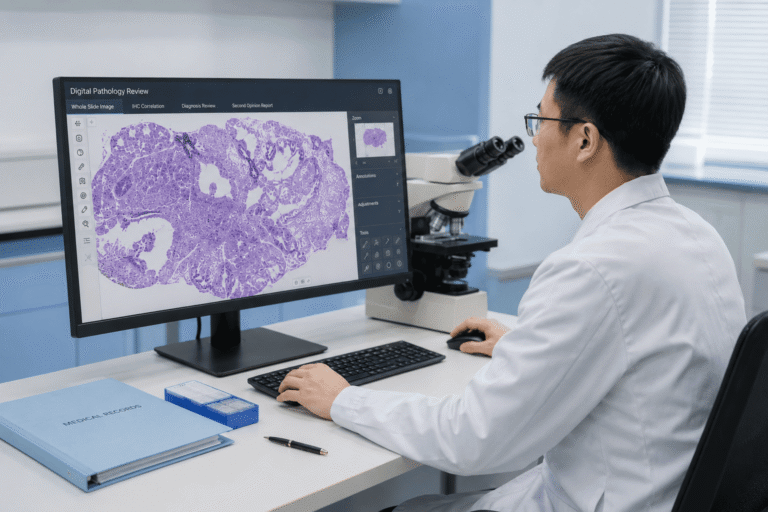
China has established a national remote pathology network, and some top centers can accept whole slide imaging (WSI) for remote consultation [11]:
- KingMed Diagnostics: has been providing cross-border remote pathology consultations with UPMC since 2012, with 27 central laboratories serving 13,000+ hospitals
- Some major Tier-3A hospitals have remote pathology collaborations with leading international institutions (UCSF, Mayo Clinic, etc.)
Practical implication for international patients:
- Remote digital pathology can serve as a “pre-screening” before shipping physical slides
- But final diagnosis still requires physical slides — digital pathology resolution and detail still doesn’t fully match physical microscopy
- Recommended workflow: remote digital pre-screening → ship physical slides for formal re-reading → final diagnosis report
Common Questions
Can I skip pathology re-reading and just use my home country’s diagnosis? Legally yes, but Chinese physicians have the right to require re-reading based on responsibility considerations — especially for surgery or complex treatment. Strongly recommend accepting re-reading — it’s the critical step against treating in the wrong direction.
What if my home country’s pathology department won’t release the paraffin block? Requesting 10–15 unstained sections is a reasonable baseline ask. If they won’t release those either, at minimum bring:
- All existing H&E slides
- All existing IHC slides
- High-quality digital pathology images (if their WSI system is in place)
- Detailed original pathology report
Are there risks in shipping pathology slides internationally? Yes, but manageable. With proper packaging + reliable carrier, actual loss or damage probability is low. The most important precaution is photographing everything before shipping — even if lost, you have visual evidence.
Can my home country’s pathology department just send digital pathology images to the Chinese hospital directly? Yes, as “pre-screening,” but most top Chinese centers still require physical slides for final diagnosis — digital pathology resolution and stain detail still doesn’t match physical microscopy.
What if pathology re-reading changes my diagnosis? This is a common situation (6–25% per international data). Chinese physicians will revise the treatment plan based on the new diagnosis. Recommended:
- Send the new diagnosis report back to your home physician for evaluation
- Arrange a multidisciplinary consultation (MDT) if needed to discuss what the new diagnosis means
- Don’t panic — re-reading that changes the diagnosis is a positive outcome (it prevents incorrect treatment)
Can rare tumors be diagnosed in China? Chinese major Tier-3A hospitals have reached international levels of capability for rare tumor pathology — particularly PUMC, CICAMS, SYSUCC. Some extremely rare tumors may still require international consultation (Chinese pathology jointly reviewing with US/European leading institutions) — MedCareInChina can help arrange.
Bottom Line
The clinical value of pathology re-reading (based on international authoritative data):
- Common tumors: 6–11% major discrepancy rate
- Complex tumors (lymphoma, sarcoma, rare tumors): 12–38% major discrepancy rate
- 88% of second opinions provide new or more refined diagnoses
Materials international patients must bring:
- ✅ All H&E stained slides
- ✅ All IHC stained slides
- ✅ Paraffin blocks or 10–15 unstained sections (the most commonly missed)
- ✅ Original pathology report copy
- ✅ Relevant clinical and imaging materials
Shipping practicalities:
- Room temperature + double packaging
- Ship Monday/Tuesday
- Complete commercial invoice and customs documentation
- Ship 4–6 weeks before travel
Cost vs value: pathology re-reading is a relatively small investment compared with total treatment costs, but the value of preventing treatment in the wrong direction is immeasurable.
If your case involves oncology, MedCareInChina’s standard pre-travel workflow includes pathology re-reading coordination — we guide your home pathology department on collaboration, provide the Chinese IMD’s receiving address and customs documentation, and expedite the re-reading process.
Start with a free Pathway Scan. We will tell you whether China is worth further consideration and which type of next step may fit. The free scan does not include hospital or doctor recommendations, medical advice, individualized cost estimates, insurance determinations, or treatment planning.
See Service & Refund Policy and Medical Disclaimer for service boundaries.
Sources
- MD Anderson Pathology Second Review Study — 2,718-case study, 25% discrepancy rate, 6.2% major discrepancies (affecting treatment). https://pubmed.ncbi.nlm.nih.gov/24695900/
- NCI 11-Center Multicenter Study — 13,109 cases, overall discrepancy rate 11.4%, major discrepancies 2.7%. https://ar.iiarjournals.org/content/38/5/2989
- Mayo Clinic 71,811-Case Study — 88% of second opinions provided new or more refined diagnosis, 21% completely changed. https://newsnetwork.mayoclinic.org/discussion/mayo-clinic-researchers-demonstrate-value-of-second-opinions/ ; Mayo Clinic Proceedings systematic review https://www.mayoclinicproceedings.org/article/S0025-6196(14)00245-6/fulltext
- Soft Tissue Sarcoma Expert Second Review — Discrepancy 25–38%, major discrepancies 12–25%. https://pmc.ncbi.nlm.nih.gov/articles/PMC7542501/ ; https://www.ncbi.nlm.nih.gov/pmc/articles/PMC4138733/
- Cancer Hospital, Chinese Academy of Medical Sciences (CICAMS) Pathology — National Key Clinical Specialty. 80–120 cases re-read per day, ≥80% same-day signoff rate. https://www.cicams.ac.cn/dzb/pathology/bingli/zhong.html ; consultation workflow https://www.cicams.ac.cn/dzb/pathology/bingli/bing.html
- Pathology Consultation Material Requirements — Standard requirements across centers: H&E slides + IHC slides + paraffin blocks/unstained sections + original report + clinical/imaging materials + patient identification. CICAMS consultation guidelines https://www.cicams.ac.cn/dzb/pathology/bingli/xu.html ; Fudan Cancer Center pathology consultation guidelines https://myyk.fh21.com.cn/guide/detail/4139.html
- Sun Yat-sen University Cancer Center Pathology — Established 1964, National Key Academic Discipline in Oncology. https://www.sysucc.org.cn/department/introduction/60 ; https://www.sysucc.org.cn/blhz
- Peking Union Medical College Hospital Pathology — >35,000 cases processed annually, 55,000+ cumulative consultations. https://www.pumch.cn/department_binglk.html
- International Pathology Specimen Shipping Guide — FFPE paraffin blocks and unstained slides ship at room temperature; DHL international shipping document requirements. https://nrgbb.ucsf.edu/document/processing-shipping-packing-tips-2026-0 ; https://www.dhl.com/discover/en-global/ship-with-dhl/documents-and-customs-advice/what-paperwork-do-I-need-for-international-shipping
- PUMC IMD Pathology Consultation Pricing — Typically starts at approximately $770 USD, scaled by specialist count and case complexity. https://www.pumch.cn/detail/12928.html
- China Remote Pathology Network — KingMed Diagnostics has provided cross-border remote pathology consultations with UPMC since 2012, with 27 central laboratories serving 13,000+ hospitals. https://pmc.ncbi.nlm.nih.gov/articles/PMC3849533/