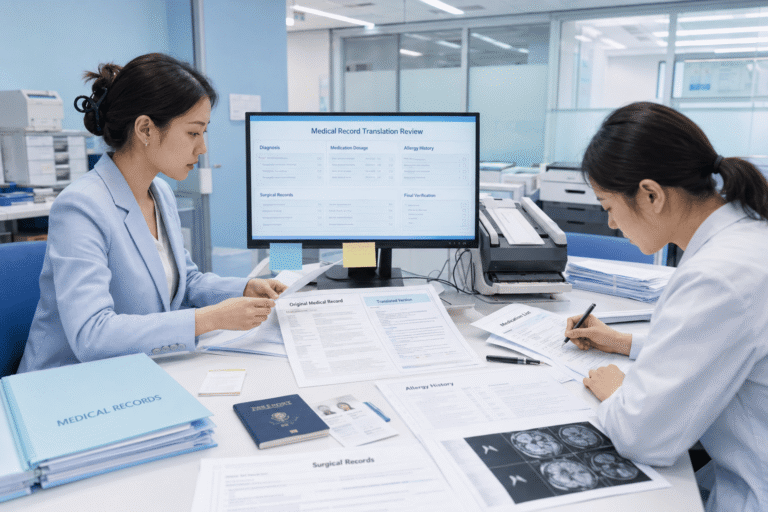
Title: What to Bring for a Medical Consultation in China: A Complete Document Checklist for International Patients
10 minutes read
For international patients traveling to China for medical care, how thoroughly you prepare your medical records directly determines the efficiency of your first consultation. With proper preparation, diagnosis and treatment planning can be completed within three days; without it, you may end up spending 7–10 days in China before treatment can even begin, with hotel costs and repeat-testing expenses far exceeding what record preparation would have cost. This article breaks down the five categories of essential records, the special requirements around imaging and pathology, the visa invitation process, and the six most common mistakes international patients make.
Five Essential Categories of Medical Records
Category 1 · Past Medical History and Diagnosis Letter
- Current diagnosis letter: the most recent diagnosis letter from your primary physician, with specific diagnosis (ideally with ICD-10 codes), date of discovery, and treatment history
- Past medical history: all relevant prior conditions (hypertension, diabetes, cardiac disease, allergies, etc.)
- Surgical history: if applicable, including procedure name, date, hospital, lead surgeon, and outcome
Time horizon:
- Common conditions (routine surgery, internal medicine): most recent 6–12 months
- Oncology and chronic disease: most recent 1–2 years of complete records
- Pediatric / rare disease: complete history
Chinese IMDs accept bilingual Chinese-English medical records, do not require notarized translation, but require key reports to have English versions [1].
Category 2 · Laboratory Test Results
- Complete blood count, comprehensive metabolic panel, liver/renal function, coagulation, tumor markers (if applicable)
- Pathogen tests (if applicable): blood culture, sputum culture, urine culture
- Endocrine panel (if applicable): thyroid, HbA1c, sex hormones
- Cardiovascular markers (if applicable): troponin, BNP
Practical note: even with these reports in hand, complete blood count, metabolic panel, coagulation, and the infectious disease panel will almost certainly be repeated upon arrival in China — explained in the section below.
Category 3 · Imaging Files (DICOM originals required)
This is the most common preparation mistake.
- DICOM format disc / USB: the original DICOM files of all digital imaging — CT, MRI, PET-CT, X-ray, ultrasound
- PDF reports alone are not sufficient — Peking Union Medical College Hospital’s IMS English page explicitly states: “Doctors need to see the actual CT/MRI films/discs, not just the paper report” [2]
Why DICOM originals matter:
- Chinese Tier-3A physicians need to re-read the original imaging data, not just the textual interpretation from your home physician
- Different physicians may reach different conclusions reviewing the same images — this is normal medical practice
- DICOM contains all slice data; the PDF report is just the summary text
Media priority [3]:
- DICOM disc (best) — all Chinese Tier-3A hospital PACS systems support it
- DICOM USB (next best) — ensure the USB is not encrypted
- Cloud link (backup option) — some Chinese hospitals’ computers may not be able to access overseas cloud platforms reliably due to firewall restrictions
- Films / PDF (least preferred) — hospitals will usually recommend re-imaging in China
Strongly recommended: bring both a DICOM disc and a USB as physical media backups, in addition to any cloud links.
Category 4 · Pathology Slides (if oncology or biopsy is involved)
This is the category international patients most commonly overlook — most assume bringing the pathology report is enough, but major Chinese hospitals’ pathology departments require “pathology slide re-reading” [4].
Peking Union Medical College Hospital pathology consultation explicitly requires the following materials from external hospital cases [5]:
- Original or copy of the external hospital pathology report
- Stained slides (H&E + immunohistochemistry) — this is the core requirement
- For difficult cases: paraffin blocks or 10–15 unstained slides (4 micron thickness)
Why pathology slide re-reading is so important:
- Precise tumor subtyping directly determines treatment choices (chemotherapy, targeted therapy, immunotherapy selection)
- Pathology diagnostic standards and laboratory quality control vary across regions globally, and approximately 10–30% of oncology cases have their diagnosis adjusted upon re-reading [6]
- Sun Yat-sen University Cancer Center, Cancer Hospital of the Chinese Academy of Medical Sciences, and Peking Union Medical College Hospital have the strongest pathology consultation services in China
Shipping requirements: room-temperature storage, broken-slide-resistant packaging, paraffin blocks packaged separately. Most hospitals accept SF Express collect-on-delivery shipments. International patients typically ship pathology materials in advance through their coordination service.
Category 5 · Medication List and Current Treatment
- Complete current medication list: drug names (generic name + brand name), dosage, frequency, start date
- Past treatment records (such as chemotherapy regimens for oncology patients, long-term medications for cardiovascular patients)
- Drug allergy list (drug allergy history is a mandatory field on IMD admission forms)
- Carry 1–2 weeks of your current medications: don’t stop suddenly in the days before traveling; China may not have an exact match for the brand name of your current drug
The Practical Reality of Medical Record Translation
NAATI / ATA certification is not required — Chinese IMDs do not require notarized or internationally certified translation [1]. The requirements are:
- Translation must be accurate and traceable
- Key reports must have English versions (diagnosis letter, imaging reports, pathology reports, surgical records)
- Chinese translation is not mandatory — most IMDs can read English directly
Translation options and pricing [7]:
| Option | Price | Best For |
|---|---|---|
| Self-translation + physician verification | Free | Simple records, fluent English speakers |
| Professional medical translation company (China-based) | Typically $28–$56 USD per 1,000 characters | Complex cases, oncology, rare diseases |
| Small languages (Russian, Japanese, German, French) | Typically $35–$69 USD per 1,000 characters | Non-English-speaking countries |
| Rush service (24–48 hours) | 30–100% surcharge | Tight timelines |
| IMD in-house translation | Pricing not publicly disclosed | Patients already admitted to an IMD |
Recommendation: for complex cases (especially oncology, rare diseases, complex cardiac surgery), use a professional medical translation company. Simple cases can be self-translated. Professional translation agencies should hold ISO 17100 certification or equivalent [8].
Repeat Testing You’ll Face After Arriving in China
International patients often ask: “My home country already did these tests — why do they have to be repeated?” Here’s the reason:
Tests that will almost always be repeated:
- Infectious disease panel: Hepatitis B, Hepatitis C, HIV, syphilis/RPR. External reports are not accepted — this is a hard requirement under China’s infection control regulations, with internally generated results required before any admission or surgery [9]
- Complete blood count, metabolic panel, coagulation: must be within 7 days pre-surgery; external reports outside this window are not accepted
- ECG and chest X-ray: pre-surgical cardiopulmonary assessment
Tests that may be repeated:
- Imaging re-do: if your imaging is more than 1 month old, or you only have films/PDFs (without DICOM originals), repeat imaging is usually required
- Pathology re-read: oncology patients have their pathology re-read almost 100% of the time — this isn’t distrust of your home diagnosis; it’s because treatment plans depend on extremely precise pathology
Why these can’t be skipped:
- Infectious disease screening is a mandatory infection control requirement
- Insurance and hospital liability determination requires internal hospital records
- Variations in laboratory quality control standards across regions can affect clinical decisions
- Imaging quality, scanning parameters, and slice thickness need to be re-evaluated
Budget guidance: in China, reserve $300–$800 USD for repeat testing (standard outpatient pricing), or $800–$2,000 USD if going through an IMD. Actual cost depends on the specific tests required and the hospital tier.
Visa Documents for Medical Treatment (S2 / S1)
Important update: China has no dedicated “medical visa”; medical treatment is handled under S2 (short-term, ≤180 days) / S1 (long-term, ≥180 days) private-affairs visas. For short, predictable care, many nationalities can also enter visa-free (30 days) or on an L visa — see our visa guide. The “M visa” is no longer used for medical purposes [10][11].
Documents required for an S2 (medical-purpose) visa application:
- Hospital invitation letter (from an accredited Chinese Tier-3A hospital IMD, with red official seal)
- Medical certificate from the physician (with Chinese translation)
- Visa application form (completed online and printed)
- Passport (validity remaining ≥ 6 months)
- Photo (white background, meeting visa specifications)
- Bank statements (most recent 6 months, demonstrating financial capability)
- Accommodation proof (hotel booking or hospital-arranged housing)
Hospital invitation letter must include:
- Patient’s full name (matching passport), gender, date of birth, passport number, nationality
- Specific diagnosis / planned treatment
- Expected treatment duration, arrival/departure dates
- Lead physician’s name, title, department, contact information
- Statement of financial responsibility
- Hospital’s official seal (red seal)
Timeline [10]:
- Hospital issues invitation letter: 3–7 business days
- Embassy processing: standard 4 business days; expedited 1–3 business days
- Overall recommendation: start the process 4–8 weeks in advance
The Six Most Common Mistakes International Patients Make
Mistake 1: Bringing only the pathology report, not the pathology slides Consequence: must redo the biopsy in China, or urgently international-ship the slides — potentially delaying 1–2 weeks.
Mistake 2: Bringing only PDF imaging reports, not DICOM discs Consequence: must redo CT/MRI in China, adding $200–$1,000 USD and 1–3 days of delay.
Mistake 3: Diagnosis letter has no English translation Consequence: the IMD admitting physician understands the case indirectly through interpreters and may miss details.
Mistake 4: Applying for an M visa, only to find it’s now S2 Consequence: the visa application is returned, costing 1–2 weeks of additional processing.
Mistake 5: Bringing medications without prescriptions or translations Consequence: customs questioning is difficult to navigate, and some medications may be detained.
Mistake 6: All records combined into a single file Consequence: physicians need to spend time classifying and organizing. Better practice: organize records into category-named folders (Past History / Imaging / Pathology / Lab / Medications), with date-based filenames.
An Ideal Medical Records Package Structure
Paper / PDF section:
📁 [Name]_MedicalRecords_[Date]
  📄 1_Current_Diagnosis_CN_EN.pdf
  📄 2_Past_History_CN_EN.pdf
  📄 3_Surgical_Records_CN_EN.pdf (if applicable)
  📄 4_Latest_Lab_Results_CN_EN.pdf
  📄 5_Pathology_Report_CN_EN.pdf (if applicable)
  📄 6_Imaging_Reports_CN_EN.pdf
  📄 7_Current_Medications_CN_EN.pdf
  📄 8_Allergy_History_CN_EN.pdf
  📄 9_Hospital_Invitation_Letter_CN_EN.pdf
  📄 10_Insurance_Proof.pdf
Physical media:
- DICOM disc / USB (imaging originals)
- Pathology slides (if applicable)
- Paraffin blocks or unstained slides (for difficult pathology cases)
Electronic backup:
- Cloud drive (Google Drive, iCloud, OneDrive) with complete backup
- Photos of key reports stored on your phone
Common Questions
Do all records need to be translated into Chinese? No. Chinese IMDs accept English records. Key reports (diagnosis letter, imaging reports, pathology reports) ideally have both Chinese and English versions for easy review by different physicians.
Can DICOM files be sent via cloud link instead of a disc? In theory yes, but strongly not recommended as the only medium — some Chinese hospital computers may not be able to reliably access overseas cloud platforms due to firewall restrictions. Always carry physical media (disc / USB) as well.
Can pathology slides be replaced with digital pathology? Cross-hospital digital pathology transmission is not yet widely implemented at Chinese IMDs. Physical slides remain standard.
What’s the relationship between M visa and S2 visa? M visa is a business visa — not a medical visa. China now uses S2 (short-term, ≤180 days) / S1 (long-term, ≥180 days) for medical purposes.
Do hospital invitation letters cost extra? Usually no extra charge — issuance is part of standard IMD service. But patients typically pay a pre-booking deposit (usually $300–$1,000 USD), which is later credited against the first consultation fee.
What repeat testing should I expect after arriving in China? Infectious disease panel, pre-surgical CBC and coagulation, ECG, and chest X-ray are nearly always repeated. Oncology patients have pathology re-read almost 100% of the time. Budget $300–$2,000 USD.
Can a Chinese coordination service prepare and translate records on my behalf? Yes. Coordination services typically partner with professional medical translation companies and help your home physician complete the Chinese IMD’s pre-booking forms.
Bottom Line
Five categories of records are non-negotiable: past medical history, lab results, imaging (DICOM originals), pathology (physical slides), and current medications.
Three high-frequency errors:
- Imaging brought only as PDFs (must bring DICOM)
- Pathology brought only as reports (must bring slides)
- Visa applied as M (should be S2 / S1)
Budget guidance:
- Translation costs: $200–$800 USD (depending on volume)
- Repeat testing: $300–$2,000 USD (depending on tests required)
- Shipping costs: $50–$200 USD (international pathology slide shipping)
Free Pathway Scan boundary: We reply with one routing decision — whether it appears worth continuing and which type of next service step fits. It does not include a hospital or doctor list, record checklist, insurance determination, individualized cost estimate, case summary, diagnosis, or treatment recommendation. Share only basic non-sensitive details at this stage; do not send full medical files.
Start with a free Pathway Scan. We will tell you whether China is worth further consideration and which type of next step may fit. The free scan does not include hospital or doctor recommendations, medical advice, individualized cost estimates, insurance determinations, or treatment planning.
See Service & Refund Policy and Medical Disclaimer for service boundaries.
Sources
- Chinese IMD records language and translation requirements — Public information from PUMC, Ruijin, Huashan, and other IMDs. Bilingual Chinese-English records accepted; notarized or internationally certified translation not required. https://www.pumch.cn/department_ims/detail/28388.html ; https://www.rjh.com.cn/2018RJPortal/txylbjzx/sy/index.shtml
- PUMC IMS English-language imaging requirements — “Doctors need to see the actual CT/MRI films/discs, not just the paper report.” https://www.pumch.cn/en/detail/43295.html
- DICOM 3.0 as universal standard at Chinese hospitals — NEMA documentation + Chinese hospital information science consensus. All Tier-3A hospital PACS systems support DICOM 3.0 import. https://dicom.nema.org/dicom/minutes/committee/2011/2011-04-12/Reports/DICOM-Standard-of-China_2011-03.ppt
- Sun Yat-sen University Cancer Center pathology consultation — https://www.sysucc.org.cn/blhz
- PUMC external pathology consultation requirements — Patient ID + registration slip + external pathology report + stained slides (H&E + immunohistochemistry) + paraffin blocks or 10–15 unstained slides (4 micron thickness) for difficult cases. Reports issued in 2–3 business days. https://www.pumch.cn/detail/12703.html ; https://www.pumch.cn/detail/14170.html
- Pathology re-reading and treatment plan impact — Cancer Hospital of the Chinese Academy of Medical Sciences pathology consultation notes. https://www.cicams.ac.cn/dzb/pathology/bingli/xu.html
- China-based professional medical translation pricing — Aggregated public pricing from multiple companies: English-to-Chinese medical records typically approximately US$30–65 per 1,000 characters (~$28–$56 USD), small languages typically approximately US$40–80 per 1,000 characters (~$35–$69 USD), per-page pricing starting around US$21 per page. Sources: Artlangs Translation https://www.artlangs.cn/newsDetail/translation-newsdetail/27980.html ; Transfu Times https://www.transfu.com/zhengjian/blfy.html
- Professional medical translation agency credentials — Business license including translation services, public security bureau-registered “translation seal,” ISO 9001 / 17100 certification.
- Infectious disease screening requirement — China’s hospital infection management regulations require internal hospital results before any admission or surgery.
- China medical visa S1 / S2 information — Chinese Embassy in the United States December 2024 advisory. https://us.china-embassy.gov.cn/lsfw/zj/zytz/202208/t20220823_10749655.htm
- Chinese visa category overview — Beijing Municipal Government English-language briefing + third-party visa guides. S2 short-term medical ≤180 days; S1 long-term medical ≥180 days. https://english.beijing.gov.cn/quickguideservices/medicalguide/majormedicalinstitutions/202312/t20231220_3505728.html