7 minutes read
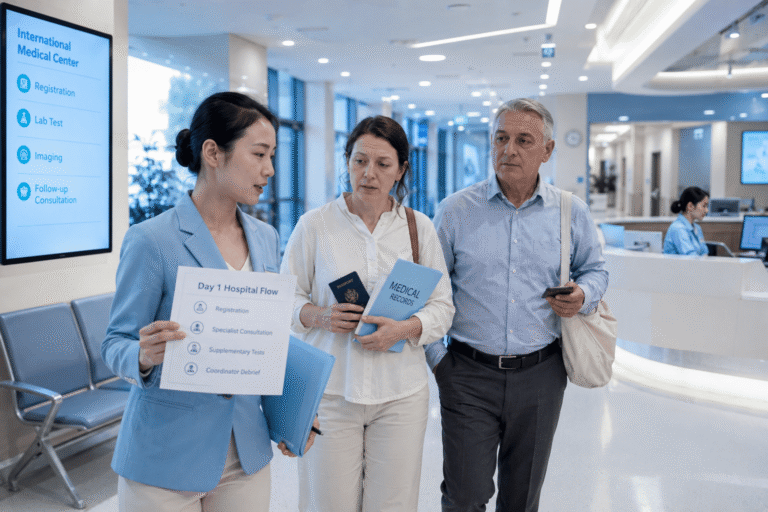
Before international patients travel to China for medical care, a seemingly simple but actually nuanced question often comes up: “Do I need to bring family with me? Who? How many?” The answer isn’t black-and-white — it depends on your condition, cultural background, decision-making style, and your comfort with navigating an unfamiliar medical environment alone. Chinese hospital culture differs meaningfully from Western culture (with a much stronger emphasis on family involvement), and understanding this helps you make a more informed plan. This article walks through the five core roles a family member plays in a Chinese hospital visit, who to bring, how many, and the situations in which you can travel alone.
How Chinese Hospital Culture Frames the Family’s Role
The Chinese hospital system defaults to assuming patients are accompanied by family members — a meaningful difference from the Western “patient-autonomy-first” culture:
- Admission paperwork: most hospitals’ admission processes default to requiring family signatures (especially for surgical consent and anesthesia consent)
- Surgical decisions: before complex surgery, physicians typically discuss the plan with both the patient and family together — this is cultural custom, not a legal requirement
- During hospitalization: traditionally in China, family members provide bedside companionship, meal delivery, daily-life care during inpatient stays — even with a full nursing team in place, family presence remains the norm
- Critical communication: in case of sudden deterioration or emergency, physicians notify the family immediately — physicians assume family is the patient’s most important support system
Practical implication for international patients: you don’t need to replicate the Chinese tradition of “the entire family accompanies,” but having at least one family member (or authorized representative) present during key decision moments makes the entire process smoother.
Five Core Roles of an Accompanying Family Member
Role 1 · Emotional support
The most intuitive and most important role. In an unfamiliar hospital environment facing potential surgery or major treatment decisions, a family member’s emotional support is something no professional can replace.
Role 2 · Information capture and memory backup
Even with complete consultation summaries, having a family member as “a second set of ears” is highly valuable for international patients:
- Listens alongside while the physician explains, taking notes (preventing missed details)
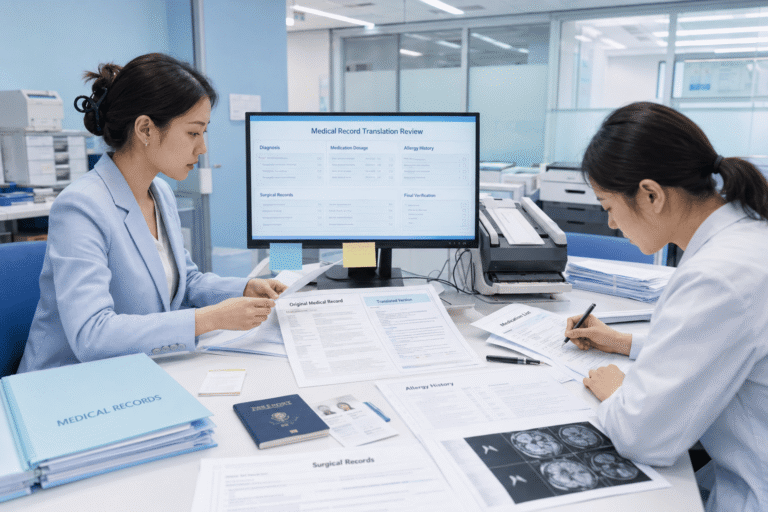
- Catches potential gaps in interpreter translation by raising questions
- Helps you recall “what the physician actually said” afterward — especially when you’re jet-lagged or tense
Role 3 · Medical decision participation
Complex treatment decisions (surgery vs conservative, aggressive vs moderate, immediate vs wait) typically require time to absorb and discuss. Family is your most natural discussion partner — more direct, with deeper shared interest, than discussing with a coordinator.
Role 4 · Practical logistics support
Especially during treatment and recovery:
- Picking up meals, buying daily necessities, assisting with bathing (especially when post-operative mobility is limited)
- Simple Chinese-language communication with hotels, taxis, shops
- Help managing medications and dosing schedules
- Handling errands while you rest (collecting reports, signing routine paperwork)
Role 5 · Cultural and emotional buffer
The loneliness and cultural shock of seeking medical care in a foreign country is real. Family presence provides familiar language, familiar food preferences, familiar emotional rhythms — these seemingly small things have a real impact on the recovering patient’s mental state.
Who to Bring? Four Typical Companion Options Compared
Spouse / Partner
- Strengths: knows your medical history and treatment preferences best; decision authority is clearest; deepest emotional connection
- Limitations: if your spouse is also elderly or has mobility issues, they may need care themselves
- Best fit: most situations — this is the most common companion choice
Adult Child
- Strengths: physically capable, can take on more logistics; typically stronger English (especially with higher education); more familiar with modern medical concepts
- Limitations: may need to take leave, separated from their own family
- Best fit: parents traveling to China for treatment; especially recommended for oncology, complex surgery, and other high-intensity treatments
Sibling
- Strengths: similar age, can discuss decisions as equals; typically more flexible work schedule
- Limitations: may not fully know your medical history
- Best fit: unmarried or single patients; when a spouse can’t travel
Parent (if you’re a young patient)
- Strengths: deep emotional support; typically has time to accompany
- Limitations: elderly parents may need care themselves; may struggle with medical terminology
- Best fit: routine companionship for young patients
How Many? Typical Configurations
1 companion (most common)
- Best for: routine surgery, well-defined treatment, short hospitalization (<1 week)
- Value: sufficient to cover emotional support + decision discussion + basic logistics
2 companions
- Best for: complex surgery, longer hospitalization (1–4 weeks), major treatment decisions (such as complex oncology plans)
- Value: division of labor — one primarily accompanies hospital workflow, the other handles hotel and daily logistics; can rotate rest (especially during the intensive 24–72 hour post-surgical period)
3+ companions
- Best for: rare situations (end-of-life farewell, family reunion-style accompaniment)
- Note: may be limited by hospital IMD ward visitor policies (most IMD wards restrict simultaneous visitor count)
Can You Come Alone? Four Situations to Consider
Situation 1 · Coming alone is fine
- Your condition is well-defined and treatment is simple (routine checkup, single outpatient consultation, simple surgery)
- You’re psychologically resilient and can handle an unfamiliar environment independently
- You fully trust and have engaged MedCareInChina or a similar coordination service
- Your medical decisions are already made in your home country; the trip to China is mainly for execution
Situation 2 · Strongly recommended to bring family
- Complex surgery (cardiac, neuro, complex orthopedic, major oncology surgery)
- Treatment decisions remain undetermined and will require further evaluation and decision-making in China
- Hospitalization expected to exceed 1 week
- You are elderly (65+) or have mobility limitations
- Your native language is not English and the IMD primarily uses English
Situation 3 · Family member or authorized representative is required
- Critical illness (with potential ICU monitoring)
- Pre-anesthesia consent — most hospitals require a family member or legal representative to be present for signing
- Irreversible decisions (such as the boundary between radical surgical resection and palliative care in oncology)
Situation 4 · Coordinator partially replaces the family role
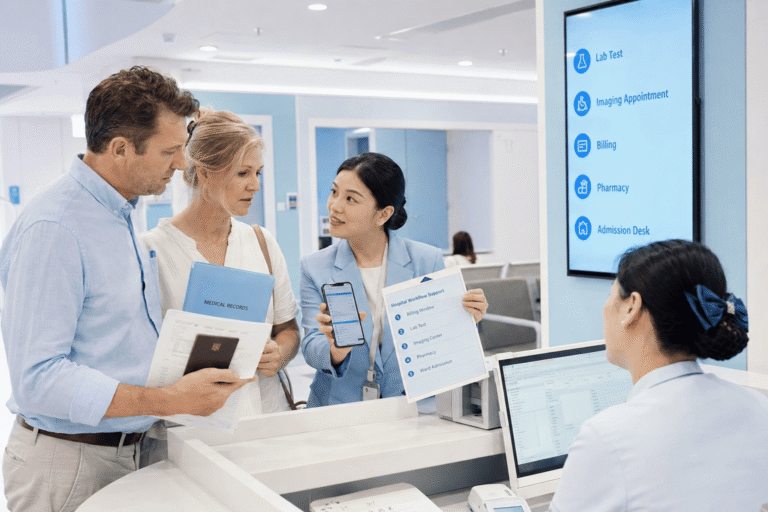
If you truly cannot bring family, MedCareInChina’s coordinator can take on many practical roles:
- ✅ Information capture and translation verification
- ✅ Logistics support (meals, transportation, errands)
- ✅ Decision support (providing information so you can decide)
- ✅ Emergency contact with your home-country family
But emotional support and decision authority are roles the coordinator cannot replace — so coming alone should be a deliberate choice, not a reluctant fallback.
Practical Arrangements for Accompanying Family Members
Visa
Accompanying family members typically apply for a S2 visa (same as the patient) — embassies require:
- Patient’s medical visa invitation letter (from the Chinese hospital)
- Family relationship proof (marriage certificate, birth certificate) — notarized
- Visa application materials (similar to the patient’s)
Accommodation
Two main options:
- Hotel near the hospital (most common recommendation): stays with the patient, travels to the hospital daily. Mid-range hotels near major Chinese Tier-3A hospitals typically run $80–$200 USD per night
- Family companion bed in the hospital ward: most IMD single rooms include one companion bed (cost included in the room rate). Best for the intensive post-surgical period
Meals
Family members can:
- Eat at the hospital cafeteria (public hospitals typically have a patient-family cafeteria, $3–$8 USD per meal)
- Eat at restaurants near the hospital
- Bring food to the patient (with attention to dietary restrictions for specific conditions)
Cost considerations
Typical additional costs for an accompanying family member:
- Flight: same cabin as the patient
- Accommodation: $80–$200 USD per night × treatment duration
- Meals: $20–$50 USD per day
- Visa fee: $70–$150 USD (varies by nationality)
Total additional cost for one family member over a one-week treatment cycle: typically $1,500–$3,500 USD (excluding flights)
Specific Family Member Functions at Each Treatment Stage
Consultation phase (Day 1–2):
- Listens to specialist explanations alongside you
- Records key information
- Helps you organize questions
- Discusses with you during decision-making
Pre-surgical / pre-treatment:
- Co-signs informed consent (most hospitals require family signature)
- Prepares pre-surgical needed items
- Provides emotional reassurance
During surgery / treatment:
- Waits in the surgical waiting area or ward
- Receives intra-operative updates from the physician (such as if the procedure needs to be expanded)
- Maintains communication with the coordinator — the coordinator represents you with the hospital; family represents the family
Day 1 post-surgery (the most sensitive 24 hours):
- Bedside companionship
- Helps the nursing team understand changes in your status
- Helps you handle post-surgical pain, discomfort, and emotional fluctuations
Recovery phase:
- Logistics support
- Helps maintain your spirits
- Assists the coordinator with discharge paperwork
Common Questions
Do I have to bring a spouse? Can an adult child come instead? Legally, any adult family member or authorized representative can serve as “accompanying family.” Chinese hospitals don’t restrict “who is family” — anyone the patient designates and who can sign consent forms qualifies.
Can an unmarried partner serve as accompanying family? Yes, for daily companionship, but there may be restrictions on signing legal documents like surgical informed consent. We recommend also designating a legal family member (such as a parent or sibling) as the decision authority, or preparing a written power of attorney in advance.
Can friends accompany me? Friends can accompany you for daily matters, but cannot sign medical legal documents. Important decisions still require a legal family member or representative.
Can accompanying family enter the operating room? Typically no. Operating rooms are sterile environments restricted to medical personnel. Family is positioned outside the recovery room or ICU after surgery.
Do accompanying family members need PCR testing or health declarations? Currently (as of May 2026) routine PCR is generally not required. For specific requirements, check the latest regulations from the National Immigration Administration of China.
I can’t bring any family to China — can family members participate in decisions remotely? Yes. MedCareInChina can arrange video conferences during important decision moments so your home-country family members (regardless of time zone) can participate in real-time discussions. This applies to patients who have decided to travel but whose family cannot accompany due to visa, work, or health reasons.
Bottom Line
Bringing accompanying family is the default recommendation — Chinese hospital culture differs from your home country in ways that make the process smoother, safer, and less lonely with family present.
Typical configurations:
- Routine situations: 1 companion (spouse or adult child)
- Complex treatment: 2 companions (rotating for rest)
- No companion: possible, but recommended to authorize the MedCareInChina coordinator for some roles + arrange remote family decision participation
Coming alone is feasible if:
- The treatment plan is already defined
- You’re psychologically resilient
- You’ve engaged a trustworthy coordination service
- You’ve arranged remote decision-making with family at home
If you plan to bring family with you, MedCareInChina assists with S2 visa invitation letters, flights, and accommodation for accompanying family members.
Start with a free Pathway Scan. We will tell you whether China is worth further consideration and which type of next step may fit. The free scan does not include hospital or doctor recommendations, medical advice, individualized cost estimates, insurance determinations, or treatment planning.
See Service & Refund Policy and Medical Disclaimer for service boundaries.
Sources
- Chinese hospital family accompaniment cultural norms — Based on operational experience at multiple major Tier-3A IMDs and Chinese healthcare tradition.
- S2 visa accompanying family application — Referenced from Article 7 medical visa sources. https://us.china-embassy.gov.cn/lsfw/zj/zytz/202208/t20220823_10749655.htm
- IMD companion bed arrangement — Referenced from Article 6 on IMD ward configuration.
- Hospital family cafeteria pricing range — Public information from major Chinese comprehensive hospitals.