9 minutes read
When international patients prepare for medical care in China, one of the most common role confusions is: “I’ll just bring a translator, right?” The answer is no — medical interpreter and care coordinator are two distinct roles, each solving a different category of problem. Solving only the language problem without solving the workflow problem leaves the entire treatment experience chaotic, delayed, and prone to errors. This article walks through the boundary between these two roles, when you need which, and why most complex cases need both.
The Fundamental Difference Between the Two Roles
Medical Interpreter
- Core function: language conversion
- Working window: typically only during your face-to-face communication with the doctor
- What they do: convert the doctor’s Chinese into your native language; convert your native language into Chinese; translate written reports
- Not responsible for: hospital workflow coordination, insurance settlement, cross-department navigation, decision support
Care Coordinator
- Core function: end-to-end workflow management
- Working window: from before you decide to travel → throughout your time in China → through post-discharge follow-up
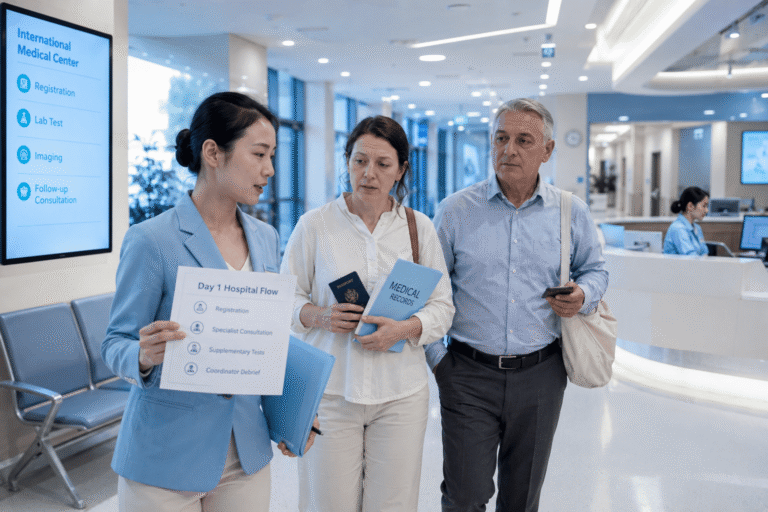
- What they do: pre-travel record preparation, visa invitation letter, flights, accommodation, airport pickup, hospital appointments, accompaniment at consultations, insurance direct billing coordination, report interpretation, cross-department coordination, treatment pace management, family communication, post-return follow-up
- Typically includes: arranging medical interpretation at key encounters
A simple analogy:
- Medical interpreter = “language bridge”
- Care coordinator = “project manager + private guide + doctor-patient relationship manager”
The Real Boundary of IMD-Provided Translation Services
This is the most commonly misunderstood point for international patients: “I’ll go through the IMD, so the translator they provide should be enough, right?”
The reality is that in-house interpreters at major Chinese Tier-3A IMDs typically cover only the following moments:
- ✅ Real-time interpretation during the doctor’s consultation
- ✅ Verbal explanation of key examination reports
- ✅ Treatment plan discussion
- ✅ Basic admission paperwork
But typically do not cover:
- ❌ Imaging center — the actual CT, MRI, PET-CT scanning process (technician–patient communication)
- ❌ Laboratory — blood draw, urine collection, etc.
- ❌ Billing window — hospital cashier counters typically operate only in Chinese
- ❌ Inpatient ward daily life — routine communication with nurses and ward physicians
- ❌ Pharmacy — discharge medication usage instructions
- ❌ Operating room — pre-anesthesia assessment, post-operative recovery period communication
The practical consequence: the interpreter you meet at the IMD typically only accompanies you for a 30–60 minute consultation. Once you leave the consulting room — for imaging, billing, hospital admission — patients often find themselves in a language island.
The Real Cost of Translation Errors
Medical interpretation isn’t just about “smooth communication” — translation errors can have severe clinical consequences. Several widely-cited real cases from the international medical literature:
- Willie Ramirez case (Florida, USA): the Spanish word “intoxicado” (meaning food poisoning) was mistranslated as “intoxicated” (meaning drug overdose). The medical team treated for drug overdose, and the patient’s intracerebral hemorrhage was not diagnosed in time, resulting in quadriplegia. Final settlement approximately $71 million USD [1]
- Heart medication “once” misuse: a Spanish prescription read “once” (Spanish for “11”), which went untranslated. The patient took 11 pills per day instead of 1, causing severe poisoning [1]
- Decimal format misreading: a European prescription written as “1,5 mg” (European notation for 1.5 mg) was misread as “1.5 mg” or “15 mg” — a dose discrepancy of up to 10-fold
- mg / μg confusion: misreading mg (milligram) as μg (microgram) = a 1,000-fold dose error — essentially fatal in chemotherapy drugs
The implication for international patients:
- High-quality medical interpretation is a critical link in clinical safety, not an “optional add-on”
- Using inexpensive non-professional interpreters (tourist interpreters, hotel front desk staff, English-language students) for medical content carries extremely high clinical risk
- Complex cases (especially oncology, cardiac surgery, complex medication regimens) should use professional medical interpreters with credentials such as CATTI, NAATI, or ATA certification
How MedCareInChina Minimizes Translation Risk: Our Six Safeguards
Knowing the cost of translation errors is one thing — preventing them is another. MedCareInChina operates a six-layer safeguard specifically designed to drive medical translation accuracy as close to 100% as possible:
Safeguard 1 · Certified medical interpreters only We work exclusively with CATTI Level 1/2 certified interpreters or equivalent international credentials (NAATI, ATA, AIIC). General business interpreters or tourist interpreters are never deployed on medical encounters, no matter how cost-attractive.
Safeguard 2 · Dual interpretation for high-risk encounters For high-stakes encounters — initial diagnosis discussion, treatment plan confirmation, surgical consent, ICU communication, chemotherapy/targeted therapy briefings — we deploy a primary medical interpreter + a verification coordinator who cross-checks each clinically critical statement in real time.
Safeguard 3 · Written confirmation of all critical information Every drug name, dosage, frequency, treatment date, and surgical detail is captured in writing in both languages and signed by the patient. We never deliver dosage information verbally without written backup. This eliminates the single largest category of medical translation errors.
Safeguard 4 · Standardized terminology lockdown We use pre-prepared bilingual reference materials for high-risk content:
- Drug names: always include both generic and brand names (e.g., “osimertinib / Tagrisso 泰瑞沙”)
- Dosages: written with explicit units (mg, mcg/μg, mL) — no shorthand
- Numbers: critical values spelled out alongside numerals (e.g., “fifteen milligrams · 15 mg”)
- Routes of administration: explicit (oral / IV / IM / subcutaneous), no abbreviations
Safeguard 5 · Patient teach-back protocol At the end of every consultation, the patient is asked to repeat back the key understanding in their own words: “So I take this pill twice a day for 14 days, starting tomorrow morning.” If teach-back reveals misunderstanding, we clarify before ending the session. This single practice catches roughly half of translation errors before they become clinical events.
Safeguard 6 · Post-consultation bilingual written summary Within 24 hours of every consultation, the patient receives a bilingual written summary covering: diagnosis discussion, treatment plan, medications (with full dosing instructions), follow-up actions, and questions raised. The patient confirms accuracy in writing. This creates a permanent record that both the patient and the physician can refer back to — and lets the patient catch any oral misunderstandings before they translate into wrong action.
The combined effect: while no human-mediated communication can ever be 100% error-free, this six-layer approach is designed to push translation accuracy to the highest achievable level — by combining certified human interpretation with structural redundancy (written confirmation, teach-back, post-visit summary) at every high-risk juncture.
Market Pricing for Medical Interpretation in China
Typical pricing for medical interpretation in China [2]:
| Service Type | Price (USD) | |
|---|---|---|
| General accompanying interpretation | $70–$140 / hour | |
| Medical accompaniment (daily package, 8 hours) | $278–$694 / day | |
| Specialized medical interpretation | $111–$278 / hour | |
| Overtime rates | Base rate +25% to +50% | Same proportion |
Language variations: English is the baseline; Japanese, Korean, French, German pricing is similar; Arabic, Russian, Portuguese, and other small languages typically cost 30–80% more.
Channel variations:
- Translation companies: highest pricing (includes 30–50% management fees), with full invoicing and quality assurance
- Freelance interpreters: lower pricing, but no built-in quality guarantee
- Hospital IMD in-house interpreters: typically bundled into IMD service fees (covering only the consultation period)
- Third-party coordination services: typically include medical interpretation as part of total treatment-cycle pricing
What a Care Coordinator Does
International benchmark coordinator services (such as Mayo Clinic International Patient Coordinator [3] and Cleveland Clinic Global Patient Services with 70+ specialists in an account manager model [4]) cover:
Pre-travel phase (4–8 weeks before arrival):
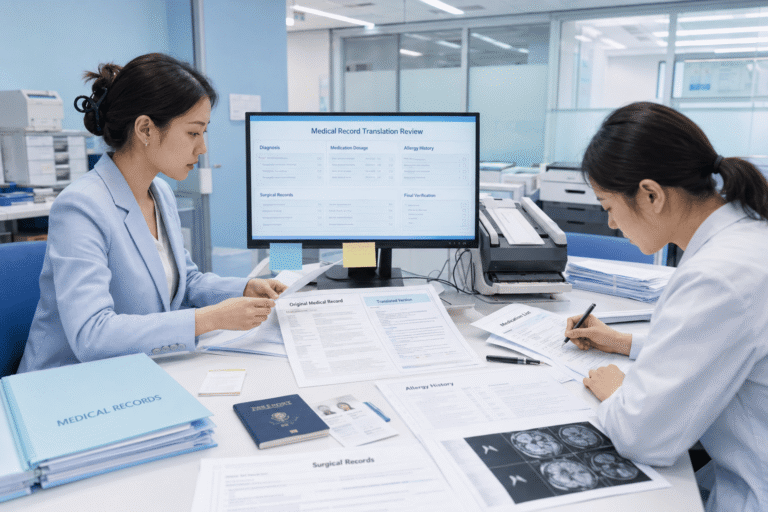
- Medical records collection and translation
- Matching with Chinese specialists
- Remote second opinion or MDT arrangement (see Articles 9, 10)
- Medical visa invitation letter application
- Flights, accommodation, visa application support
- Treatment budget estimation
Arrival phase (first 1–3 days after landing):
- Airport pickup
- Accommodation setup
- Initial hospital appointment confirmation
- Necessary supplemental testing arrangement
Treatment phase (during in-China stay):
- Accompanying every consultation (including medical interpretation)
- Full accompaniment through imaging, labs, examinations
- Insurance direct billing coordination
- Pre-operative family communication
- Real-time family updates during surgery
- Report interpretation and treatment plan discussion
- Cross-department coordination (such as ICU transfer, consultation requests from other departments)
Discharge phase (after release):
- Discharge paperwork
- Medication list and dosage translation
- Imaging and pathology materials organization
- Departure procedures
Follow-up phase (after return home):
- Remote follow-up consultation arrangement
- International shipping of imaging and pathology
- Bridge between Chinese physician and home country physician
- Coordination of return visits to China if needed
The fundamental difference: a coordinator’s job is to let you “not have to think about” workflow issues, so you can focus on the treatment itself; an interpreter only enables you to “understand.”
When You Need Which
Medical interpretation alone is enough when:
- A single remote second opinion (you’re at home, only need translation for the specialist consultation)
- A short visit to China for a single outpatient consultation (no hospitalization, no complex decisions)
- You or a family member speaks fluent Chinese and is familiar with Chinese hospital workflows
- You’ve already arranged for a local family member or friend to coordinate
You need a coordinator (with interpretation included) when:
- Any treatment involving hospitalization, surgery, or multiple consultations
- Using international insurance direct billing (insurance settlement workflows are relatively complex in China)
- Complex cases: oncology, complex cardiovascular, rare diseases, cross-department treatment
- Bringing elderly family members or those with limited language capability
- First time visiting China for medical care, with no familiarity with the Chinese healthcare system
- Need to arrange consultations or comparisons across 2–3 hospitals
The practical principle: for the vast majority of international patients, a coordinator (with medical interpretation) is the safer, easier, and ultimately more economical choice. Purchasing standalone medical interpretation often looks cheaper, but the added cost of your own time, potential pitfalls, and missed details typically makes the total cost higher.
What MedCareInChina’s Service Includes
MedCareInChina provides a complete care coordinator service, with medical interpretation included:
- Pre-travel: Free Pathway Scan + remote second opinion or MDT (priced per Articles 9, 10)
- Arrival: full accompaniment from landing through departure
- Treatment: medical interpretation + workflow coordination + insurance settlement
- Departure: discharge handling and materials organization
- Post-return: follow-up coordination + materials shipping + remote bridge
Compared with purchasing standalone medical interpretation:
- A coordinator can address problems you “don’t know you don’t know” (hospital workflows, insurance details, physician preferences, cultural nuances)
- A coordinator represents your interests in communication with hospitals and insurers — standalone interpreters don’t carry this role
- A coordinator can actively intervene when treatment pace develops issues (such as surgery delays, medication adjustments, family coordination)
Common Questions
The IMD already provides a translator — do I still need a coordinator? Usually yes. IMD translators only cover the consultation period, not the full workflow of imaging, billing, hospitalization, insurance, or discharge.
How is the coordinator fee billed? MedCareInChina’s coordinator service is priced by treatment cycle and bundled with the remote second opinion or MDT service ($800 Single Expert / $1,000 per expert MDT). Specific pricing is customized based on case complexity and length of stay in China.
Is the coordinator a doctor? Not necessarily. MedCareInChina’s coordinators are primarily medically trained project managers — familiar with the Chinese healthcare system, with medical interpretation capability, and able to communicate effectively with physicians. When specific clinical decisions are needed, the coordinator facilitates specialist consultation rather than offering medical advice independently.
Can I use only part of the coordinator service? Yes. For example, you might use only “pre-travel visa invitation + airport pickup + accompaniment at the first consultation” without full coordination. Specific service packages can be customized to your situation.
Can the coordinator guarantee treatment outcomes? No. No medical service can guarantee outcomes — what a coordinator can guarantee is workflow smoothness, information transparency, and well-founded decisions. Clinical outcomes depend on the physician, the hospital, and your specific condition.
Can the coordinator make medical decisions for me? No. All major medical decisions are made by you (or a family member you authorize). The coordinator’s role is to help you fully understand each option so you can decide based on complete information.
Bottom Line
Medical interpreter: solves the language problem Care coordinator: solves the workflow, decision, cross-department, and relationship problems (with interpretation included)
The most practical judgment for international patients:
- Single remote consultation / short outpatient visit → medical interpretation alone may be enough
- Hospitalization, surgery, complex treatment, insurance settlement → a coordinator (with medical interpretation) is almost always necessary
The cost of translation errors in clinical settings far outweighs the savings from cutting translation costs — this is the core rule of the medical translation market.
MedCareInChina provides complete care coordinator service with medical interpretation, covering the full cycle from pre-travel to post-return follow-up.
Start with a free Pathway Scan. We will tell you whether China is worth further consideration and which type of next step may fit. The free scan does not include hospital or doctor recommendations, medical advice, individualized cost estimates, insurance determinations, or treatment planning.
See Service & Refund Policy and Medical Disclaimer for service boundaries.
Sources
- Real medical translation error cases — Willie Ramirez case, heart medication “once” misuse, decimal format misreading. Synthesized from international medical literature and legal cases. https://www.k-international.com/blog/medical-translation-gone-wrong-4-devastating-examples/ ; https://boostlingo.com/blog/the-high-price-of-medical-interpreting-errors/ ; https://healthlaw.org/wp-content/uploads/2018/09/Language-Access-and-Malpractice.pdf
- Medical interpretation market pricing in China — Synthesized from multiple translation company public pricing pages: general accompanying interpretation $70–$140/hour; medical accompaniment daily package $278–$694/day; specialized medical interpretation $111–$278/hour. Overtime rates +25% to +50%. https://www.meyvnls.com/blog_escort.html ; https://www.chinapharmconsulting.com/cn/hy_zs/14962.html ; https://www.jinyutrans.com/news/human_translation_interpretation_price_list_jinyu
- Mayo Clinic International Patient Coordinator — Standard international patient coordinator responsibilities: embassy/intermediary liaison, itinerary arrangement, Letter of Guarantee scope confirmation, cross-departmental coordination. https://www.mayoclinic.org/international/support ; https://jobs.mayoclinic.org/job/rochester/international-patient-coordinator/33647/87564485616
- Cleveland Clinic Global Patient Services — 70+ coordination specialists; arranges appointments, hotel, airport pickup, interpretation, financial consultation; assigns a dedicated Account Manager for end-to-end follow-through. https://my.clevelandclinic.org/patients/international
- In-house translation capability at major Chinese Tier-3A IMDs — PUMC IMS (Chinese-English primary), Shanghai Ruijin IMD (Chinese-English + others on coordination), Shanghai Huashan IMC (multi-language), Sun Yat-sen 1st Affiliated Nansha IMC (40+ countries multi-language), Shanghai Jiahui International Hospital (1,000+ staff from 13 countries with English, Japanese, Korean, French, German, Russian, Spanish, Arabic, etc.), Beijing United Family (English-primary with multi-language support). https://ims.pumch.cn/guide/1.html ; https://www.rjh.com.cn/2018RJPortal/txylbjzx/sy/index.shtml ; https://www.huashan.org.cn/xueke/detail/41.html ; https://nansha.fahsysu.org.cn/node/28960 ; https://www.jiahui.com/en
- Reference for service scope of Chinese international medical coordination agencies — Compiled from publicly available service scope information across multiple international medical coordination agencies. https://www.medicaltravelchina.org/zh-hans/