Reading time: 12 minutes
Introduction
Not every international patient coming to China for medical care has international health insurance. Based on MedCareInChina’s 2024–2025 patient data, a substantial portion of our international patients choose to self-pay — reasons include: their insurance does not cover overseas treatment, the insurer rejected the claim citing pre-existing conditions, the patient wanted to avoid lengthy pre-authorization timelines, or they chose treatments outside their policy’s scope (certain CAR-T therapies, proton/heavy-ion therapy, novel drugs, etc.).
This article walks you through:
- How much to budget for self-pay treatment in China
- How the deposit system works
- Which payment methods Chinese hospitals accept
- How to handle cross-border funds in a compliant way
- The practical service space self-pay patients actually have in China’s medical system
1. Why Many International Patients Choose Self-Pay
- Insurance does not cover overseas treatment — most domestic base insurance plans exclude treatment abroad
- Claim rejected — pre-existing condition clauses, experimental treatment exclusions
- Avoiding pre-authorization delays — urgent treatment cannot wait 5–10 business days
- Privacy considerations — some patients prefer not to have treatment records enter the insurance system
- Broader choice — drugs and technologies outside insurance formularies can be used freely
2. An Important Note on Remote Consultations
Many patients first encounter MedCareInChina through our remote consultation product — the rules here must be clear:
- Remote consultations (Article #2 Single Expert Consultation and Article #3 MDT) are cross-border medical advisory services. They are not in-hospital inpatient or outpatient care in China, and therefore cannot be issued a formal Chinese hospital invoice (Fapiao). They are also generally not accepted by international insurance companies as a reimbursable expense.
- We provide only a MedCareInChina service receipt — with the amount, date, and service scope clearly itemized. It may be used for your personal tax records or employer reimbursement at home, depending on local rules.
- Remote consultations are self-pay and paid 100% upfront — USD 800 for a Single Expert Consultation, USD 1,000 per expert for an MDT.
- Refund rule: Full refund if cancelled before we begin consultation preparation; once started (medical records submitted, expert contacted), no refund.
If you are talking about inpatient or outpatient treatment delivered by a hospital in China, that portion can be issued a Fapiao — the rules are in Section 6.
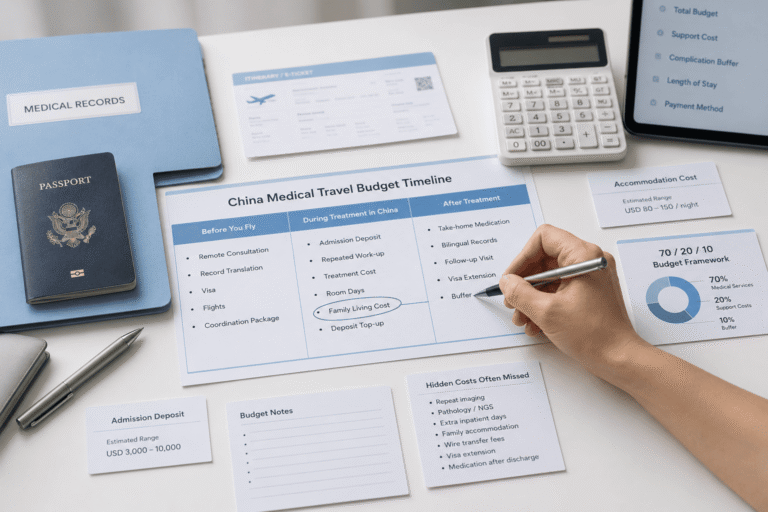
3. How Much to Prepare for Self-Pay (Typical Treatment Ranges, USD)
The ranges below are based on our actual patient data, converted at. For budgeting reference only — final amounts depend on each hospital’s actual quote.
| Treatment Type | Self-Pay Total Budget (USD) | Notes |
|---|---|---|
| Single remote expert consultation | 800 | MedCareInChina standard |
| MDT multi-disciplinary consultation | 1,000 / expert | Usually 3–5 experts |
| Full imaging assessment package | 3,000–6,000 | PET-CT + MRI + pathology |
| Standard chemotherapy (6 cycles) | 15,000–40,000 | Incl. supportive care |
| Complex oncologic surgery | 18,000–45,000 | Incl. anesthesia & ICU |
| Proton/heavy-ion therapy | 45,000–60,000 | Full course |
| CAR-T therapy | 160,000–220,000 | Incl. inpatient stay |
| Allogeneic stem cell transplant | 80,000–150,000 | Full course |
| Liver transplant | 90,000–140,000 | Incl. 1 month post-op |
Key reminder: Total self-pay budget ≠ treatment cost. Reserve an additional 20%–25% as a buffer for complications, extended hospitalization, added tests, and accompanying-family living expenses.
4. The Self-Pay Deposit System (Where Patients Most Often Get Caught Off-Guard)
Deposit expectations at China’s major tertiary hospitals’ international medical departments, and at the high-end private hospitals we work with, are generally:
- Outpatient consultation: typically no deposit; payment at point of service
- Standard inpatient admission: USD 5,000–8,000 on day of admission
- Major surgery / transplant / CAR-T: USD 15,000–30,000 before admission, with top-ups as treatment progresses
- Proton/heavy-ion therapy: USD 30,000–60,000 prepaid before treatment begins
Deposits are prepaid funds — settled at discharge with refund of any unused balance. They are not non-refundable.
5. Payment Methods Accepted by Hospitals
Major tertiary hospitals’ international departments, and most private hospitals we partner with, support:
- Foreign credit cards — Visa / Mastercard / Amex via on-site POS (some hospitals cap single transactions at USD 5,000; you may need to split into multiple charges)
- UnionPay (China-issued cards)
- International wire transfer — to the hospital’s corporate account (the hospital provides SWIFT details)
- Cash — small amounts only, typically capped at USD 10,000 per day
- Third-party medical payment platforms — a few hospitals work with Pacific Prime / Now Health and similar
- WeChat Pay / Alipay — some hospitals allow foreign card binding (exchange rate is not always favorable)
Most reliable combination: International wire transfer (large amounts) + credit card (smaller amounts and backup).
6. Fapiao and Cross-Border Payment Compliance
On Fapiao (China’s official tax invoice):
- Inpatient, outpatient, diagnostic, surgical, and pharmacy services you receive inside a Chinese hospital — the hospital can issue a Fapiao
- The cross-border consulting and coordination service fees you pay to MedCareInChina — these are our overseas advisory services and do not come with a Chinese hospital Fapiao; we issue only a MedCareInChina service receipt
- Keep the two categories of documentation separate to avoid confusion during home-country tax filing or employer reimbursement
On cross-border transfers: China imposes monitoring rules on inbound foreign currency, but medical treatment remittances are not restricted — provided that:
- The transfer purpose is clearly stated as “Medical Treatment”
- The recipient is the hospital’s corporate account (never a personal account)
- All transfer receipts are retained
Do not wire medical fees to MedCareInChina, or to any intermediary’s personal account — Chinese regulations expressly prohibit this. Treatment fees go directly to the hospital, and documentation is issued directly from the hospital to you. MedCareInChina collects only its own service fees through our own corporate account.
7. The Service Space Self-Pay Patients Actually Have
A self-pay status carries some practical advantages within China’s medical system — use them sensibly:
- Bundled diagnostic pricing — imaging centers can often offer a “full oncology workup” package for self-pay patients, typically 10–15% cheaper than itemized totals
- Imported consumable options — self-pay means you can follow your physician’s recommendation on consumables (e.g., joint prostheses, cardiac stents) without being constrained by the national insurance formulary
- Faster scheduling — self-pay patients can typically be scheduled for surgery within 48–72 hours
- Newer drugs — certain newer targeted and immunotherapy agents not yet on the national formulary are immediately available to self-pay patients
These are not “VIP privileges” — they are structural differences between China’s national insurance system and the foreign self-pay pathway.
8. What MedCareInChina Actually Supports in Self-Pay Scenarios
What we do:
- Budget planning — issue a treatment budget table based on your medical situation (including buffer recommendations)
- Deposit coordination — pre-confirm deposit amounts with the hospital’s international department to avoid last-minute changes on admission day
- Payment method optimization — help you select the right credit card / wire transfer mix
- Discharge accompaniment — review the itemized hospital bill with you at discharge to catch any duplicate charges
- Documentation guidance — explain which receipts to keep and what each is used for
What we do not do — and have never promised to do:
- We do not file insurance reimbursement claims on your behalf with your home-country insurer
- We do not issue Chinese hospital Fapiao (Fapiao is issued directly by the hospital to you)
- We do not hold treatment funds on your behalf (you pay the hospital directly)
9. Action Checklist
- List your expected treatment types → estimate your budget using the table above
- Add a 20–25% buffer
- Confirm your home country’s single-transaction outbound foreign-exchange limit in advance
- Get written confirmation of the deposit amount from the hospital’s international department
- Prepare at least two payment methods (wire transfer as primary + credit card as backup)
- At discharge, file your hospital Fapiao and MedCareInChina service receipt separately
References
[1] State Administration of Foreign Exchange of China — Personal Foreign Exchange Administration Regulations. https://www.safe.gov.cn/en/
[2] Peking Union Medical College Hospital — International Medical Services. https://www.pumch.cn/en/
[3] Shanghai Ruijin Hospital — International Medical Care Center. https://www.rjh.com.cn/
[4] Fudan University Shanghai Cancer Center — International Medical Department. https://www.shca.org.cn/
[5] World Bank — Out-of-Pocket Expenditure (% of current health expenditure), China. https://data.worldbank.org/indicator/SH.XPD.OOPC.CH.ZS?locations=CN
[6] OECD Health Statistics 2024 — Health Expenditure and Financing. https://www.oecd.org/health/health-data.htm
[7] MedCareInChina internal 2024–2025 self-pay patient case data (on file).