Reading time: 13 minutes
Most international patients build their budget around one number — the price of the treatment itself. That number is real, but it isn’t the whole budget. The patients who run into financial surprises in China almost always missed the same handful of categories: pre-treatment work-up costs they didn’t know would be repeated locally, accompanying-family living expenses, deposit top-ups during long admissions, the buffer for added tests or complications, and the back-end costs of getting medication and follow-up after they go home. This guide walks through every line item, in time-order, so you can build a budget that survives contact with reality. All figures use the convention and are presented as planning ranges, not quotes.
Stage One: Before You Fly
These are the costs you incur before setting foot in China — and they are easy to underestimate.
| Item | Typical cost (USD) | Notes |
|---|---|---|
| Single remote expert consultation (Article #2) | 800 | MedCareInChina standard, prepaid |
| MDT multi-disciplinary consultation (Article #3) | 1,000 per expert × 3–5 experts | Depends on case complexity |
| Translation of prior medical records | 200–500 | Imaging, pathology, discharge summaries |
| Visa application fee | 30–185 | Varies by nationality |
| International airfare (economy) | 600–2,500 | Varies by origin |
| MedCareInChina coordination package | 2,000–8,000 | Varies by scope of in-country support |
| Stage One subtotal | 4,630–14,985 |
Two important notes on this stage. First, the consultation fees you pay us are for our advisory service; they are not Chinese hospital charges and cannot be issued a Chinese hospital Fapiao or claimed against most international insurance policies. We provide a MedCareInChina service receipt only. Second, the visa fee is the smallest line in the table but the most schedule-critical — visa processing windows of 5–10 business days are a real planning constraint.
Stage Two: During Your Treatment in China
This breaks into two parallel cost streams — what happens inside the hospital, and what it costs to live near it.
Inside the hospital
| Item | Typical cost (USD) |
|---|---|
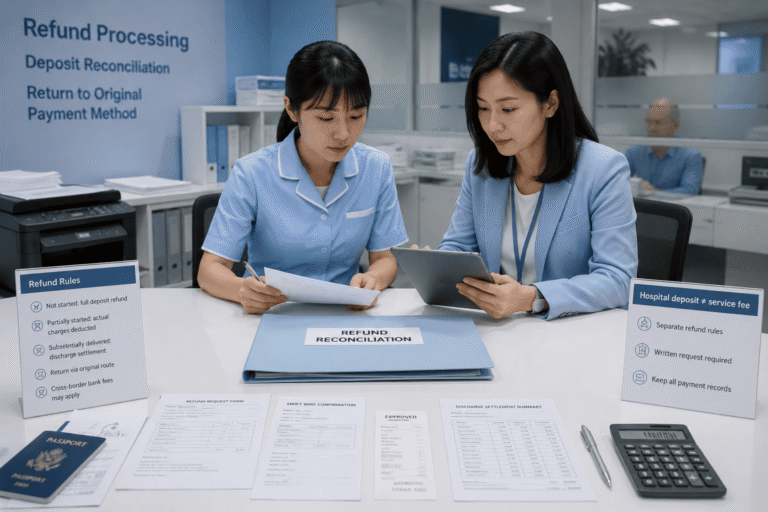
| Admission deposit | 5,000–30,000 (prepaid, reconciled at discharge) |
| Full imaging and pathology work-up on arrival | 3,000–6,000 |
| Treatment itself (varies widely) | See Article #39 self-pay table for ranges |
| International department room (per day) | 200–600 |
| Accompanying-person fold-out bed (per day) | 50–150 |
Outside the hospital
| Item | Typical cost (USD) |
|---|---|
| Hotel or short-term apartment (per day) | 80–250 |
| Daily meals | 30–80 |
| Local transportation | 10–30 |
| Interpreter or care coordinator (per day, if not in package) | 100–200 |
The single biggest cost-control lever at this stage is length of stay. A 21-day inpatient course costs more in living expenses than the airfare; a 56-day CAR-T course costs more in living expenses than many people’s planning allowed for treatment itself. Build the living-cost line against the full expected duration, not just the inpatient days — outpatient follow-up windows often add 2–3 weeks.
Stage Three: After Treatment, Before You Go Home (and After)
| Item | Typical cost (USD) |
|---|---|
| Take-home medication (3-month supply) | 500–3,000 |
| Bilingual medical records package for home-country follow-up or insurance claim | 300–800 |
| Follow-up visit airfare (if returning for review) | 600–2,500 |
| Residence permit renewal or extension (long-stay patients only) | 30–100 |
The take-home medication number deserves attention. Some Chinese-launched targeted and immunotherapy drugs are not licensed in your country of residence, which means you may need to carry forward 3–6 months of supply at a time and arrange import permissions in your home country. The medication cost in China is often dramatically lower than the equivalent abroad — but the logistics need planning before discharge, not after.
Three Worked Examples
These are typical end-to-end budgets we see in coordinated cases. Each is illustrative — your actual numbers will move with diagnosis, hospital selection, length of stay, and complication rate.
Example A: Early-stage lung cancer, minimally invasive surgery, 3 weeks total in China
- Pre-trip costs: ~ 5,000
- Treatment (surgery + pathology + 7-day inpatient stay): ~ 22,000
- Living costs over 21 days: ~ 3,000
- Post-treatment medication and records: ~ 1,500
- Total: approximately 31,500–42,000
Example B: Relapsed/refractory hematologic malignancy, CAR-T therapy, 6–8 weeks total in China
- Pre-trip costs: ~ 8,000
- Treatment (CAR-T product + 28-day inpatient stay): ~ 160,000–220,000
- Living costs over 56 days: ~ 8,000
- Post-treatment follow-up and medication: ~ 5,000
- Total: approximately 181,000–241,000
Example C: Liver transplant, 10–12 weeks total in China including pre-transplant evaluation and recovery
- Pre-trip costs: ~ 10,000
- Treatment (transplant, ICU, 28-day inpatient): ~ 120,000
- Living costs over 84 days, including accompanying family: ~ 18,000
- Post-transplant immunosuppression and follow-up: ~ 8,000
- Total: approximately 156,000–210,000
Hidden Costs Most People Forget
These are the line items we most often see missed when patients build budgets on their own.
- Additional pre-treatment investigations. Your treating physician in China will often repeat or add to the work-up you brought from home, both for clinical safety and because diagnostic standards differ. Expect USD 500–1,500 in additional imaging or labs.
- Pathology immunohistochemistry and genomic profiling. Modern oncology decision-making increasingly depends on biomarker testing — IHC panels, NGS panels, MSI/MMR, PD-L1, HER2. These can add USD 1,000–4,000 and are often necessary before treatment starts.
- Complication-related extra inpatient days. Reserve 10–15% of the treatment budget for this. Most cases don’t need it; the ones that do, need it badly.
- Accompanying family living expenses. Spouse, parent, or adult child accompanying a patient costs the same per day as the patient outside the hospital — and is often forgotten when patients budget for themselves.
- Cross-border wire fees. USD 30–80 per transfer. Across multiple transfers — deposit, top-up, MedCareInChina fees, refund — this adds up.
- Visa extension or change of residence permit. Required for any stay exceeding the initial visa validity, plus a trip to the local Public Security Bureau exit-entry office.
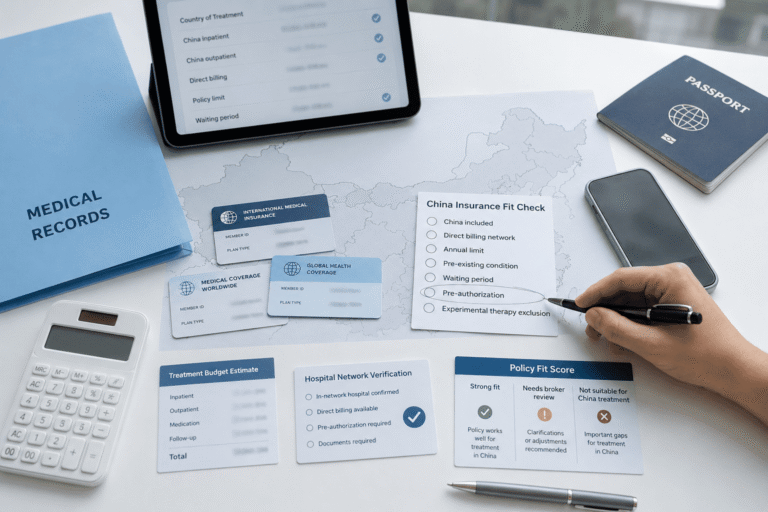
- Insurance gap costs. If your existing policy is between coverage years, or if you’re applying for a new policy after a diagnosis, there can be waiting periods or coverage gaps that fall in the middle of your treatment.
The 70/20/10 Budget Framework
A working rule of thumb we use when helping patients plan:
- 70% of total budget to actual hospital-delivered medical services.
- 20% of total budget to supporting costs — accommodation, meals, interpretation, travel inside China, accompanying family.
- 10% of total budget as a buffer for added tests, extended stay, and complications.
If your draft budget is 90% treatment cost and 10% everything else, you have probably under-budgeted the support and buffer categories. Rework it.
How the Cost Picture Differs by Treatment Type
A few shortcuts worth knowing:
- Routine elective procedures (knee replacement, cataract, single-vessel cardiac stent) — total cost is dominated by the procedure itself, support and buffer are smaller in absolute terms. The 70/20/10 ratio holds reasonably well.
- Oncology with multi-cycle therapy (chemo, immunotherapy maintenance) — support costs grow because total time in China is longer. Expect support to creep toward 25–30%.
- Transplant and CAR-T — buffer is the single most important category because the complication tail is real. Plan toward 15% buffer, not 10%.
- Proton/heavy-ion therapy — treatment cost is the dominant line and rarely overrun; support cost is large because the course is 4–8 weeks. The 70/20/10 ratio holds well here.
Action Checklist
- Use the stage-by-stage tables to draft a line-item budget for your specific case.
- Apply the 70/20/10 framework to check whether your draft has enough support and buffer allocation.
- Confirm the hospital deposit amount in writing with the international department before you wire any funds.
- If you carry international insurance, confirm your annual benefit limit comfortably exceeds your worst-case total.
- If you are self-paying, line up two payment methods (wire and credit card) and confirm your home-bank’s outbound foreign-exchange limit.
- Build a separate budget line for accompanying family — do not bury it inside the patient’s living costs.
Sources
[1] Hospital fee references — Public fee schedules of the international medical departments of Peking Union Medical College Hospital (https://www.pumch.cn/en/), Shanghai Ruijin Hospital (https://www.rjh.com.cn/), Fudan University Shanghai Cancer Center (https://www.shca.org.cn/), Zhejiang University First Affiliated Hospital, and Fuwai Hospital (https://www.fuwaihospital.org/), 2024–2025.
[2] World Bank — Out-of-pocket health expenditure benchmarks — https://data.worldbank.org/indicator/SH.XPD.OOPC.CH.ZS
[3] OECD Health Statistics 2024 — Health expenditure and financing dataset: https://www.oecd.org/health/health-data.htm
[4] iPMI Magazine — Cost of Medical Travel 2024 — https://www.ipmimagazine.com/
[5] MedCareInChina internal patient billing aggregate 2023–2025 — Real coordinated-case billing data anonymized and aggregated. Used to derive range bands and worked-example totals. Not a published dataset; ranges should be treated as planning guidance, not quotes.