11 minutes read
Many international patients who come to China for treatment plan to pay out of pocket first, then file a reimbursement claim with their insurer back home. The biggest risk on this path is not in the hospital — it’s after you leave. Insurers commonly reject or partially reject claims because the documentation is incomplete, the translation isn’t accepted, the Fapiao (Chinese tax invoice) doesn’t match the passport name, or a required pre-notification step was skipped before treatment started. This article walks you through what to prepare, how, and when — so you arrive home with a claim package that has the best chance of being paid in full.
One thing to set straight at the top: MedCareInChina does not file insurance claims on your behalf, and has never offered to. Insurance reimbursement is between you and your insurer. What we do is make sure the in-China documentation you’ll need is correctly issued by the hospital while you’re still here. The actual claim submission, follow-up, and appeals — those are yours to handle.
Reimbursement Starts Before You Fly
The single most common reason a claim gets rejected isn’t anything that happens in China — it’s that the patient didn’t do pre-notification with their insurer before treatment started. Most international policies (Cigna Global, Bupa Global, Allianz Care, AXA, MSH, GeoBlue) require you to notify the insurer in advance of inpatient admissions, major outpatient procedures, or any treatment over a certain cost threshold — even if you’re paying out of pocket and intending to file later[1].
Skipping pre-notification can cap your reimbursement at 50–80% even when everything else is in order. Before you board the flight to China, do three things:
1. Request the latest Claim Form and required documentation list from your insurer in writing (email is fine).
2. Submit a pre-notification with your provisional treatment plan, expected admission dates, and the name of the receiving hospital. Keep the confirmation reference number.
3. Confirm the currency, exchange rate convention, and submission deadline (most policies allow 90 days post-discharge; a few are stricter).
The Four Documents That Determine Whether You Get Paid
International insurers across the major carriers look for the same core set of documents. If any one of these four is missing, weak, or non-compliant, expect either a rejection or a request for additional documentation that delays payment by weeks.
1. Complete medical records (bilingual) — admission note, operative report, chemotherapy orders, pathology report, imaging reports, and discharge summary. These must carry the physician’s signature and the hospital seal. Insurers do not accept patient-translated records; they need a translation from a qualified source.
2. Itemized bill (é€é¡¹è´¹ç”¨æ¸…å•) — this is critical, and where many patients get blocked. A summary statement showing “Total: $32,500” is not enough. The insurer needs a line-by-line breakdown showing every test, drug, consumable, room day, and service. Most Chinese hospitals can produce this — but you have to ask for it before discharge, in writing, ideally with English column headers.
3. Fapiao (Chinese tax invoice) — this is the official tax document recognized by China’s tax authority[2]. For reimbursement purposes the rule is simple and rigid: the name on the Fapiao must exactly match the English name on your passport. A single transposed letter, a missing middle name, or a Pinyin variation can cause an insurer to reject the document. Confirm the spelling with the hospital cashier the first time a Fapiao is issued, and check every subsequent one.
4. Payment proof — credit card slips, wire transfer SWIFT confirmations, or WeChat/Alipay receipts. The total here must reconcile to the Fapiao total. If you paid in multiple instalments, keep all of them.
Translation Standards That Insurers Actually Accept
Insurers will not accept a translation done by you, a family member, or a freelance translator without credentials. The accepted standards are:
• Translation issued by the hospital’s international medical department on hospital letterhead, with hospital seal — this is the strongest form.
• Translation from a qualified translation agency with a notarized translator’s stamp, ideally one familiar with the insurer’s format.
• Translations must be one-to-one with the original; selective or summarized translation gets rejected.
• Medical terminology should follow standard references (ICD-10 codes where applicable, standard drug INN names rather than Chinese trade names alone).
In practice, the cleanest path is to have the hospital’s international department issue the bilingual records and bills before you check out. Some hospitals do this automatically as part of the international medical package; others do it on request for a separate fee. Confirm in writing during admission, not at discharge.
The Six Most Common Reasons Claims Get Rejected
Across the international claims we’ve observed for patients between 2023 and 2025, rejections and partial rejections cluster around the same handful of issues:
1. Fapiao name mismatch with passport (most common). Insurers treat this as a documentation failure, not a typo to be forgiven.
2. Records not translated, or translated by an unqualified source.
3. No pre-notification before treatment started. This is the second most common reason and the most expensive.
4. Annual policy limit reached. Major treatments like CAR-T, transplants, and proton/heavy-ion therapy can blow through standard annual limits.
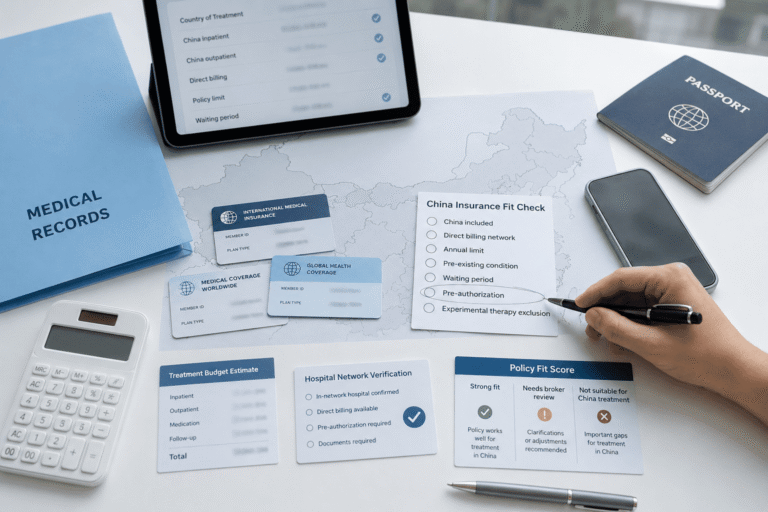
5. Pre-existing condition exclusion triggered. Read your policy carefully — many cancers have waiting periods of 6–24 months on new policies[3].
6. Treatment falls into a policy exclusion. Common exclusions: experimental therapies, certain new drugs not yet approved in your country of residence, fertility treatment, cosmetic procedures, dental work.
Submission Timeline
| Stage | Typical timing |
|---|---|
| Document collection & translation | 1–2 weeks post-discharge |
| Submission to insurer | Within 30 days post-discharge (strongly recommended) |
| Initial review by insurer | 5–10 business days |
| Request for additional information (if any) | 1–4 weeks |
| Final decision & payment | 4–8 weeks total |
Most major international policies require the first claim submission within 90 days of discharge. Some are stricter (60 days, occasionally 30). Check your policy and treat the deadline as hard — late submissions are routinely rejected even when the underlying treatment was covered.
If the Claim Comes Back Partially Paid
Insurers commonly approve 70–90% of the total and disallow specific line items as “not medically necessary,” “above reasonable and customary rates,” or “outside the standard protocol.” If this happens:
1. Request the rejection reason in writing, line by line.
2. Ask your treating physician for a Letter of Medical Necessity explaining why each disputed item was clinically indicated. Hospitals in China will write these when asked, but you need to request through the international department, not the ward team directly.
3. File an appeal. Appeal success rates vary by insurer, but in our observation roughly one-third of partial-rejection appeals result in additional payment when supported by a proper medical-necessity letter.
What MedCareInChina Does and Doesn’t Do Here
To be transparent about scope:
What we do during your treatment in China:
• Coordinate with the hospital’s international medical department so the bilingual medical records, itemized bill, and Fapiao are issued correctly before discharge.
• Flag the Fapiao name-match requirement to the hospital cashier on the first issuance so you don’t end up with twenty incorrect Fapiao at discharge.
• Help you request a Letter of Medical Necessity from the treating physician if you anticipate needing one for appeal.
• Provide the MedCareInChina service receipt for our own fees (separate from the hospital Fapiao — see our self-pay guide for the distinction).
What we do not do:
• We do not file claims with your insurer on your behalf.
• We do not communicate with your insurer’s claims department for you.
• We do not handle appeals.
• We cannot guarantee any specific outcome from your insurer — the policy is between you and them.
This is a boundary we hold firmly. Filing claims and managing appeals is regulated activity in most jurisdictions and is properly your or your broker’s job. Our role is to ensure the in-China side of the paperwork is clean enough that your filing has the best chance of success.
Action Checklist
1. Before flying: request current Claim Form & documentation list from your insurer; submit pre-notification; confirm submission deadline.
2. On admission in China: confirm in writing with the international department that bilingual records, itemized bills, and Fapiao will be provided, and confirm the name spelling for Fapiao.
3. During treatment: keep copies of every payment receipt; ask for cumulative Fapiao to be reconciled weekly for long admissions.
4. Before discharge: request the complete bilingual document package and verify every Fapiao matches your passport name exactly.
5. Within 30 days post-discharge: submit your first claim. Don’t wait until day 89.
Free next step: Start with a free Pathway Scan. We will tell you whether China is worth further consideration and which type of next step may fit. The free scan does not include a hospital or doctor recommendation, individualized documentation plan, insurance determination, medical advice, cost estimate, or treatment planning.
Email hello@medcareinchina.com to start the free Pathway Scan.
See Service & Refund Policy and Medical Disclaimer for service boundaries.
Sources
- Pre-notification and claims documentation requirements — Compiled from publicly available claims procedure documentation of major international insurers, including Cigna Global Claims Procedure (https://www.cignaglobal.com/), Bupa Global Claims Centre (https://www.bupaglobal.com/), Allianz Care Claims Submission Guidelines (https://www.allianzcare.com/), AXA Global Healthcare Claims (https://www.axaglobalhealthcare.com/), and GeoBlue member resources (https://www.geobluetravelinsurance.com/). Specific notification windows and required forms vary by policy and should be confirmed with your insurer directly.
- Fapiao (Chinese tax invoice) standards — State Taxation Administration of the People’s Republic of China, regulations on invoice issuance for medical services. Official site: https://www.chinatax.gov.cn/. Fapiao is the legally recognized tax document in China and is required by international insurers as proof of payment to a regulated entity.
- Pre-existing condition and waiting period clauses — Standard international medical insurance contract language varies by carrier and plan tier. Patients should review their Certificate of Insurance carefully and request written confirmation from their insurer of any waiting periods relevant to their planned treatment. The 6–24 month range referenced is typical for cancer-related waiting periods on newly issued international medical policies as observed in carrier documentation 2024–2025.
- MedCareInChina observed claim outcomes 2023–2025 — Internal aggregate data on partial rejections, appeal outcomes, and common rejection reasons observed across patients who shared claim outcomes with us. Not a published dataset; numbers cited as “in our observation” are directional rather than statistically representative.