Reading time: 10 minutes
One of the most reasonable worries international patients have before signing anything is this: what happens to my money if I can’t come, or if I come and the treatment can’t go ahead? It’s a fair question, and the answer has two halves — what the hospital does with its deposits, and what MedCareInChina does with its service fees. The two operate on different rules, and you should understand both before you commit funds to either. This article lays the rules out plainly.
Hospital Deposit Refunds
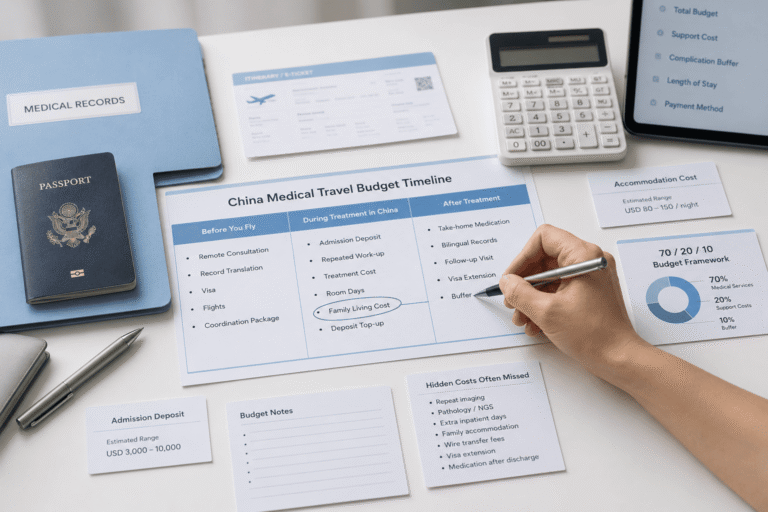
Hospital deposits in China are by design prepaid funds, not non-refundable charges. The mechanism is straightforward: you prepay an amount sized to your expected treatment, the hospital draws against it as services are delivered, and at discharge the bill is reconciled with refund of any unused balance. The Chinese phrase 押金 (yājīn) literally translates as “deposit” in the same prepaid sense as a hotel hold, not in the sense of a non-refundable booking fee.
How it behaves at the major tertiary hospital international departments and the high-end private hospitals we work with:
- Treatment not yet started (registration complete but no investigations or surgery yet) — the deposit is refunded in full.
- Treatment partially started (some imaging, lab work, or medication delivered) — the deposit is refunded minus actual consumption.
- Treatment substantially delivered (surgery performed, CAR-T infused, transplant completed) — the deposit has already been converted into treatment charges; what’s left is the normal post-discharge settlement, which can still be a refund if the deposit exceeded the final bill.
Refund mechanics worth knowing:
- Refunds must return via the original payment method — this is a Chinese foreign-exchange compliance requirement [1]. If you wired the deposit from your overseas account, the refund goes back to that same account; you cannot redirect it.
- Typical processing time is 5–15 business days for cross-border refunds.
- Bank-side handling fees of roughly USD 30–80 may apply on cross-border wires; these come out of the refund total, not from the hospital.
MedCareInChina Service Fee Refunds
Our service fees follow a different structure because what we sell is professional time and coordination rather than prepaid treatment.
Remote consultation products (Article #2 Single Expert Consultation, Article #3 MDT)
These are paid 100% upfront — USD 800 for a Single Expert Consultation, USD 1,000 per expert for an MDT. The refund rule is binary:
- Not started (we have not yet contacted the expert or begun preparing your case file) — full refund.
- Started (medical records submitted to the expert, or expert contacted on your behalf) — no refund.
This is deliberately simple because the underlying cost — the expert’s time and our case-preparation work — is incurred at the moment the consultation begins.
Full coordination packages (in-country navigation, ranging USD 2,000–8,000 depending on scope)
Refund schedule based on time before your scheduled arrival in China:
- More than 14 days before arrival — 70% refund.
- 7 to 14 days before arrival — 50% refund.
- Less than 7 days before arrival — 30% refund.
- After arrival in China — no refund on the package fee, but any hospital deposits you’ve put down remain refundable on the hospital’s terms above.
On-demand add-on services (additional interpreter days, extra family support, post-discharge follow-up assistance) — any unused portion is refunded in full.
Force Majeure and Medical Change of Circumstance
Some situations are nobody’s fault. We handle them with discretion rather than rigid schedules.
- Visa refused — coordination package fee is refunded at 70% after deducting documented work already performed.
- Medical deterioration that prevents travel — with a physician’s certificate, the same treatment applies (refund minus documented work).
- Insurer withdraws coverage at the last minute — same as above.
- Flight cancellations, geopolitical disruption, public-health travel restrictions — we will rebook your treatment window rather than refund, with no change fee on our side; you may still owe airline change fees and any non-refundable hotel charges.
Reschedule First, Cancel Second
In most cases rescheduling is more economical than cancelling outright. Hospital deposits can typically be held in the hospital’s system for around six months. MedCareInChina coordination retainers can be held for twelve months. A modest administrative change fee (USD 100–200) may apply, but you avoid the larger refund haircut and the cross-border wire fees that come with a cancellation. If the situation that’s blocking you now is likely to resolve within a year, rebook rather than refund.
Refund Timeline
| Step | Typical timing |
|---|---|
| Written refund request submitted | Day 0 |
| MedCareInChina internal review | 2–3 business days |
| Hospital-side reconciliation (if hospital deposit involved) | 3–5 business days |
| Finance initiates outbound refund | 1–2 business days |
| Funds land in your account | 5–15 business days (cross-border) |
End-to-end you should plan for 2–4 weeks from request to money in your account.
How to Protect Yourself Before You Sign
Five practical habits that pay off when something goes wrong:
- Insist on a written contract with explicit refund terms, deposit handling, and force-majeure clauses. Verbal commitments don’t survive the moments when you need them most.
- Keep every payment record — wire SWIFT confirmations, credit-card slips — for at least three years.
- Never wire medical fees to a personal account. Treatment funds go to the hospital’s corporate account; coordination fees go to MedCareInChina’s corporate account. Anything else is a red flag, including from us.
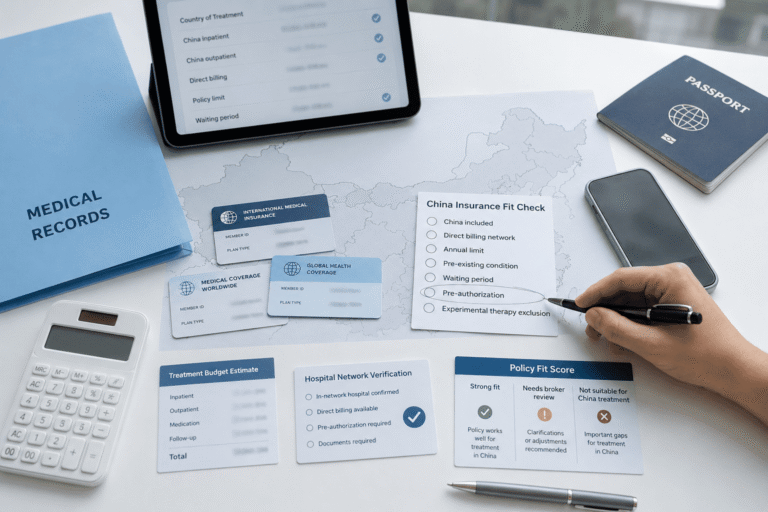
- For very large treatments, look into Medical Trip Interruption coverage. Several international insurers, including Cigna Global and Bupa Global, offer it as an add-on for medical tourism scenarios [2]. It can cover non-refundable deposits and travel costs if you’re medically unable to proceed.
- Notify changes in writing immediately — an email with a timestamp is enough. Refund schedules are time-bound, and “I called and told someone” doesn’t protect you.
What Triggers a Full Refund Most Reliably
In practice the cleanest full refunds happen when:
- You notify us before any consultation work has begun.
- The cancellation reason is documented (visa refusal letter, physician’s certificate, insurer’s withdrawal notice).
- You haven’t yet wired the hospital deposit (so there’s nothing on the hospital side to reconcile).
- The request is in writing through the same channel you used to book.
Action Checklist
- Read the full refund clauses in your contract before paying any amount, including the USD 800 remote consultation fee.
- Keep originals of every payment confirmation in a single folder, digital and physical.
- If circumstances change, send written notice the same day — don’t wait to “see how things develop.”
- Default to rescheduling rather than cancelling when the disruption is likely temporary.
- For treatments above USD 50,000, evaluate whether Medical Trip Interruption coverage is worth the small additional premium.
Sources
[1] Cross-border refund return-to-source requirement — State Administration of Foreign Exchange of China, regulations on cross-border medical-fee refunds requiring funds to return via the original payment path. Official site: https://www.safe.gov.cn/en/
[2] Medical Trip Interruption coverage — Add-on coverage offered by major international medical insurers including Cigna Global (https://www.cignaglobal.com/) and Bupa Global (https://www.bupaglobal.com/). Coverage scope, eligibility, and premium structure vary by insurer and policy tier; confirm with your insurer directly.
[3] People’s Republic of China Law on the Protection of Consumer Rights and Interests — Provisions governing service contracts, refund obligations, and dispute resolution. National People’s Congress legal database: http://www.npc.gov.cn/
[4] MedCareInChina Standard Service Agreement (template v2025.3) — Internal contractual document; copy provided to every patient at engagement.