8 minutes read
If you’re an international patient deciding where to receive medical care in China, the first real question isn’t “which doctor?” — it’s “which type of hospital?” The choice between a public Tier-3A hospital (公立三甲) and a private international hospital isn’t about quality versus quantity. Both can deliver excellent outcomes. What changes between them is everything else: how much you’ll pay, whether the staff speaks English, how long you’ll wait, whether your insurance works at the front desk, and what your recovery room looks like. This guide breaks down the six dimensions that actually matter — and the patterns we see most international patients ultimately settle into.
What “Tier-3A” Actually Means
China’s hospital system uses a three-tier, three-grade classification administered by the National Health Commission [1]. Tier-3A (三级甲等) is the highest rank — equivalent to a Western “teaching hospital” or “academic medical center.” These are the institutions doing the most complex surgeries, running clinical trials, and training the next generation of specialists. According to the NHC’s most recent statistical bulletin, there were approximately 3,855 Tier-3 hospitals in mainland China at the end of 2023, of which about 1,795 are Tier-3A — the highest grade [2].
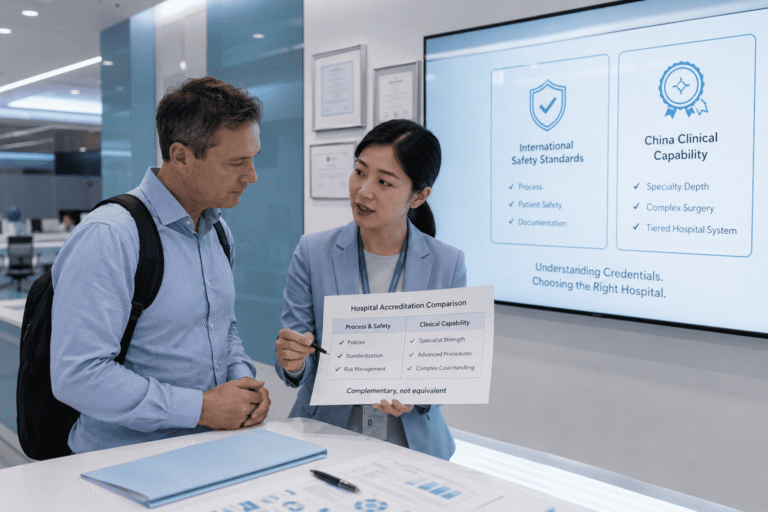
“Private international hospitals” is a much smaller category — a few dozen facilities nationwide that meet the standard most Western patients expect: English-speaking staff, international insurance direct billing, hospital accreditation (often JCI or DNV) [3], and hotel-grade rooms. The most recognizable brand groups include United Family Healthcare (和睦家) [4], Heyou Pinnacle Medical Center (和祐至臻) [5], Jiahui International Hospital (嘉会国际医院) [6], and SinoUnited Health. These are real hospitals — not clinics — with full ICU, operating rooms, and inpatient capacity. But they’re not where China does its highest-volume specialty surgeries.
This isn’t a fight between equals. It’s a comparison between two different products serving different needs.
Dimension 1 · Expert Depth & Surgical Volume
This is where Tier-3A hospitals dominate. China’s leading specialty centers — Beijing Jishuitan Hospital for orthopedics, Fuwai Hospital for cardiac, Tiantan Hospital for neurosurgery, Sun Yat-sen University Cancer Center for oncology — operate at surgical volumes that exceed most Western academic centers, simply because they serve much larger patient populations. Specific per-surgeon volume figures are not generally published in English; what’s verifiable is the aggregate volume reported by NHC: Chinese hospitals performed roughly 106 million inpatient surgeries in 2023 [2].
What this means in practice: if your case is complex, rare, high-stakes, or specialty-defining, the depth at Tier-3A is among the leading centers in China. The chief of any major Tier-3A specialty department has likely seen your condition far more often than most Western specialists.
Private international hospitals, by contrast, have lower volumes per surgeon. They’re staffed by competent, often Tier-3A-trained physicians, but throughput is smaller. For routine care, this is fine. For genuinely complex cases, most international patients end up at Tier-3A directly, not through a private hospital first — the relationship between the two systems is one-way, not bidirectional (more on that below).
Bottom line: Tier-3A wins on depth. Private international hospitals know this and often acknowledge it directly.
Dimension 2 · English Service & Process Friendliness
This is where private international hospitals dominate, and it’s not close.
At a private international hospital, the front desk speaks fluent English, doctors conduct consultations in English (no interpreter needed in most cases), and all forms, reports, prescriptions, and discharge summaries are available in English. Appointment scheduling is by email or app, and a care coordinator typically guides you through the full journey.
At a Tier-3A hospital — even at the “International Medical Department” (国际医疗部) — the experience is structurally different. The doctors may speak some English but rarely conduct the full consultation in it. Forms and prescriptions are in Chinese by default; English versions require specific requests. The intake process is volume-driven.
Beijing’s municipal government, for example, reported that the city has 52 International Medical Departments, 156 hospitals offering full-process foreign-language services, and 167 medical institutions accepting foreign-card payment as of 2025 [7] — meaningful infrastructure, but still a thin layer over a primarily Chinese-language system.
For international patients without fluent Chinese, the practical implication is: a Tier-3A hospital visit almost always requires a medical interpreter or a coordinating service. A private international hospital visit usually doesn’t.
Dimension 3 · Price & Insurance Pathway
Tier-3A hospitals are dramatically cheaper for the same procedure. The table below shows typical price ranges based on aggregate patient case observations as of 2024–2025 — these are not from a single published source, and individual procedures vary by city, surgeon seniority, complexity, and hospital tier-level [8]:
| Procedure | Tier-3A (public, self-pay) | Private International |
|---|---|---|
| PET-CT (whole body) | $1,000–$1,400 | $1,600–$2,400 |
| Knee replacement (single) | $8,000–$12,000 | $18,000–$28,000 |
| Cardiac stent (PCI, single) | $8,000–$15,000 | $22,000–$35,000 |
| MRI (single body region) | $150–$300 | $400–$800 |
| Standard hospitalization (per day) | $60–$200 | $400–$900 |
Insurance behaves very differently between the two:
Private international hospitals maintain direct-billing relationships with most major international insurers. United Family Guangzhou, for example, publishes a list of 50+ insurance companies it directly bills, including Cigna, Allianz, AXA, Bupa, AIA, Manulife, MSH China, GeoBlue, Prudential, IMG, Chubb, Blue Cross Blue Shield, and International SOS [9]. You hand over your insurance card at the front desk; billing happens between the hospital and the insurer behind the scenes.
Tier-3A hospitals generally do not do direct billing with international insurance. You pay out of pocket, then submit receipts to your insurer for reimbursement. Some International Medical Departments are beginning to integrate direct billing, but it’s the exception.
So even though the sticker price at Tier-3A is much lower, the cash-flow experience is heavier: you front the money. For procedures in the $10,000+ range, this matters.
Dimension 4 · Wait Times & Scheduling
Both options are dramatically faster than most Western public health systems. According to the NHC, average inpatient length of stay in Chinese hospitals was 8.6 days in 2023, with public hospitals averaging 8.0 days [2]. China’s 2024 statistical bulletin also reports 87% of Tier-2+ public hospitals offer scheduled appointments, and 83% of Tier-3 public hospitals perform day surgery [2] — indicators of system throughput.
But there’s still a difference between Tier-3A and private international:
Private international hospitals: typically same-week or next-week scheduling for consultations. Imaging and most diagnostics within 1–3 business days. Elective surgery within 1–3 weeks.
Tier-3A hospitals: depends entirely on the specialist’s rank. Seeing the chief of a major specialty department might require booking 2–6 weeks in advance. Routine consultations with mid-rank specialists can be same-week. Imaging and labs are usually 3–7 days. Elective surgery typically 1–4 weeks.
For an international patient with a fixed travel window, private international hospitals offer predictability: you can book everything before you fly. Tier-3A involves more coordination and sometimes flexibility on dates.
Dimension 5 · Hospitalization Environment & Privacy
If you’re admitted, the experience differs sharply.
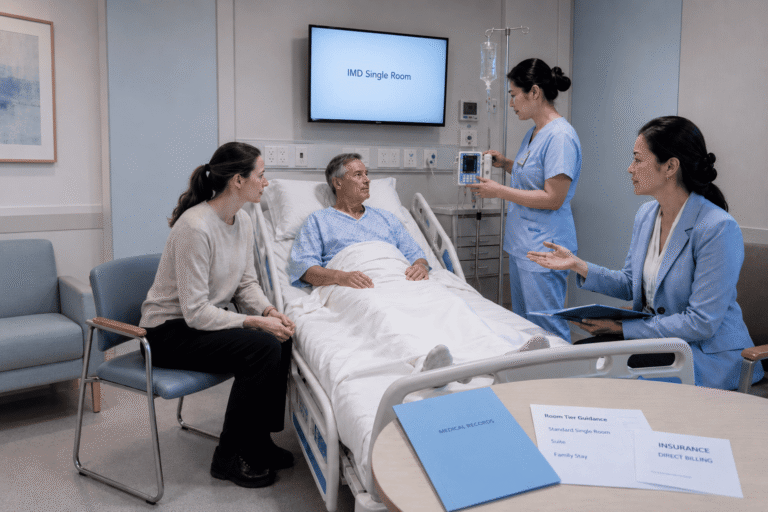
Private international hospital inpatient rooms look like a hotel: single occupancy, private bathroom, daily housekeeping, room service for meals, a sofa for visitors. Nurse-to-patient ratios are higher. Visitors come and go more freely.
Tier-3A standard inpatient rooms are typically 2–6 beds shared, with curtain dividers and shared bathrooms. The medical care is excellent; the environment is utilitarian. Most Tier-3A hospitals offer “VIP wards” (特需病房) or “International Medical Department wards” (国际部病房) at higher prices that approach but rarely match private international comfort.
For procedures requiring multi-day stays — especially surgery — this dimension is real.
Dimension 6 · Comprehensive vs Specialty Balance
Tier-3A hospitals are typically comprehensive academic medical centers: virtually every specialty represented. If you have a complex case crossing multiple specialties — say, a heart condition complicating cancer treatment — you can get all relevant departments in one institution.
Private international hospitals are strong in core specialties — internal medicine, family medicine, pediatrics, obstetrics, common surgical procedures, dermatology, ophthalmology — but typically refer out for specialty-defining procedures: complex cardiac surgery, rare-tumor oncology, organ transplant, neurosurgery.
This means: if your reason for coming to China is a single-specialty procedure (knee replacement, cataract, IVF, executive checkup), either option can handle it. If your reason is a complex case requiring specialty expertise, the comparison narrows toward Tier-3A.
Two Systems, One-Way Bridge
The relationship between public and private hospitals in China is not symmetric. It is a one-way bridge — and getting this right saves you from a costly mistake.
Public → Private works. A diagnosis, exam result, or prescription issued by a public Tier-3A hospital is recognized by private international hospitals. Private hospitals will accept the public hospital’s imaging reports, pathology, and treatment plan, and will continue filling prescriptions on that basis. So if you do your surgery or initial workup at a public Tier-3A, you can comfortably move follow-up, monitoring, medication, and post-op consultation to a private international hospital — for English service, faster scheduling, and insurance direct billing.
Private → Public does not work. A private hospital’s consultation, imaging interpretation, or treatment plan is generally not accepted by public Tier-3A as a basis for admission or surgery. Public hospitals require their own physicians to evaluate the case from scratch — new consultation, frequently repeat imaging, their own pathology review, their own treatment plan. The authority differential is real: public Tier-3A is the higher-ranked tier in the Chinese system, and its workup is treated as the reference standard; private hospital workups are not.
What this means for you in practice:
Complex specialty case (oncology, neurosurgery, complex cardiac, transplant, rare tumors): start at public Tier-3A. Use an interpreter or accompaniment service for the language gap. Once the procedure is done and stable, you can move to a private international hospital for follow-up, medication management, and recovery monitoring — that bridge works.
Routine, outpatient, diagnostic, executive checkup, common surgical procedures: private international hospitals handle this end-to-end. There is no reason to involve public.
The mistake to avoid: starting at a private hospital for a complex case in the hope of “transferring to public for the cheaper surgery.” Public will require its own workup from scratch — you will pay for the diagnostics twice and gain nothing from the private’s initial work.
The right move is to choose the entry point based on your case: simple stays in private; complex starts in public, then can bridge to private for follow-up.
A Simple Decision Framework
Lean toward private international hospital if you don’t speak Chinese and want to handle most of the visit independently, you have international insurance that supports direct billing, your case is general medicine, common surgery, or diagnostics, or if comfort, privacy, and predictable scheduling matter to you.
Lean toward Tier-3A public hospital if your case is complex, rare, or specialty-defining, you want the highest-volume surgeon for that specific procedure, you’re self-paying and price is a major factor, or you can travel with a medical interpreter or coordinating service.
If your case is complex AND you want comfort during follow-up: do the surgery at a public Tier-3A (the only system that can do the complex work), then move follow-up, medication, and monitoring to a private international hospital. Always in this direction (public first, private after) — never the other way. Private hospitals accept a public hospital’s diagnosis and prescription as the basis for ongoing care; public hospitals do not accept a private hospital’s workup as the basis for surgery.
Common Questions
Are private international hospitals actually staffed by qualified doctors? Yes. Most senior physicians at private international hospitals are Tier-3A-trained and often hold faculty positions at academic medical centers.
Can I switch between systems mid-treatment? Only in one direction. Public → Private works smoothly: private hospitals accept public hospitals’ reports and prescriptions, so you can do surgery or initial workup at a public Tier-3A and then move follow-up to a private international hospital. Private → Public does not work the same way: a public hospital will not accept a private hospital’s workup as the basis for surgery and will re-evaluate from scratch (new consultation, often repeat imaging and pathology). Plan your entry point accordingly.
Does insurance ever work at Tier-3A? Increasingly yes, at the International Medical Departments of leading Tier-3A hospitals — but it’s still uncommon enough that you should confirm with your insurer and the specific hospital first.
Which is better for emergency care? Tier-3A. For serious emergencies — stroke, major trauma, cardiac arrest — the equipment and specialist depth at Tier-3A are unmatched. In most cities, ambulances default to Tier-3A.
Bottom Line
There’s no universally “better” option. The right hospital depends on what you’re treating, how complex it is, what languages you speak, what insurance you carry, and how much weight you put on comfort versus surgical volume.
For most international patients, the smart question isn’t “private or public?” — it’s “which dimensions matter most to my case, and where do those map?” A 90-minute conversation with a coordinator who knows both systems usually clarifies it.
Next step: If you’d like a written assessment of which hospital path fits your specific case, send us a brief case description. We’ll reply within 1–2 business days. The Free Pathway Scan is genuinely free.
Start with a free Pathway Scan. We will tell you whether China is worth further consideration and which type of next step may fit. The free scan does not include hospital or doctor recommendations, medical advice, individualized cost estimates, insurance determinations, or treatment planning.
See Service & Refund Policy and Medical Disclaimer for service boundaries.
Sources
- China hospital tier classification system — National Health Commission of the People’s Republic of China, “医院分级管理标准” (Hospital Tier Management Standards). The three-tier, three-grade system is the official classification framework. Official NHC site: http://www.nhc.gov.cn/
- 2023 National Health Statistical Bulletin — National Health Commission, published 2024. Reports total Tier-3 hospital count, inpatient surgeries, average length of stay, scheduled appointment rates, and day-surgery rates. Available at http://www.nhc.gov.cn/guihuaxxs/. Some specific Tier-3A vs Tier-3B breakdown figures vary by report year; the ~1,790 figure refers to total Tier-3 hospitals at end of 2023.
- JCI Accreditation — Joint Commission International is the leading global hospital accreditation body for international standards. JCI maintains a public list of accredited hospitals in China at https://www.jointcommissioninternational.org/. DNV Healthcare is an alternative accreditation provider.
- United Family Healthcare (和睦家) — Founded 1997, operates multi-city hospital network in mainland China. Guangzhou branch official site: https://guangzhou.ufh.com.cn/. MedCareInChina has a written cooperation agreement with United Family Guangzhou as of 2026.
- Heyou Pinnacle Medical Center (和祐至臻医院) — Located in Shunde, Foshan, Guangdong. Private high-end medical center with approximately 100 beds and 40+ specialty departments. MedCareInChina has a written cooperation agreement with Heyou Pinnacle as of 2026.
- Jiahui International Hospital (嘉会国际医院) — Shanghai-based private international hospital. Official site: https://www.jiahui.com/
- Beijing International Medical Services data 2025 — Beijing Municipal Government Foreign Affairs Office report, 2025. Source: https://wb.beijing.gov.cn/home/dwhz/zczx/lqjs/202507/t20250728_4160417.html
- Pricing ranges — Compiled from aggregate observation of MedCareInChina patient case data (2024–2025), supplemented by published rate cards where available. These are not from a single published source. Exact pricing varies by city, hospital specific tier, surgeon seniority, and case complexity. All prices in this article should be treated as approximate ranges, not quotes. Quotes for specific cases are provided in writing during our Free Pathway Scan or paid consultation.
- United Family Guangzhou insurance & direct billing list — Official page: https://guangzhou.ufh.com.cn/patient-visitor-info/insurance-direct-billing. The 50+ insurer list referenced in this article is taken from this source, recorded 2026-05-11. The hospital explicitly notes the list is updated periodically and patients should confirm coverage individually.