9 minutes read
Pre-authorization is a prerequisite for international medical insurance direct billing — without pre-authorization, even when your insurance company has a direct billing agreement with the target hospital, you may still be required to pay the full amount in cash upfront upon arrival. This article details the standard pre-authorization workflow, required documents, typical timeline, denial reasons, and appeals strategies. Key data: approximately 82% of pre-authorization denials succeed on appeal with adequate supplemental documentation [1] — meaning initial denial isn’t the endpoint, and the right appeals strategy often recovers denied claims.
What Is Pre-Authorization, and Why It Matters
Pre-authorization (also called pre-approval / pre-certification): the insurance company’s process of reviewing and authorizing specific medical services before treatment occurs to confirm policy coverage [2].
Consequences of treatment without pre-authorization:
- Insurance company denies the claim after treatment
- Hospital refuses direct billing, requires cash upfront
- Even with subsequent remediation, may be limited to reimbursement pathway (4–12 week wait)
- Major treatment (oncology, surgery) may require $50,000-$200,000+ USD cash upfront
Practical implication for international patients: pre-authorization isn’t just procedural — it’s the actual threshold for whether treatment can be initiated. All planned China treatment must complete pre-authorization before travel.
Which Treatments Require Pre-Authorization
While requirements vary slightly by insurance company, the following treatments typically all require pre-authorization [3]:
✅ Mandatory pre-authorization:
- All inpatient and daypatient procedures
- Outpatient procedures requiring general anesthesia
- Cancer treatment: chemotherapy, radiation, targeted therapy, immunotherapy, CAR-T
- Organ transplant
- High-cost medications (especially specialty drugs with annual costs $10,000+)
- Complex diagnostic studies (some insurers require pre-auth for MRI, PET-CT)
- Genetic testing, molecular testing
- Experimental / newly approved therapies
Typically don’t require pre-authorization:
- Routine outpatient visits (no major procedures)
- Standard lab tests (CBC, metabolic panels)
- Emergency medical care (but requires 48-hour notification)
- Routine prescription medications
Core principle: when uncertain, pre-authorization = the safe option.
Standard Pre-Authorization Timeline
Timing requirements by insurance company [4]:
| Insurance Company | Standard Advance Submission | Urgent Response Time | Pre-Auth Validity |
|---|---|---|---|
| Bupa Global | Advance submission | Target 48-hour response | 31 days |
| Cigna Global | Advance submission | Emergency 48-hour notification | Per specific approval |
| Allianz Care | 5 business days advance | Urgent expedited | Per specific approval |
| MSH China | 5 business days advance | Urgent expedited | Per specific approval |
| GeoBlue | Phone via ID card | 48-hour Direct Pay application | Per specific approval |
| CMS Standard (US) | Urgent 72 hours / non-urgent 7 days | — | — |
Practical recommendations for international patients:
- Start pre-authorization 4–6 weeks before traveling to China — gives insurance company adequate review time and reserves time for supplemental document requests
- Emergency situations (within 48 hours) — clearly mark as “emergency”
- Pre-authorization validity period typically 31 days — don’t apply too early to avoid expiration before treatment
Major International Insurance Pre-Authorization Channels
Cigna Global [5]:
- 24/7 global customer service hotline: +44 (0)1475 788182 or 1-800-835-7677
- Overseas direct billing hospitals typically handle pre-authorization
- Member portal: cignaglobal.com
Bupa Global [6]:
- MembersWorld online portal → Treatment Authorisation module
- Emergency situations through the portal or 24/7 hotline
- Required modules: physician information, diagnosis, recommended treatment
Allianz Care [7]:
- Email: medical.services@allianzworldwidecare.com
- Official Pre-authorisation Form (PDF download)
- Online portal: MyHealth app or website
MSH China [8]:
- Online submission Claim & Pre-authorization system
- China customer service hotline, bilingual
- Deep integration with major Chinese hospital networks
GeoBlue [9]:
- Utilization review phone number on ID card
- Xplorer plan certain items don’t require pre-authorization — check policy
- Overseas treatment requires 48-hour Direct Pay application
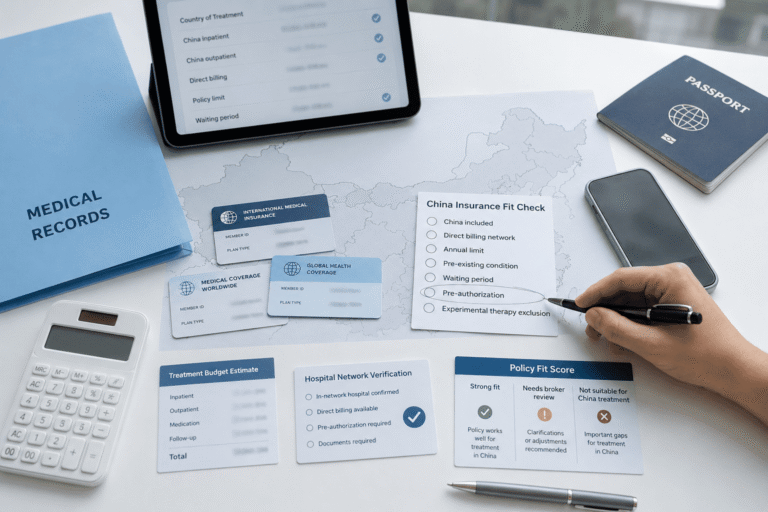
Practical recommendation: contact your insurer directly for coverage, pre-authorization, reimbursement and appeals. MedCareInChina can ask the target hospital about insurer acceptance or direct billing and can help translate hospital-issued documents, but we do not represent you in insurer communications.
Pre-Authorization Application Documentation Checklist
Synthesized from various insurance company forms, a complete pre-authorization application typically requires:
Patient Information:
- ✅ Member / policy number
- ✅ Name, date of birth, passport number
- ✅ Contact information
Clinical Information (core of review):
- ✅ Diagnosis (with ICD-10 codes)
- ✅ Symptoms and medical history
- ✅ Recommended treatment plan (with specific procedures or drug regimens)
- ✅ Medical necessity justification — why this treatment is necessary, why this hospital, why now
- ✅ Attending physician information (including credentials, specialty)
Supporting Evidence:
- ✅ Attending physician / specialist report — Bupa explicitly requires [6]
- ✅ Lab, imaging, pathology results — Allianz explicitly requires [7]
- ✅ Past medical history and prior treatment records
- ✅ Generic names of planned medications
Financial Information:
- ✅ Estimated cost itemization
- ✅ Treatment location (hospital name + complete address)
- ✅ Treatment dates (planned start date + expected duration)
- ✅ CPT codes (US system, e.g., CAR-T uses 0540T, 0537T-0539T) or international equivalents
Special Treatment Supplements:
- CAR-T: inpatient CAR-T uses ICD-10-PCS XW033C3/XW043C3 [10]
- Transplant: donor (liver / marrow) evaluation materials, ethics committee approval
- Novel therapy / experimental drug: FDA / NMPA approval status documentation, relevant clinical guidelines
Common Reasons for Pre-Authorization Denial
Multi-source aggregated denial reason proportions [1][11]:
| Denial Reason | Proportion | Notes |
|---|---|---|
| Insufficient medical necessity evidence | ~6% | Among most common categories |
| Experimental / investigational treatment | ~15% | Includes CAR-T, novel immunotherapy, gene therapy, etc. |
| Documentation and coding errors | Common | CPT/ICD errors, missing pathology/imaging |
| Out-of-network hospitals | — | Bupa explicitly does not guarantee full payment |
| Pre-existing condition exclusion | — | Depends on policy terms |
| Lifetime cap reached | — | Common issue for long-term treatment |
| Non-formulary drugs | — | Specific drugs not covered by policy |
| Late application | — | Allianz reserves the right to deny if not submitted 5 days in advance |
Experimental treatment determination criteria [12]:
- Lacks FDA or local regulatory indication-specific approval
- Lacks high-quality published clinical evidence
- Not included in mainstream international clinical guidelines (NCCN, ESMO, etc.)
- Used only in clinical trial phase
Practical recommendation: Before submitting pre-authorization, confirm with your attending physician whether the treatment plan:
- Complies with mainstream international guidelines such as NCCN / ESMO
- Has FDA / NMPA approval (if cross-border, at least one side approved)
- Has published clinical evidence supporting it
If your treatment is in “frontier” areas (CAR-T, novel immunotherapy, gene therapy, etc.), insurance companies are at higher risk of determining it as experimental — the physician needs to proactively provide detailed medical necessity justification.
Appeals Process After Pre-Authorization Denial
Key fact: approximately 82% of pre-authorization denials succeed on appeal with adequate supplemental documentation [1] — denial isn’t the endpoint.
Internal Appeal
Time window: submit within 180 days (6 months) of receiving denial notification [13]
Insurance company decision timeline:
- Treatment not yet performed: respond within 30 days
- Treatment already performed: respond within 60 days
Key supplementary materials:
- Peer-to-peer review by attending physician — direct communication with the insurance company’s medical reviewer
- Supplementary clinical guideline citations: NCCN, ESMO, etc.
- Independent expert opinions (if available)
- Pathology / imaging re-review reports (see Article 19 on pathology re-reading)
- International peer cases (published successful treatment cases of similar conditions)
External Independent Review
Time window: at least 60 days after internal appeal denial (federal minimum 4 months, state law can extend to 4–6 months) [14]
Review decision timeline:
- Standard: ≤ 45 days
- Urgent situations: ≤ 72 hours
In urgent situations, external review applications can be submitted simultaneously with internal appeal — avoiding missed treatment windows.
Key Strategies for Appeal Success
✅ Physician level:
- Attending physician writes detailed medical necessity letter (not a template letter, but specific to your case)
- Cite ≥3 mainstream clinical guidelines supporting your treatment plan
- Explain why alternative options (the insurance company’s likely recommended substitute) are not suitable for you
✅ Evidence level:
- Supplement all supporting evidence for the original diagnosis (pathology, imaging, lab, genetic testing)
- Provide published literature on similar cases successfully treated
✅ Process level:
- Strictly comply with appeals timelines
- Mark urgent situations as “expedited appeal”
- Consider legal consultation after multiple denials (especially for large-amount treatments)
Special Considerations for International Insurance Appeals
The US ACA framework strictly applies to US domestic policies. International policies (Cigna Global, Bupa Global, Allianz Care, etc.) are regulated by their underwriting country (such as UK, Ireland, Luxembourg):
- Appeals timelines may differ
- External review bodies may differ
- Legal remedy paths may differ
You must review policy terms to confirm the specific appeals framework.
Practical Recommendations: Key Tips for Successful Pre-Authorization
✅ Start 4–6 weeks before travel — reserve adequate time ✅ Complete documentation: all required fields filled, all supporting evidence attached ✅ Clear medical necessity justification: physician writes the letter, not patient self-statement ✅ International guideline citations: NCCN, ESMO, ASCO, etc. ✅ Clear cost estimate: hospital provides formal estimate ✅ Hospital-side coordination: MedCareInChina can ask the target hospital about insurer acceptance or direct billing; the patient must confirm all insurer-side requirements directly ✅ Preserve all communication records — emails, phone records, submission timestamps
Common Questions
Once pre-authorization is approved, are treatment costs fully covered? Not necessarily. Pre-authorization confirms the insurance company agrees to cover the treatment, but specific amounts are calculated per policy terms — may still have copays, deductibles, costs beyond lifetime cap, etc. Pre-authorization ≠ 100% reimbursement guarantee.
Can emergencies skip pre-authorization? Emergency medical care (acute attacks, trauma) typically allows post-event reporting — but you must notify the insurance company within 48 hours (most companies require). Planned treatment (surgery, chemotherapy) must have pre-authorization.
The insurance company says my treatment is experimental — what do I do?
- Have your attending physician write a medical necessity letter + cite mainstream clinical guidelines
- Provide published clinical evidence support
- Through peer-to-peer review, have your physician speak directly with the insurance company’s medical reviewer
- Appeal success rate approximately 82% (per earlier statistics)
Can MedCareInChina handle pre-authorization? No. You must apply through your insurer or its designated administrator. We can ask the target hospital about acceptance or direct billing and help organize hospital-issued documents for translation. We do not interpret your policy or represent you in insurer communications.
- Provide a checklist of questions for you to ask your insurer
- Help organize hospital-issued documents after you obtain them
- Ask the hospital which physician-issued documents may be available
- Flag that denial appeals must be handled directly with your insurer
Can I change hospitals after pre-authorization is approved? Typically requires re-applying for pre-authorization — the insurance company’s approval is based on specific treatment at a specific hospital. Hospital changes require updated pre-authorization.
How difficult is pre-authorization for special treatments like CAR-T or transplant? Higher difficulty. These treatments are expensive and in frontier domains, so insurance companies review more strictly. Key strategies:
- Provide complete clinical evidence (pathology, imaging, genetic testing, prior treatment records)
- Cite FDA / NMPA approval (such as NMPA’s 6 approved CAR-T products, see Article 21)
- Detailed medical necessity letter from attending physician
- Proactive communication with insurance company, invite peer-to-peer review
Pre-authorization approved — can I direct-bill upon arrival in China? Theoretically yes, provided:
- Receiving hospital has direct billing agreement with your insurance (see Article 37)
- Treatment plan matches pre-authorization
- Treatment is within pre-authorization validity period (typically 31 days)
For any changes, update with the insurance company promptly.
Bottom Line
Core points of pre-authorization:
- Pre-authorization is the prerequisite for direct billing — start the process 4–6 weeks before travel
- 5 business days advance (Allianz, MSH) is the industry standard
- Pre-authorization validity typically 31 days — don’t apply too early
- Complete documentation + clear medical necessity justification = high approval rate
- Denial isn’t the endpoint — 82% of pre-authorization denials succeed on appeal
Major insurance pre-authorization channels:
- Cigna: +44 (0)1475 788182
- Bupa: MembersWorld portal
- Allianz: medical.services@allianzworldwidecare.com
- MSH: online submission system
- GeoBlue: phone number on ID card
Most common denial reasons + responses:
- Insufficient medical necessity → physician detailed justification
- Experimental treatment → cite guidelines + clinical evidence
- Documentation errors → complete materials + coordinator assistance
- Out-of-network hospital → choose in-network hospital
If you need help understanding the workflow, MedCareInChina can provide hospital-side questions and help translate hospital-issued documents. You remain responsible for all communications, submissions, pre-authorization and appeals with your insurer.
Start with a free Pathway Scan. We will tell you whether China is worth further consideration and which type of next step may fit. The free scan does not include hospital or doctor recommendations, medical advice, individualized cost estimates, insurance determinations, or treatment planning.
See Service & Refund Policy and Medical Disclaimer for service boundaries.
Sources
- Pre-authorization denial appeal success rate — Approximately 82% succeed on appeal with adequate supplemental documentation. Sources: Muni Health https://muni.health/blog/what-happens-if-prior-authorization-denied-2025 ; CareRoute https://www.careroute.ai/blog/prior-authorization-denied
- Pre-authorization definition — Cigna https://www.cigna.com/knowledge-center/what-is-prior-authorization ; April International https://www.april-international.com/en/long-term-international-health-insurance/guide/pre-approval-in-health-insurance-definition-when-to-seek-it-and-why-it-is-required
- Treatments requiring pre-authorization — Cigna Precertifications https://www.cigna.com/health-care-providers/coverage-and-claims/precertification
- Pre-authorization timing — Allianz Care 5 business days + MSH China 5 business days; Bupa 48-hour response, pre-auth validity 31 days; CMS standard urgent 72 hours / non-urgent 7 days. Sources: Allianz Care https://www.allianzcare.com/en/support/member-resources/pre-authorisation-process-and-forms.html ; MSH China https://www.mshasia.com/Newsletter_View.aspx?luang=en&ID=116 ; Bupa Global https://www.bupaglobal.com/en/help-support/customer-pre-authorisation ; CMS https://www.cms.gov/priorities/electronic-prior-authorization/overview
- Cigna Global contact — 24/7 global customer service +44 (0)1475 788182 / 1-800-835-7677. Source: Cigna Global Knowledge Base https://www.gninsurance.com/health/knowledge-base-cigna/
- Bupa Global pre-authorization workflow — MembersWorld online portal. Sources: Bupa Global https://www.bupaglobal.com/en/help-support/customer-pre-authorisation ; https://www.bupaglobal.com/en/provider/pre-authorisation-quick-guide
- Allianz Care pre-authorization — Email medical.services@allianzworldwidecare.com, PDF form. Source: Allianz Care https://www.allianzcare.com/content/dam/onemarketing/azcare/allianzcare/en/docs/FRM-Global-TG-EN-0420.pdf
- MSH China pre-authorization — Online submission Claim & Pre-authorization. Source: https://www.mshasia.com/Newsletter_View.aspx?luang=en&ID=116
- GeoBlue pre-authorization — Via ID card utilization review phone. Sources: GeoBlue https://www.geo-blue.com/TX_procedural_guidelines.cfm ; ExpatInsurance https://help.expatinsurance.com/hc/en-us/articles/9264718092315-How-to-precertify-a-medical-event-with-GeoBlue
- CAR-T coding — Outpatient CPT 0540T, 0537T-0539T; inpatient ICD-10-PCS XW033C3/XW043C3. Sources: AAPC https://www.aapc.com/blog/81163-car-t-coding-update/ ; Outsource Strategies https://www.outsourcestrategies.com/blog/what-are-latest-car-t-coding-and-billing-updates/
- Pre-authorization denial reason proportions — Insufficient medical necessity ~6%, experimental treatment ~15%. Multi-source aggregated.
- Experimental treatment determination criteria — Lacks FDA approval, lacks published evidence, not in mainstream guidelines, only in clinical trial phase.
- Internal appeal time window — 180 days (6 months). Source: HealthCare.gov https://www.healthcare.gov/appeal-insurance-company-decision/internal-appeals/
- External independent review time window — At least 60 days, urgent 72 hours. Source: HealthCare.gov External Review https://www.healthcare.gov/appeal-insurance-company-decision/external-review/