10 minutes read
Rare cancers (such as sarcomas, neuroendocrine tumors, GIST, mesothelioma, thymoma, and rare pediatric cancers) are among the most difficult cancer categories to diagnose and treat globally — case scarcity means limited physician experience, weak evidence base in guidelines, difficult clinical trial enrollment, and high diagnostic error rates. China’s capability for rare cancer treatment is mixed — some areas (pathology diagnosis, sarcoma 3D-printed reconstruction, full GIST-targeted drug access, pediatric CAR-T, and more) have reached international levels; other areas (some new-target drugs, PRRT and other frontier therapies) are still catching up. This article honestly assesses China’s true capability for rare cancer diagnosis and treatment, telling international patients which situations make traveling to China clearly worthwhile and which offer limited benefit.
The Universal Challenge of Rare Cancers
Why rare cancers are difficult:
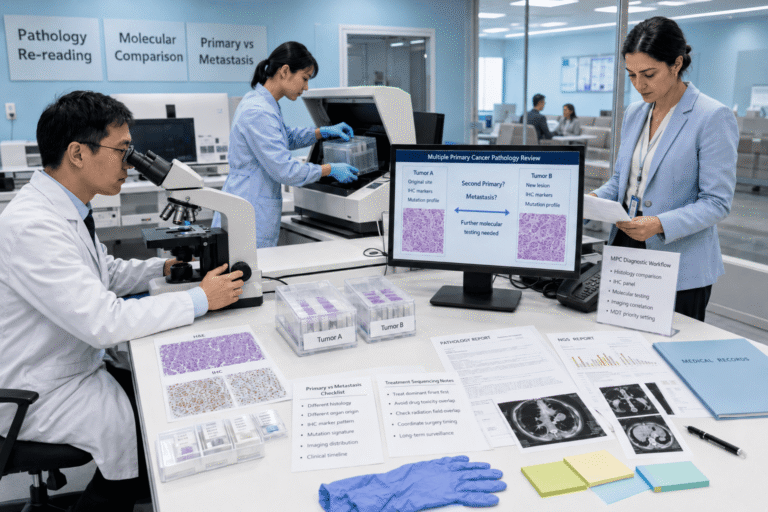
- High diagnostic error rates — Rare tumor pathology re-reading changes the diagnosis in up to 25–38% of cases (see Article 19). Many patients’ “rare cancer” diagnoses themselves need to be reconfirmed at specialty centers
- Weak evidence base in treatment guidelines — Small case numbers make large clinical trials difficult; many treatment decisions rest on experience and consensus rather than evidence
- Limited specialist concentration — Distributed across a few top centers; patients far from these centers struggle to access high-level care
- Limited drug development incentive — Small market, limited industry R&D investment
- Incomplete insurance coverage — Many frontier therapies remain in trial or out-of-pocket
China vs Western Rare Cancer Systems:
- Europe EURACAN: the European Reference Network branch for rare adult solid tumors, covering 25 countries and ~100 centers across 10 clinical domains (sarcoma, NEN, endocrine tumors, etc.) [1]
- US NORD: non-government rare disease coalition integrating multiple academic centers and advocacy organizations
- China: between 2018 and 2023 established the Rare Disease Catalog with 207 conditions, including ~24 rare tumors; established a National Rare Disease Diagnosis and Treatment Network of 324 hospitals [2]. But China lacks a specialty network specifically dedicated to rare cancers like EURACAN — rare cancer care is still delivered through “concentration at leading cancer centers + MDT case discussion”
Practical implication for international patients: China’s advantages in rare cancer diagnosis and treatment are concentrated at top centers — you must go to the right hospitals (CICAMS, SYSUCC, Fudan Cancer, Peking University People’s, Peking University Cancer Hospital, and others), not regular Tier-3A hospitals. MedCareInChina’s core value is guiding you to the right center.
China’s Genuine Strengths in Rare Cancer Care
Strength 1 · Pathology Diagnosis Re-Reading
China’s top pathology centers (Peking Union Medical College, CICAMS, SYSUCC, Fudan Cancer) have rare tumor diagnostic capability at international levels — see Article 19. This is one of the most reliable, highest-value services international patients can access in China.
Strength 2 · Multidisciplinary Team (MDT) Consultation
The core characteristic of rare cancers is the need for multidisciplinary integrated decision-making — single specialties struggle to formulate optimal plans. Major Chinese cancer centers’ MDT infrastructure is mature (see Article 10), and MedCareInChina’s $1,000 USD per specialist MDT pricing makes accessing the integrated opinions of multiple leading specialists affordable for international patients.
Strength 3 · Sarcoma Surgery + 3D Printed Prostheses
Peking University People’s Hospital Bone and Soft Tissue Tumor Treatment Center (Professor Guo Wei’s team) [3]:
- National key sarcoma diagnosis and treatment institution
- Completed the world’s first 3D-printed full sacral prosthesis implantation in 2016 (sacral chordoma patient)
- Globally leading in complex pelvic tumor resection + individualized 3D-printed reconstruction
Other sarcoma centers:
- Beijing Jishuitan Hospital (National Center for Orthopedics)
- Shanghai 6th People’s Hospital (National Center for Orthopedics co-anchor)
- Fudan Cancer Center Bone and Soft Tissue Surgery
- Cancer Hospital, Chinese Academy of Medical Sciences
Strength 4 · GIST (Gastrointestinal Stromal Tumor) — Full Targeted Drug Access
GIST is one of the most complete rare cancers in terms of NMPA-approved targeted therapy [4]:
- Imatinib — first line (Chinese-produced + imported)
- Sunitinib — second line
- Regorafenib — third line
- Ripretinib — fourth line (NMPA approved)
- Avapritinib — for PDGFRA D842V mutation (NMPA approved)
China’s leading GIST centers:
- Cancer Hospital, Chinese Academy of Medical Sciences GIST Center
- Fudan Cancer Center GIST team
- Peking University Cancer Hospital Digestive Cancer Center
Strength 5 · Neuroendocrine Tumors (NET) Comprehensive Treatment
Fudan University Shanghai Cancer Center Neuroendocrine Tumor Center (Professor Chen Jie) [5]:
- Leading NET center in China
- Released the Chinese Anti-Cancer Association Guidelines for Diagnosis and Treatment of Neuroendocrine Tumors (2025)
- Academic coordination with ENETS (European Neuroendocrine Tumor Society)
Chinese NET treatment capability:
- DOTATATE PET-CT (see Article 17) — accessible at multiple Tier-3A nuclear medicine departments
- Somatostatin analogs (SSA): octreotide, lanreotide — NMPA approved
- Targeted drugs: everolimus, sunitinib — NMPA approved
- Surgery + interventional treatment: extensive experience with TAE/TACE for liver metastases from NET
Strength 6 · Rare Pediatric Cancers
Beijing Children’s Hospital (Capital Medical University, National Children’s Medical Center) [6]:
- Leading center for rare pediatric oncology
- Has performed CD19/GD2 CAR-T therapy for relapsed/refractory neuroblastoma in over 50 cases
- Extensive comprehensive treatment experience for neuroblastoma, retinoblastoma, rhabdomyosarcoma, hepatoblastoma, and others
Shanghai Children’s Medical Center (SCMC):
- National Children’s Medical Center (Shanghai)
- Extensive experience with rare pediatric tumors
Practical implication for international patients: rare pediatric cancers are one of the categories where China can reliably provide high-level care.
China’s Genuine Limitations in Rare Cancer Care (Honest Disclosure)
Limitation 1 · PRRT (Peptide Receptor Radionuclide Therapy) Is Not Yet Widely Available
PRRT (177Lu-DOTATATE / Lutathera) is an international frontier therapy for NET. Key facts [7]:
- Lutathera has not yet been approved by NMPA in China
- In February 2025, Novartis’s Lutathera and 68Ga-DOTATATE imaging agent clinical trial application was accepted by NMPA
- China’s Phase 3 RCT (XT-XTR008-3-01): 196 patients with G1/G2 GEP-NET, median PFS in the 177Lu-DOTATATE arm 24.8 months, ORR 55.6% — data comparable to international studies
- But the vast majority of Chinese hospitals cannot perform PRRT — only a few large hospitals with nuclear medicine credentials can conduct it within clinical trial settings
- The Hainan Boao Lecheng International Medical Tourism Pilot Zone has a “special licensed drugs and devices” policy framework that could in principle become a compliance pathway for some imported drugs, but no public source has confirmed that Lutathera is actually supplied through Lecheng
Honest recommendation for international patients: if your NET case clearly requires PRRT therapy, China is not the first choice currently — Germany (HIT Heidelberg, Baden-Baden RPTC), Switzerland, Australia, and other countries where Lutathera is approved are better options. China can be considered as a subsequent option once NMPA approval is granted.
Limitation 2 · Some Rare Cancers Lack Specialty Centers
Research shows China lacks publicly identifiable specialty centers for adrenal cancer (ACC), with related research consisting primarily of case reports [8]. Adenoid cystic carcinoma and other extremely rare tumors also lack dedicated centers. Patients with these extremely rare cancers have limited value in traveling to China — Western specialty centers (such as the MD Anderson Rare Tumor program) may be more suitable.
Limitation 3 · Clinical Trial Access Is Limited for International Patients
China is one of the world’s largest oncology clinical trial markets, but China’s Regulations on Human Genetic Resources Management impose strict controls on foreign trial participant samples and data leaving China — the largest institutional barrier to international patient participation in Chinese clinical trials.
Honest recommendation for international patients: do not make “participating in a Chinese clinical trial” the primary reason for traveling to China — enrollment in any specific trial requires individual evaluation by the research center, and no definitive promise can be made. Hainan Boao Lecheng is one of the few “medical special economic zones” with “special licensed medical care + international medical exchange” policies and may serve as a compliance exploration pathway, but actual feasibility still requires case-by-case consultation.
Practical Access Pathway for International Patients
Best-suited rare cancer patients for travel to China:
- Rare tumors with unclear diagnosis → travel for pathology re-reading + MDT comprehensive evaluation (see Article 19)
- GIST patients → full TKI access in China at substantially lower cost than the US
- Complex sarcoma requiring 3D-printed reconstruction → Peking University People’s Hospital Guo Wei’s team
- Rare pediatric cancers (especially neuroblastoma) → Beijing Children’s Hospital CAR-T
- NET comprehensive treatment (non-PRRT) → Fudan Cancer NET Center
- Patients told “untreatable” at home seeking MDT second opinion → domestic leading center MDT
Not recommended for traveling to China:
- Cases clearly requiring PRRT therapy → prioritize countries where Lutathera is approved
- Extremely rare cancers without Chinese specialty centers → Western specialty centers may be more suitable
- Primary objective is participating in a Chinese clinical trial → actual feasibility is uncertain; should not be the sole motivation
Typical timeline:
| Phase | Duration | Notes |
|---|---|---|
| Pre-travel evaluation + pathology slide shipping | 4–8 weeks | Pathology slides shipped to China in advance for re-reading |
| Remote second opinion + MDT plan formulation | 1–2 weeks | Can be completed before arrival in China |
| Arrival + on-site evaluation | 1 week | |
| Treatment execution | Plan-dependent | Surgery 1–3 weeks; chemotherapy cycles longer |
| Discharge + early follow-up | 1–2 weeks | |
| Return home + long-term remote follow-up | ≥2 years |
Typical time in China: rare cancer treatment is highly complex, typically 4–10 weeks (plan-dependent).
Pricing
Rare cancer treatment costs vary substantially by plan:
- Pathology re-reading + MDT evaluation: $1,000–$4,000 USD (see Articles 19 and 10)
- Complex sarcoma surgery + 3D-printed reconstruction: typically $30K–$80K USD (substantially less than US $150K+)
- Long-term GIST TKI treatment: Chinese-produced imatinib and others substantially less expensive than US
- NET comprehensive treatment: plan-dependent, typically 1/3 to 1/5 of US
- Pediatric oncology CAR-T: Chinese domestic CAR-T approximately $154K–$198K USD (see Article 21)
Common Questions
Can rare tumors be confirmed in China? Diagnostic capability is reliable — China’s top pathology centers (Peking Union Medical College, CICAMS, SYSUCC, Fudan Cancer) provide rare tumor diagnosis at international levels. But you must bring complete pathology slides (including paraffin blocks/unstained sections), not just the report (see Article 19).
What rare cancer treatments are available in China? Approved: full GIST TKI portfolio, NET comprehensive treatment (excluding PRRT), sarcoma surgery + 3D printing, pediatric rare tumor CAR-T, and others. Frontier but not widely accessible: PRRT (Lutathera not approved), some new-target small molecule drugs.
What if China doesn’t have the drug I need? Two options:
- Accept available Chinese plans — often consistent with international guidelines
- Hainan Boao Lecheng “special licensed drugs and devices” pathway — in limited situations may introduce imported drugs not yet approved (actual feasibility requires case-by-case evaluation)
Can I participate in clinical trials for rare cancers in China? Should not be the primary reason for traveling to China. China imposes strict controls on foreign trial participant samples and data leaving the country. Enrollment in any specific trial requires individual evaluation by the research center — MedCareInChina makes no definitive promises.
Roughly how much does rare cancer treatment cost in China? Varies substantially — simple pathology re-reading + MDT may be only a few thousand dollars; complex surgery + long-term targeted therapy may be in the hundreds of thousands. MedCareInChina provides specific estimates during the Pathway Scan phase.
How do rare cancer outcomes in China compare with the West? Depends on the specific cancer:
- Sarcoma surgery, GIST, NET comprehensive treatment, pediatric oncology CAR-T: on par with international
- PRRT, some new-target drugs: still catching up
- Extremely rare cancers (such as adrenal cancer, adenoid cystic carcinoma): lack specialty centers, less developed than the West
Bottom Line
Honest assessment of China’s rare cancer capability:
| Strengths (Travel to China Has High Value) | Limitations (Travel to China Has Limited Value) |
|---|---|
| ✅ Pathology diagnosis re-reading | ❌ PRRT (Lutathera not approved) |
| ✅ MDT comprehensive consultation | ❌ Some extremely rare cancers lack specialty centers |
| ✅ Sarcoma surgery + 3D printing | ❌ Clinical trial enrollment certainty is low |
| ✅ Full GIST TKI access | |
| ✅ NET comprehensive treatment (non-PRRT) | |
| ✅ Pediatric rare cancer CAR-T |
Best-suited rare cancer patients for travel to China:
- Unclear diagnosis requiring pathology re-reading
- GIST or NET requiring comprehensive treatment
- Complex sarcoma requiring 3D-printed reconstruction
- Rare pediatric cancers
- Patients seeking cost-effective comprehensive treatment
If you have a rare cancer, MedCareInChina honestly evaluates “what China can do for you” based on your specific diagnosis — and if China isn’t the most suitable option, will tell you directly.
Start with a free Pathway Scan. We will tell you whether China is worth further consideration and which type of next step may fit. The free scan does not include hospital or doctor recommendations, medical advice, individualized cost estimates, insurance determinations, or treatment planning.
See Service & Refund Policy and Medical Disclaimer for service boundaries.
Sources
- EURACAN (European Reference Network for Rare Adult Solid Tumors) — Covers 25 countries and ~100 centers across 10 clinical domains. https://www.euracan.eu/about-us/about-euracan
- China National Rare Disease Diagnosis and Treatment Network — 324 hospitals. First Rare Disease Catalog (2018, 121 conditions) + Second Batch (Sept 2023, 86 conditions), total 207. Sources: http://english.www.gov.cn/state_council/ministries/2019/02/18/content_281476527383692.htm ; https://www.canbridgepharma.com/cn/media-news/press-release/20230921/
- Peking University People’s Hospital 3D-Printed Sacral Prosthesis — World’s first 3D-printed full sacral prosthesis implantation in 2016. Sources: https://english.pkuph.cn/ClinicalDepartments_detail/246.html ; 3Ders.org https://www.3ders.org/articles/20150710-surgeons-in-china-successfully-implant-world-first-3d-printed-full-sacral-prosthesis.html
- China GIST Targeted Drug NMPA Approval Status — Imatinib, sunitinib, regorafenib, ripretinib, avapritinib. Sources: ASCO https://ascopubs.org/doi/10.1200/JCO.2023.41.4_suppl.803 ; PMC https://pmc.ncbi.nlm.nih.gov/articles/PMC10242384/
- Fudan Cancer NET Center + 2025 China NET Treatment Guidelines — Professor Chen Jie’s team. https://www.china-oncology.com/CN/10.19401/j.cnki.1007-3639.2025.01.010
- Beijing Children’s Hospital CAR-T for Relapsed/Refractory Neuroblastoma — CD19/GD2 CAR-T performed in over 50 cases. https://mednexus.org/doi/full/10.1002/ped4.12210
- Status of PRRT (Lutathera) in China — Lutathera not yet NMPA approved; clinical trial application accepted Feb 2025; China Phase 3 RCT median PFS 24.8 months. The vast majority of Chinese hospitals cannot perform PRRT. Sources: https://bydrug.pharmcube.com/news/detail/93bf2d9b2615e6de7359143362ee3316 ; https://www.annalsofoncology.org/article/S0923-7534(25)04697-6/fulltext ; http://www.csnm.com.cn/info/2032
- China Lacks National Specialty Centers for Adrenal Cancer — Primary research consists of case reports. https://www.ncbi.nlm.nih.gov/pmc/articles/PMC11361937/
- China Thymic Epithelial Tumor Consensus — Incidence approximately 3.93/100,000. https://pmc.ncbi.nlm.nih.gov/articles/PMC10125784/
- Institutional Barriers to China-International Clinical Trial Collaboration — China’s Regulations on Human Genetic Resources Management impose strict controls on foreign trial participant samples and data leaving China. Source: Asia Society https://asiasociety.org/policy-institute/us-china-cancer-trial-collaboration-political-and-regulatory-challenges-and-path-forward